An invisible explosion rivaling a billion suns vanished in space—until its trace reached Earth
A strange fading radio signal hints at powerful gamma-ray burst or an elusive black hole.
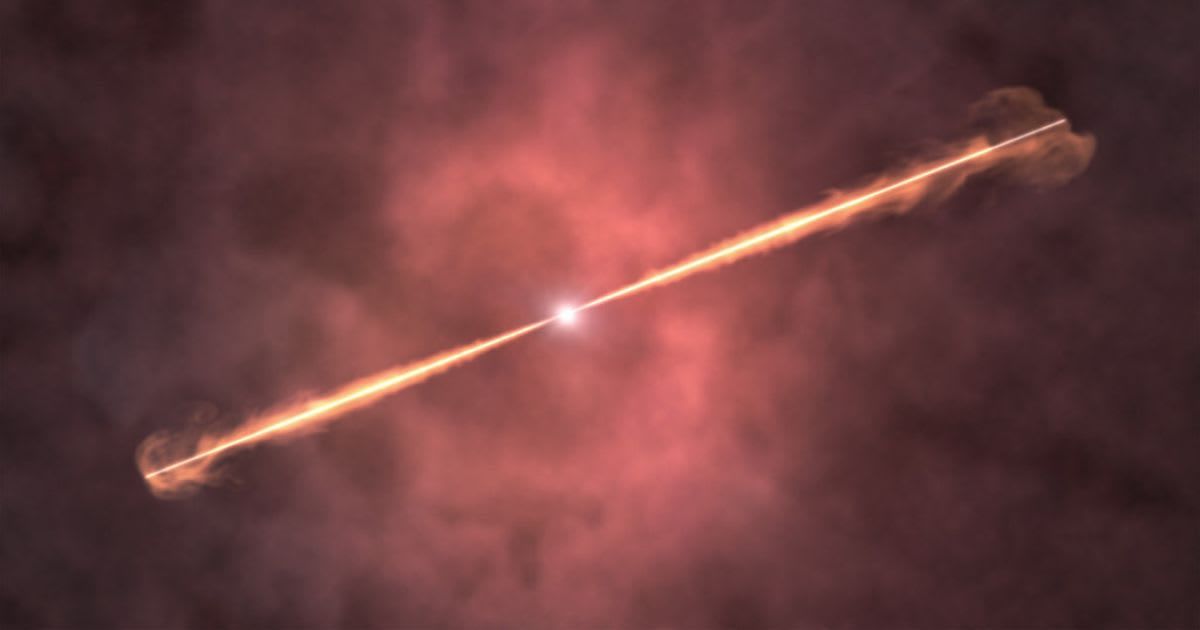
Artist’s illustration of a long gamma-ray burst, showing powerful relativistic jets blasting outward from a collapsing massive star. (Representative Cover Image Source: NASA’s Scientific Visualization Studio)

Gamma-ray bursts (GRBs) may be the most powerful explosions in the entire universe, but they can sometimes go completely unnoticed. Despite being able to release as much energy in seconds as the Sun could in its 10-billion-year lifetime, GRBs could still be ‘invisible.’ This is because they are narrow, relativistic jets, and not spherical explosions. One of these jets needs to be pointed directly at Earth in order to be able to see the bright gamma-ray flash. If not, it remains a hidden explosion, one of which astronomers believe they have detected.
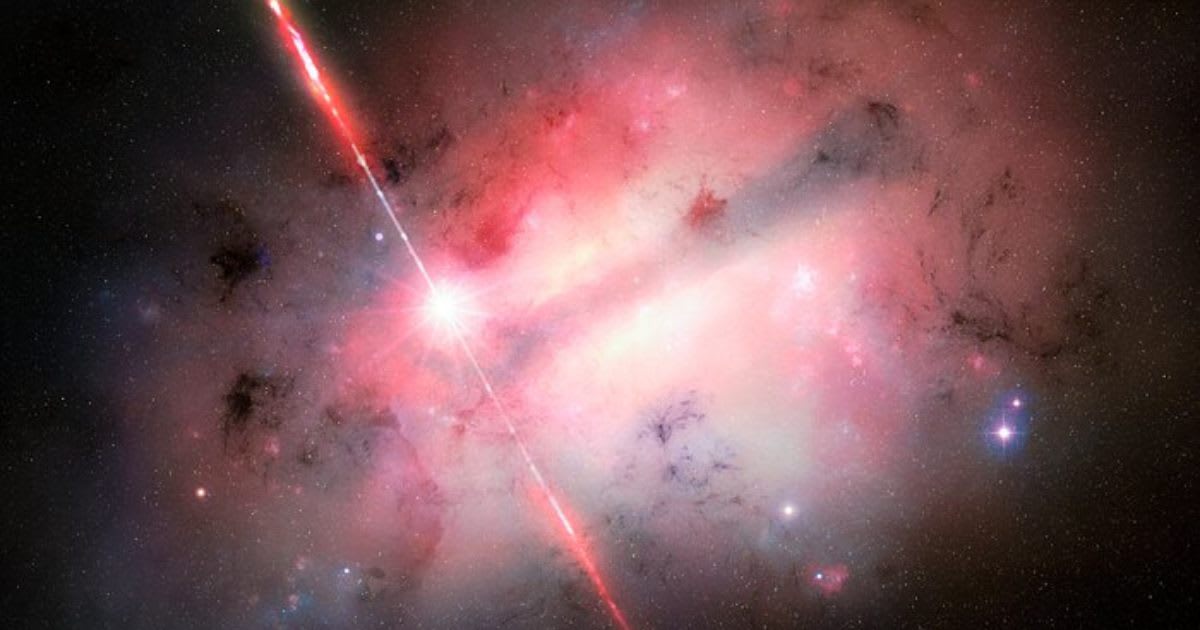
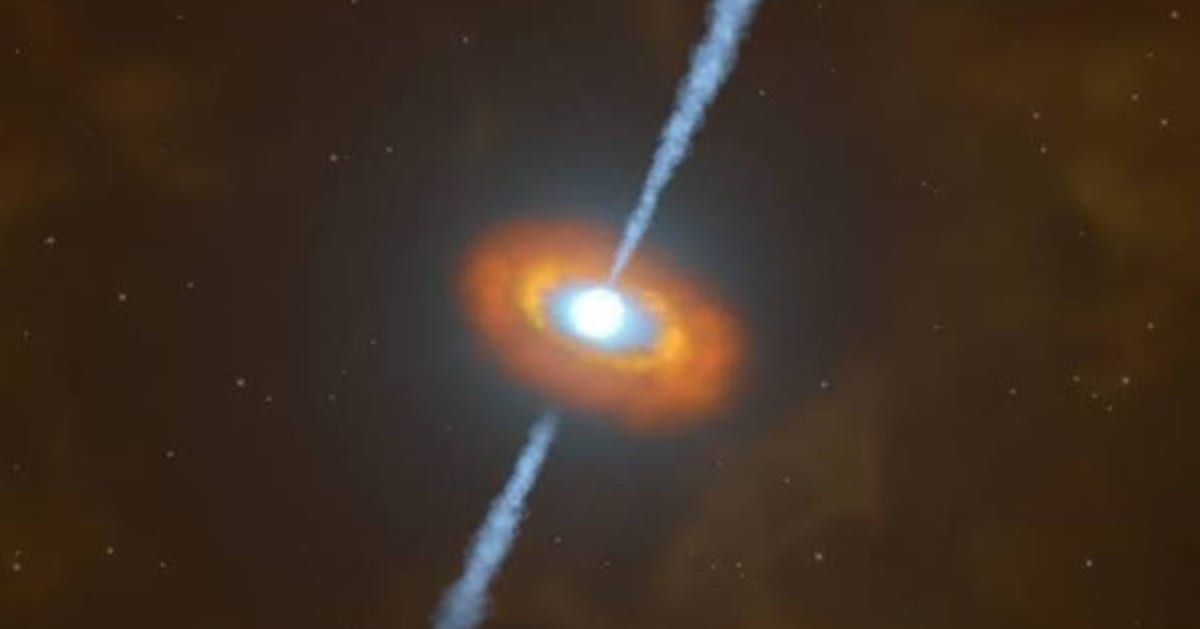
This artist’s illustration, which shows a high-speed jet of material being launched from a source that is embedded in a very dusty galaxy, depicts GRB 250702B (Cover Image Source: NOIRLab/NSF/AURA/M. Garlick)
This artist’s illustration, which shows a high-speed jet of material being launched from a source that is embedded in a very dusty galaxy, depicts GRB 250702B (Image Source: NOIRLab/NSF/AURA/M. Garlick)

A new study accepted in The Astrophysical Journal reports what may be the clearest example yet of such a hidden explosion. It explores what’s left to analyze if the initial blast of a gamma-ray burst isn’t noticed. GRBs are caused when giant stars collapse into black holes or when compact objects merge, launching jets in multiple directions. In case these jets are directed away from Earth, what remains visible is a slowly fading afterglow, especially in radio wavelengths. These echoes or “orphan afterglows” can be seen years later, as the blast wave plows into surrounding space or gas. However, it is important to note that such afterglows are not routine and hard to detect. 
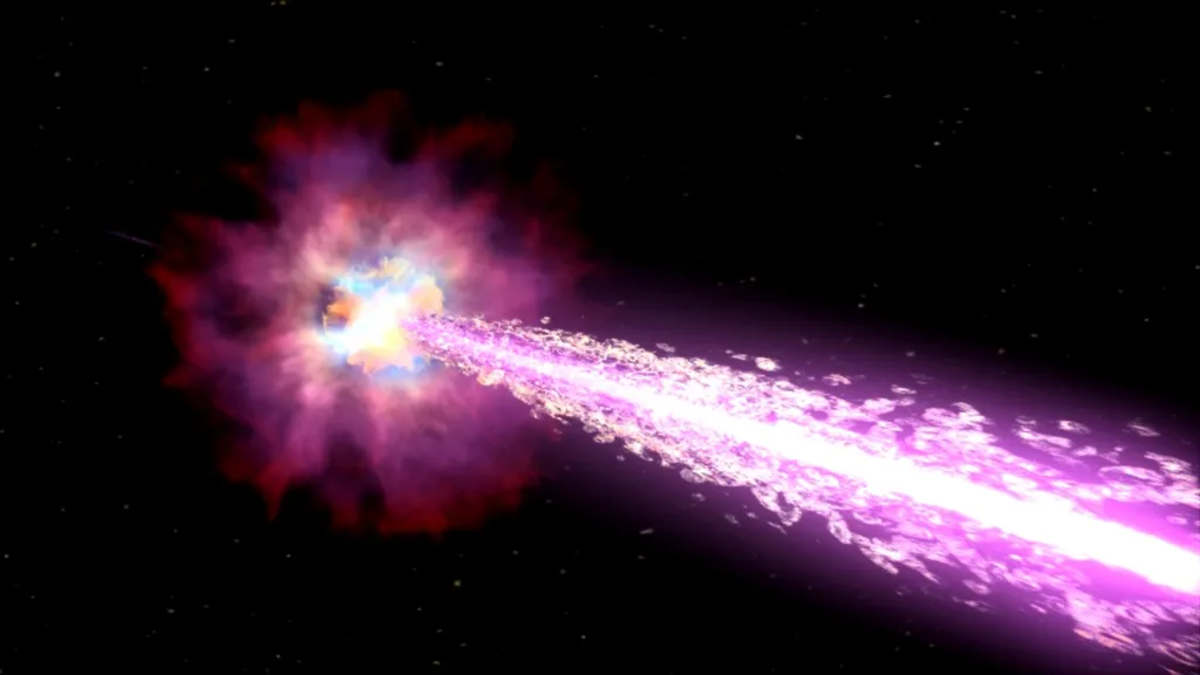
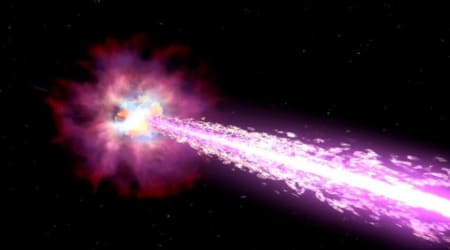
As a high-mass star explodes in this artist’s concept, it produces a jet of high-energy particles. We see GRBs when such gets point almost directly at Earth. (Representative Image Source: NASA/Swift/Cruz deWilde)
As a high-mass star explodes in this artist’s concept, it produces a jet of high-energy particles. We see GRBs when such a GRB gets a point almost directly at Earth. (Representative Image Source: NASA/Swift/Cruz deWilde)

One such strange radio signal is the ASKAP J005512–255834, detected by the Australian SKA Pathfinder (ASKAP), a 36-antenna radio telescope in Western Australia. The signal was first seen on February 4, 2022, while conducting wide-field surveys, but was absent from data taken about 250 days earlier. This radio afterglow brightened rapidly and then began to fade away slowly. At its peak, this source released 10³² watts of radio energy, comparable to the total radio emission of billions of suns. 
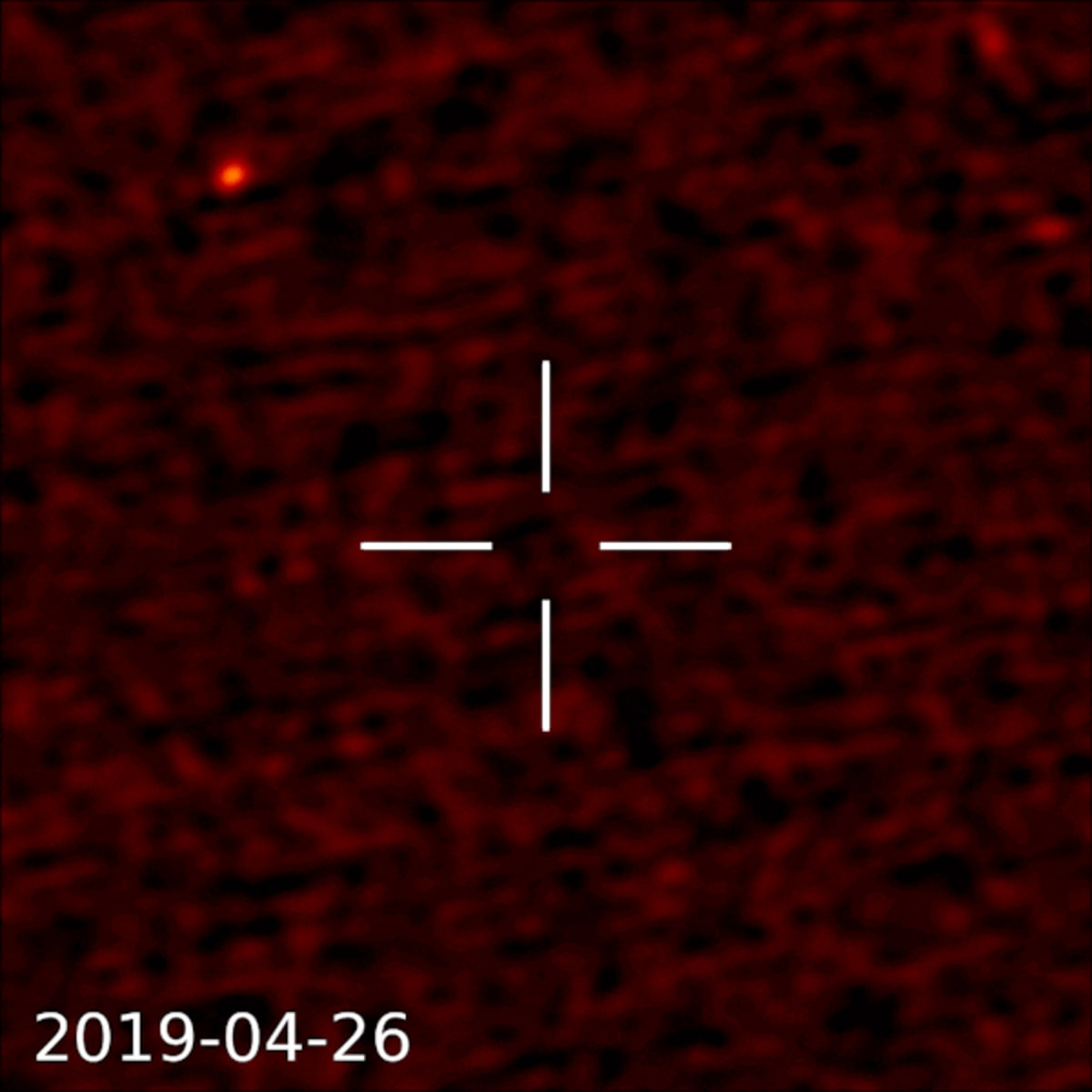
Brightening of the radio afterglow detected in the RACS survey with ASKAP. Observations beginning in 2022 capture the source turning on, after which it remains detectable for more than 1,000 days. (Image Source: Emil Lenc)

According to the study, most long-lived radio transients either evolve quickly or flare repeatedly, but this source did neither. Instead, it behaved like the echo of a single explosion, consistent with an orphan afterglow. Astronomers have been familiar with this concept for decades, but it’s virtually impossible to spot them without the initial flash. So, a massive area of sky has to be scanned, over thousands of square degrees, like what was just done using the ASKAP.
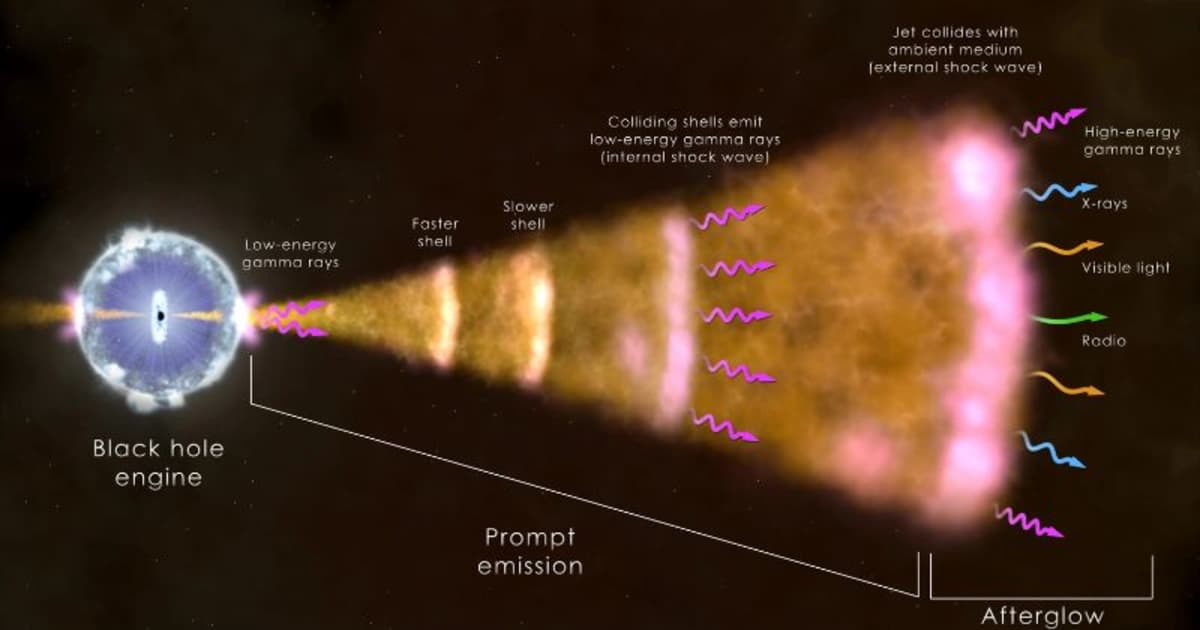
Illustration of a typical gamma-ray burst: a collapsing massive star forms a black hole that launches near-light-speed jets, producing radiation as the jet interacts with surrounding material. (Image Source: NASA’s Goddard Space Flight Center)

The ASKAP J005512–255834 was bright only in radio wavelengths, and not in visible or X-ray ones. This behavior is consistent with an off-axis GRB where the jet is not initially pointed toward Earth. It becomes visible in radio waves, as it slows and spreads. The lack of an X-ray or optical detection supports this theory but other explanations have not been ruled out just yet. 
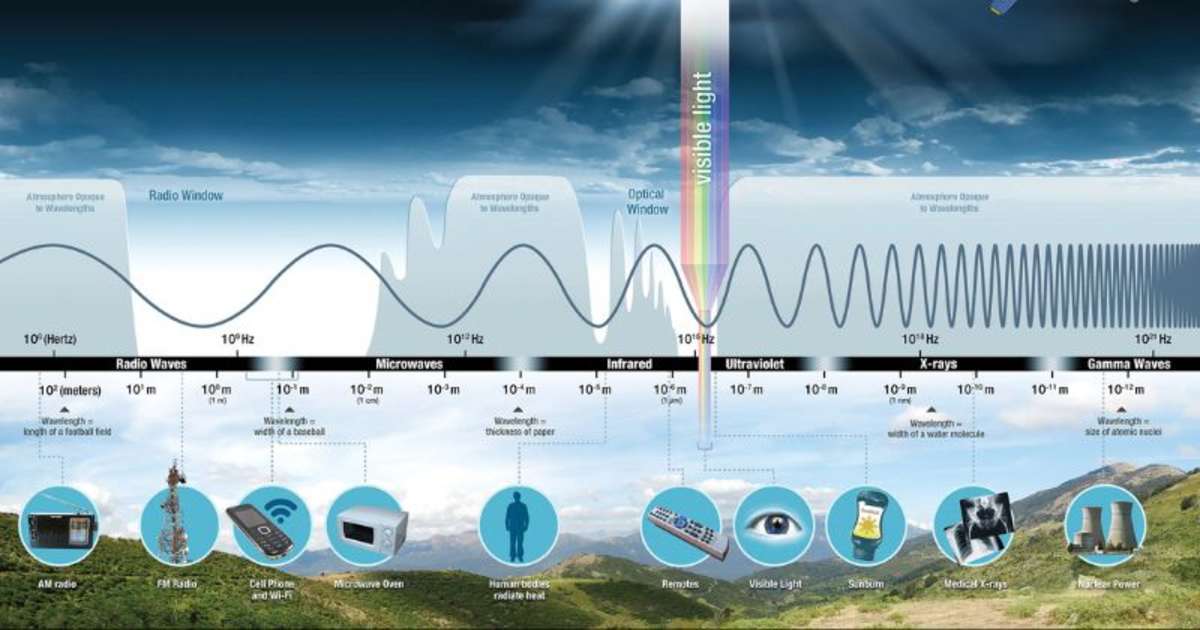
Diagram showing the electromagnetic spectrum, from radio waves to gamma rays, highlighting visible light and common human-made sources. (Image source: NASA)

The radio transient is associated with a small but bright galaxy located about 1.7 billion light-years away. It has an irregular structure where stars are being actively formed. Massive cosmic explosions and other such events usually occur in these environments. The study suggests that the blast isn’t aligned with the galaxy’s central nucleus, but rather within a compact star-forming region, possibly consistent with a nuclear star cluster.
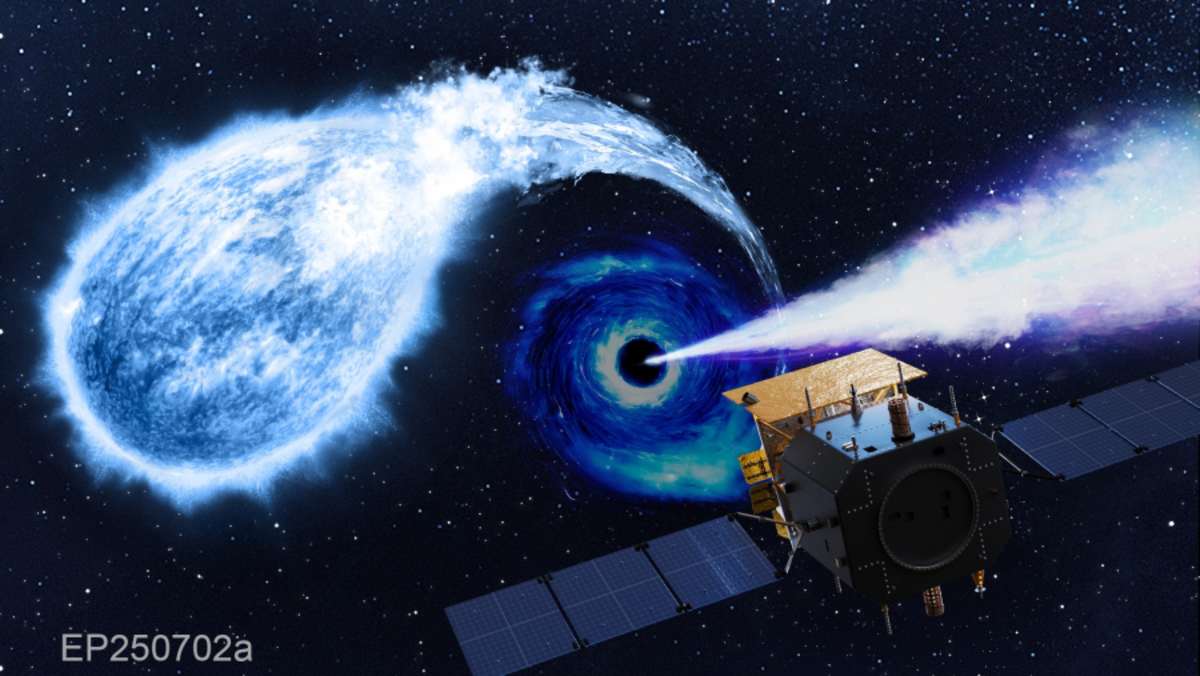
Artist's impression of the Einstein Probe satellite catching an intermediate black hole tearing apart a white dwarf. (Representative Cover Image Source: Einstein Probe Science Center, National Astronomical Observatories, CAS / Sci Visual.)
Artist's impression of the Einstein Probe satellite catching an intermediate black hole, tearing apart a white dwarf. (Image Source: Einstein Probe Science Center, National Astronomical Observatories, CAS / Sci Visual.)

Keeping the idea of orphan afterglows aside, the researchers also considered other possibilities that would explain the ASKAP J005512–255834. With stars, pulsars, and supernovae ruled out, one of the leading alternative explanations exhibiting this radio behavior is a tidal disruption event, such as a star being torn apart by an intermediate-mass black hole. This class of black holes sits between stellar-mass and supermassive, and has been extremely rare at radio wavelengths. If confirmed, that discovery would be just as huge as finding a hidden explosion as powerful as a billion suns, too.

More on Starlust

NASA's James Webb Telescope witnesses stellar explosion from just 730 million years after the Big Bang

Hubble Space Telescope captures powerful stellar explosion lighting up nearby clouds
MORE STORIES

The planet is approximately 154 light-years away and one year here takes only one Earth day. Scientists think "early Earth might have looked a lot like" this lava world.
4 days ago
Observing supernovae at their earliest stages can help us understand how the explosion develops.
Sep 24, 2026
The 42-light-year-long X-ray trail is the longest ever observed from a pulsar wind nebula.
Sep 24, 2026
The radio signals are not an indication of aliens trying to communicate with us. Instead, they are related to something we are all too familiar with.
Sep 24, 2026
“For the first time ever, nature is bringing one to us and conducting the experiment itself.”
Sep 24, 2026
Astronomers watched a neutron star's accretion disk vanish, only to reappear spinning in reverse.
Sep 22, 2026
It's one of the few known spiral galaxies with a central bulge that extends from its disk at a right angle.
Sep 21, 2026
ESA shared 3D close-ups and a topographic map to show how high or low the ground sits.
Sep 20, 2026
The supernova was found by NASA-funded ATLAS and had a magnitude of 17.3 at the time of discovery.
Sep 18, 2026
The findings provide a novel perspective on how AGN feedback influences the evolution of galaxies.
Sep 15, 2026