A dead star siphoning gas at 335,000 mph: NASA-JAXA mission makes 'groundbreaking' observation
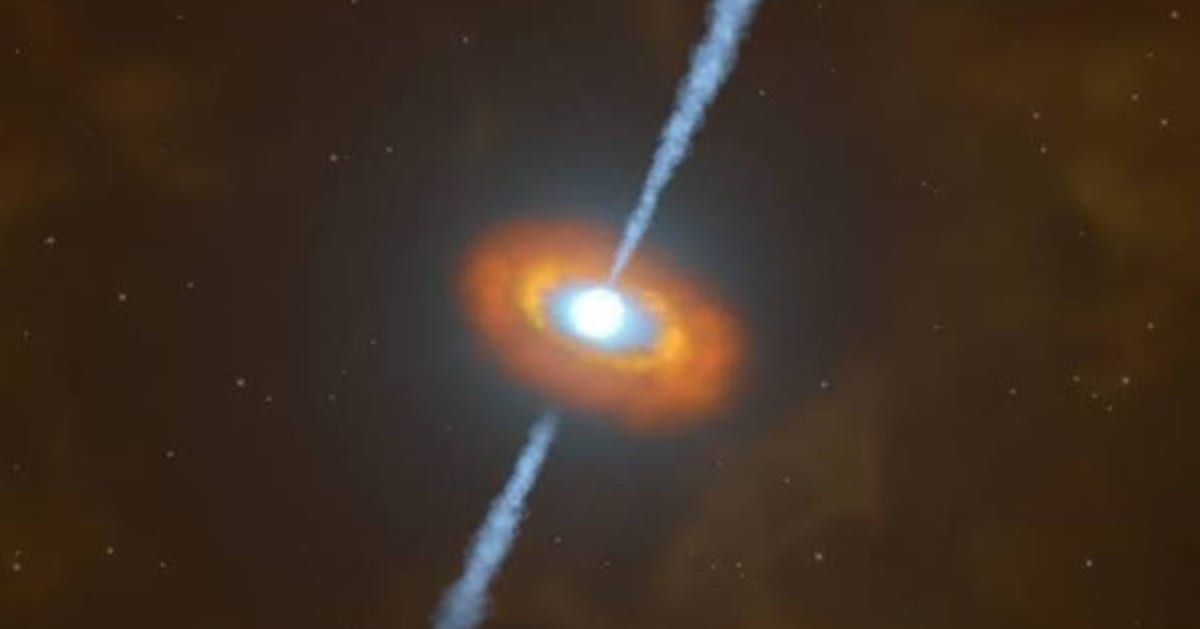
![This artist’s concept shows an isolated neutron star. [Representative Cover Image Source: NASA, STScI, Ralf Crawford (STScI)]](https://d3hedi16gruj5j.cloudfront.net/817702/uploads/58ba2440-b657-11f1-ba3b-05f54fce9422_1200_630.jpeg)
A tiny neutron star has been observed pulling gas from its massive stellar companion, offering scientists a glimpse into how matter behaves around these extreme cosmic objects. Observed by the XRISM mission operated jointly by NASA and JAXA, a rapidly spinning neutron star (also known as a pulsar) named GX 301-2 was caught in this feeding frenzy. Here's what scientists found.
A neutron star feeding on its massive companion
The observed neutron star is located in the BP Crucis binary system that lies some 13,000 light-years away from Earth. This system consists of GX 301-2 and a massive blue hypergiant named Wray 977, which is around 40 times the mass of the Sun and which continuously ejects ionized gas as stellar wind.
During its 41.5-day orbit, GX 301-2 wades through this stellar wind, with its strong gravity capturing some of the gas left behind by Wray 977. As this gas gathers around the neutron star, it heats up, producing X-rays that result in powerful X-ray flares.
XRISM catches gas falling toward the neutron star
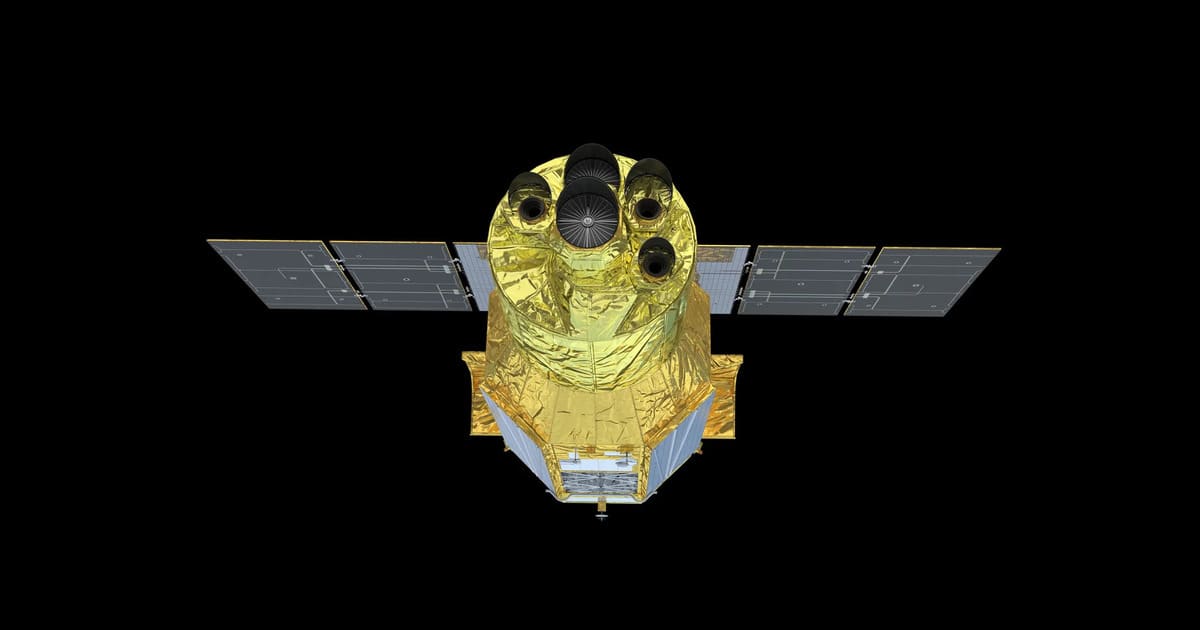
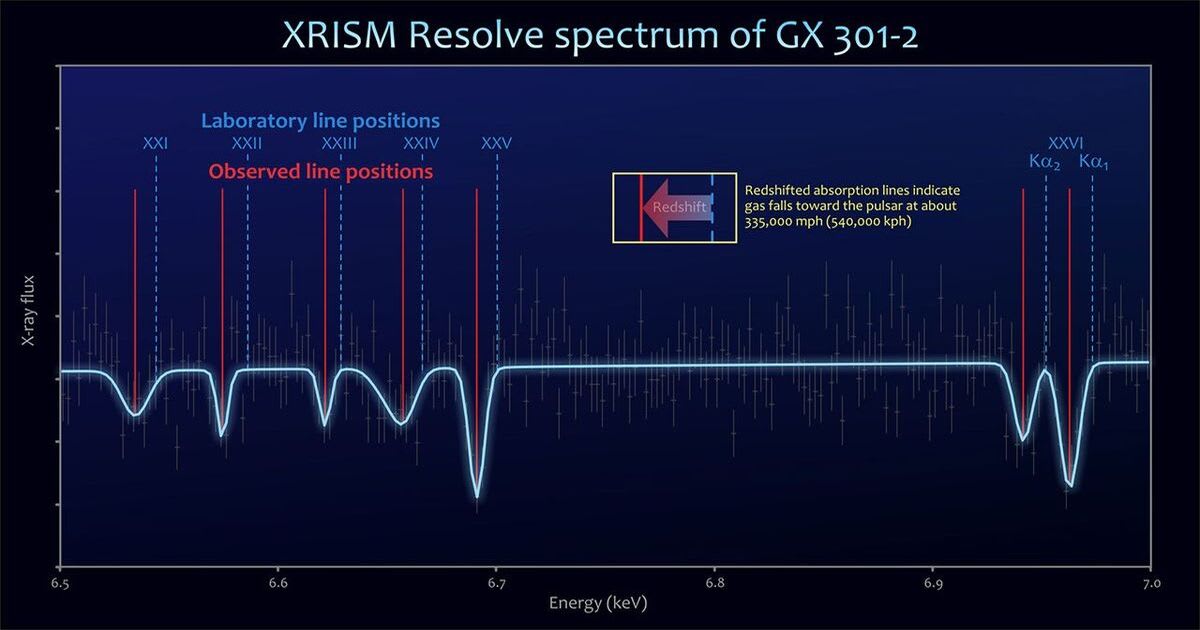
These X-ray emissions by GX 301-2 helped scientists study it closely—the Resolve instrument of the XRISM mission was used to measure the energy of the incoming X-ray photons, which revealed absorption lines from highly ionized iron. Accounting for redshift, scientists were able to learn in which direction the gas in BP Crucis was moving, and how fast.
Upon inspection, the gas was found to be moving toward the pulsar at a blistering speed of 335,000 miles per hour (540,000 km per hour), providing clear confirmation that stellar wind from Wray 977 was falling toward GX 301-2. The observations also gave scientists some insight into the behavior of dense plasma around the pulsar. "It was clear that these observations were groundbreaking ... We could see how the dense stream of plasma acts very close to the neutron star," Nazma Islam, a study co-author formerly associated with NASA, was quoted as saying by the agency.
A feeding disk that changes direction
Twice during its 41.5-day orbit, scientists recorded strong X-ray flares that went on for several days. Upon closer inspection of the system, scientists now believe that these flares occur when the pulsar travels through the gas and captures some of its matter, causing it to heat up and emit X-rays.
However, when the pulsar pushes farther into the stream of stellar wind, the disk of gas around it breaks down, and astronomers suspect that this happens due to the loss of angular momentum. Once the disk of gas around GX 301-2 dissipates, plasma flows directly into the pulsar, but the story doesn't end there. As GX 301-2 nears the end of the stream, the disk of gas briefly reappears, but this time, spins in the opposite direction. Shortly afterwards, in a matter of around four days, this disk also disappears when the pulsar exits the stream.
While GX 301-2 is an individual case, insights gained from its behavior in the BP Crucis system could help astronomers better understand how a neutron star captures material from a companion star. "The BP Crucis system is an ideal laboratory for studying wind-fed pulsar accretion, and XRISM’s sensitive, high-resolution Resolve spectrometer is an ideal instrument for advancing our understanding of the processes involved," Brian Williams, the XRISM mission’s project scientist at NASA Goddard, was quoted as saying by the agency.
More on Starlust
Rare XRISM findings reveal what a black hole looks like in its quietest X-ray phase
JAXA-NASA XRISM mission captures the clearest view of the vicinity of a rapidly-spinning black hole