Powerful solar flare erupts from the Sun, triggers radio blackout over South America
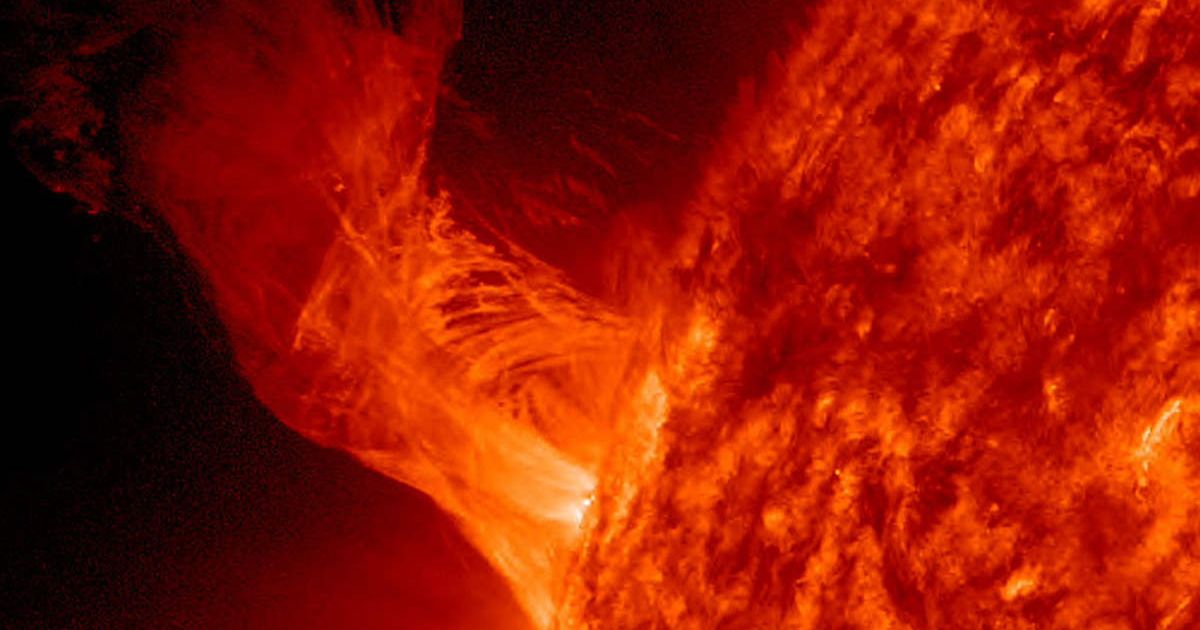
Sunspot AR3474 detonated with an X1.8 solar flare on November 4, sending an ultraviolet wave silencing South America's shortwave radio communications.
PUBLISHED 7 DAYS AGO
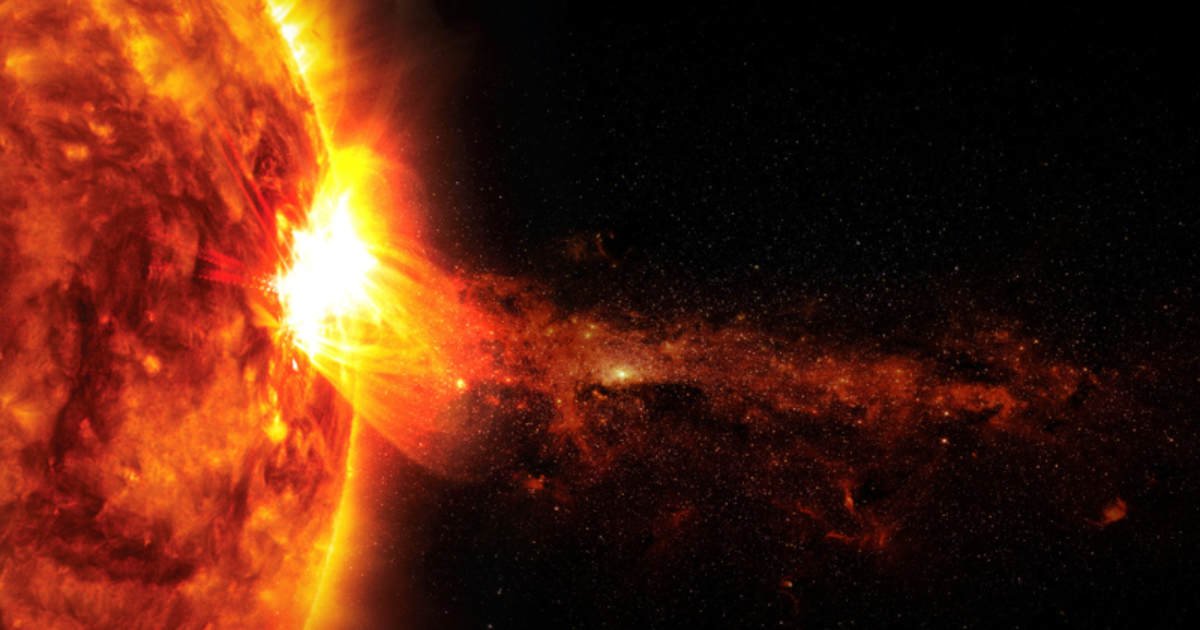
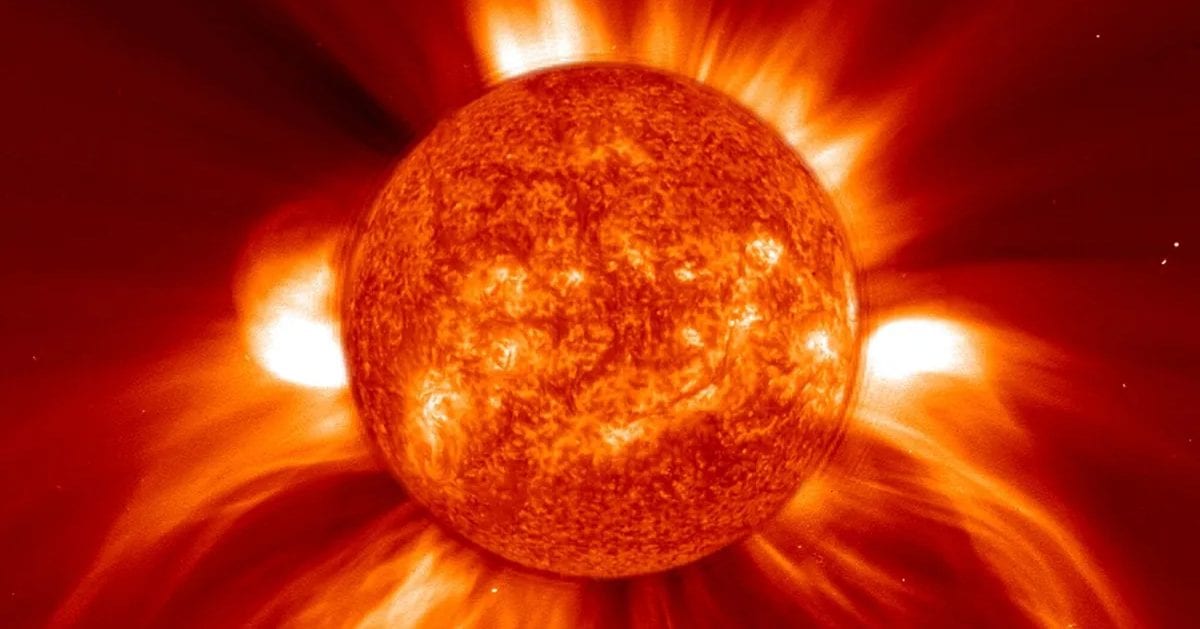
A solar eruption rises above the surface of the sun on December 31, 2012, in space, extending 160,000 miles out from the Sun and about 20 times the diameter of Earth. (Cover Image Source: Getty Images | Photo by NASA/SDO)

A powerful X1.8-class solar flare erupted from Sunspot AR3474 on November 4 (12:34 p.m. EST), unleashing a surge of extreme ultraviolet radiation that triggered a shortwave radio blackout across South America. Initial observations indicate that a Coronal Mass Ejection (CME) is also projected to be escaping the site of the powerful explosion, according to Space Weather

An image of the solar flares on the surface of the Sun.
(Representative Image Source: Getty Images | Wasan Prunglampoo.)
An image of the solar flares on the surface of the Sun. (Representative Image Source: Getty Images | Wasan Prunglampoo.)

The event occurs exactly 22 years after one of the most significant solar outbursts recorded in the Space Age. On November 4, 2003, a massive flare originated from a sunspot, though it was oriented away from Earth. The sheer intensity of that 2003 event overwhelmed X-ray sensors on GOES satellites for 11 full minutes, initially registering a clipped value of X17.4. This unprecedented energy release caused widespread communication disruptions, rendering shortwave radios silent across North America. 
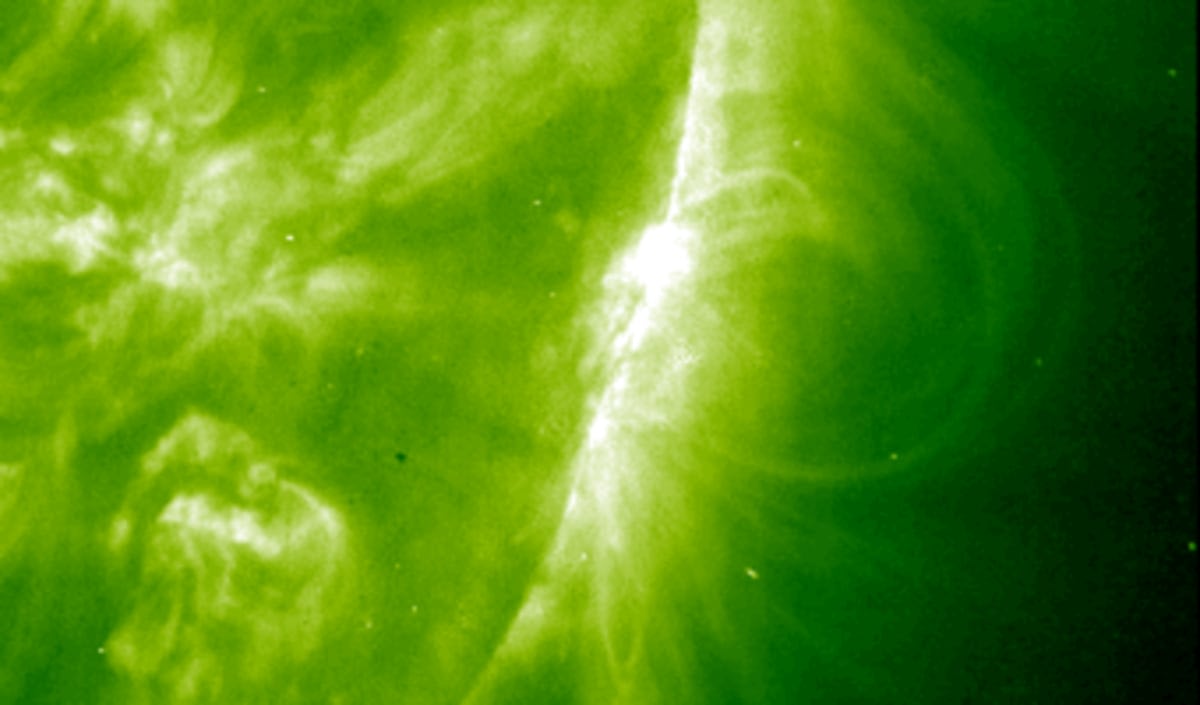
On Nov. 4, 2003, this solar flare saturated the X-ray detectors on several Sun-observing spacecraft (Image Source: NASA/ESA/SOHO)

Subsequent scientific analysis, utilising the Earth's ionosphere as a detection tool, revised the flare's true intensity to a significantly higher grade. Estimates, now widely confirmed, place that 2003 event at an estimated X45 class, putting it in the realm of the legendary 1859 Carrington Event. Space weather experts note a striking coincidence: the 2003 eruption happened during the declining phase of Solar Cycle 23. Current observations place the Sun near a similar point in the declining phase of Solar Cycle 25. Forecasters widely acknowledge that these downslopes frequently correlate with an increased likelihood of major solar explosions.
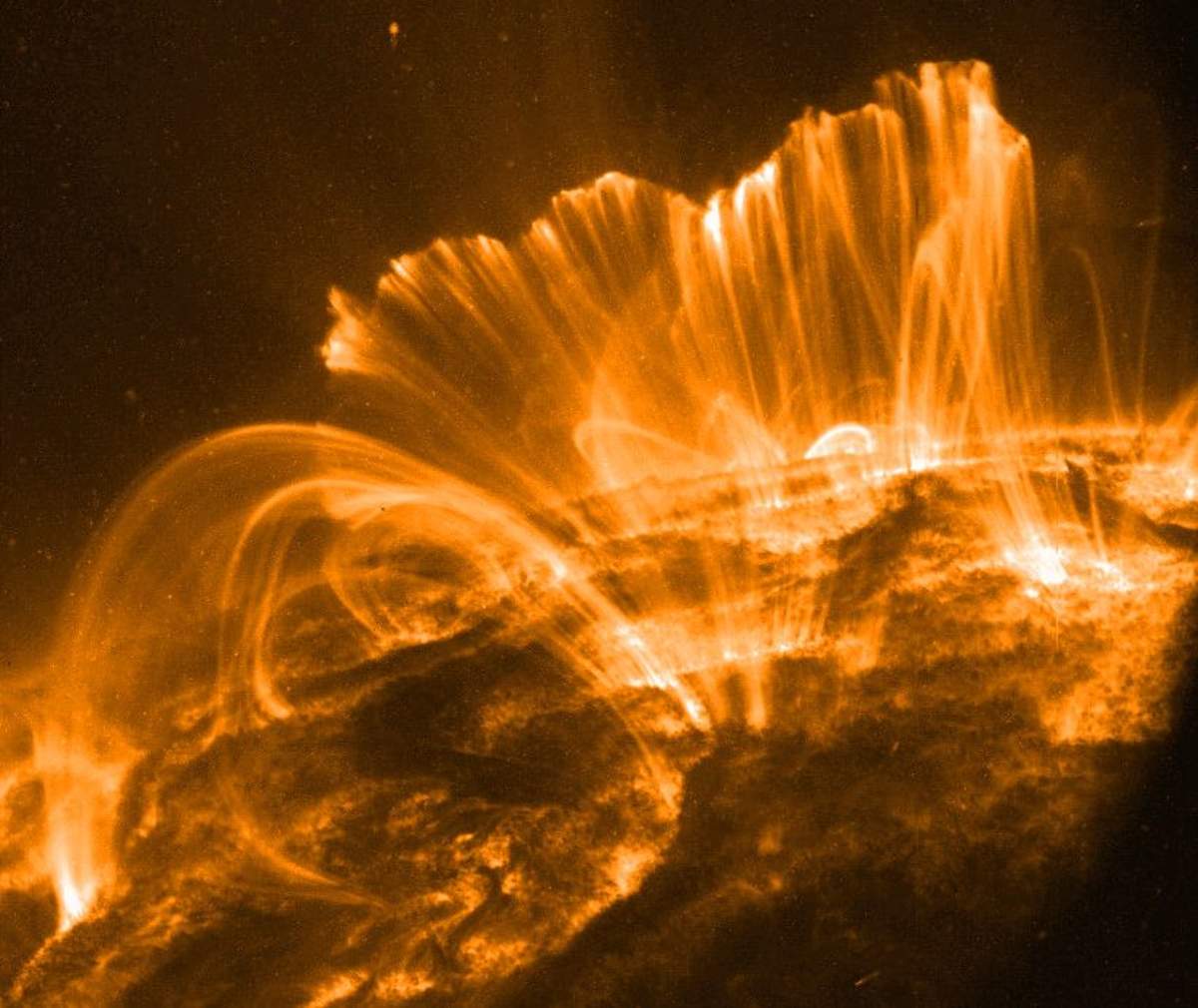
In this picture, the Sun's surface is quite dark. A frame from a movie recorded on November 9th by the orbiting TRACE telescope, it shows coronal loops lofted over a solar active region (Image Source: NASA Image and Video Library | NASA)

To grasp the power behind events like the recent X1.8 flare and the 2003 X45, scientists classify solar flares based on their peak energy output. According to NASA, this system functions much like the Richter scale for earthquakes: each ascending classification represents a tenfold increase in energy output. Flares are grouped into categories, ranging from the weakest to the most formidable: A-class, the mildest flares, are often barely detectable above the Sun's normal background radiation. Then come B-class, C-class, and M-class. Finally, X-class, representing the strongest flares.
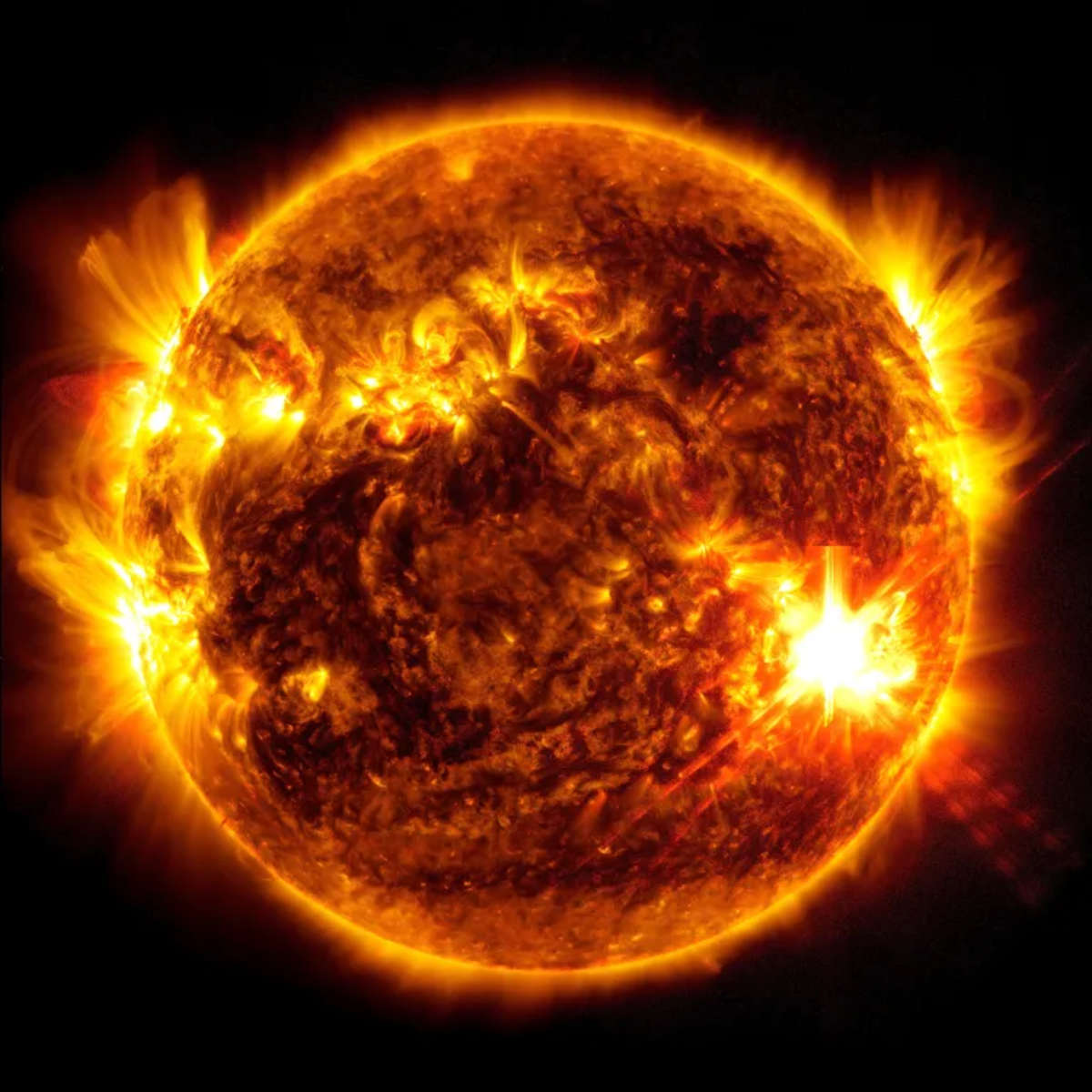
An X-class solar flare appears in the lower right part of the Sun in this extreme ultraviolet image from NASA's Solar Dynamics Observatory (Image Source: NASA/SDO)

This logarithmic scale means an X-flare is 10 times stronger than an M-flare and a staggering 100 times stronger than a C-flare. The two major events discussed, the recent X1.8 and the 2003 X45, underscore the significant difference between moderate space weather activity and genuinely hazardous solar super-storms.

These events, CMEs for short, are powerful releases of solar charged particles (plasma) and magnetic field, travelling on the solar wind (Representative Image Source: Getty | 	Mark Garlick)
These events, CMEs for short, are powerful releases of solar charged particles (plasma) and magnetic field, travelling on the solar wind (Representative Image Source: Getty | Mark Garlick)

This heightened solar activity was not limited to the November 4 event. The most significant of these preceding events occurred on June 15, peaking at 2:25 p.m. EDT (1825 GMT). This eruption, categorized as a high-end M8.46-class solar flare, narrowly missed the threshold for the X-class category and also triggered a Coronal Mass Ejection (CME). 
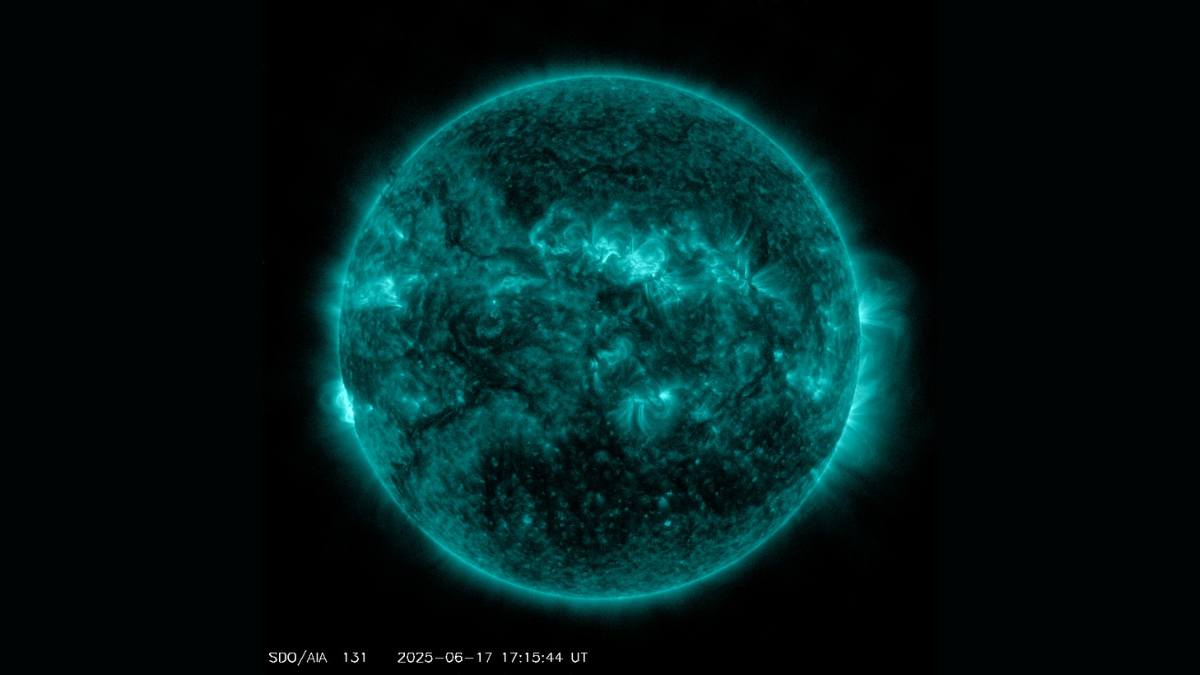
Sunspot region 4114 erupted with a colossal M8.46 class solar flare on June 15. (Cover Image Source: NASA SDO imagery.)
Sunspot region 4114 erupted with a colossal M8.46 class solar flare on June 15. (Cover Image Source: NASA SDO imagery)

The same solar dynamic that fueled these flares also drove spectacular displays of the Northern Lights, visible unusually far south. This phenomenon was a direct result of intense space weather and geomagnetic storm conditions impacting Earth. Our planet experienced the effects of a solar storm on the night of June 12-13, leading to moderate G2 geomagnetic storm levels. To keep track of such events potentially affecting Earth, NASA's all-sky cameras scan through the USA's skies for an estimate of meteoric fireballs every day. On November 4, 2025, 30 fireballs were reported (19 sporadics, 10 Northern Taurids, 1 Orionid). 

More on Starlust

Scientists solve 50-year-old mystery, discover solar flares 6.5 times hotter than expected

In a breakthrough, scientists successfully predicted a solar storm just 15 hours before it struck Earth

Highest-resolution images of solar flare and coronal loops captured by Inouye Solar Telescope

MORE STORIES

The celestial event this month is a rare one, with the Moon retreating to an apogee from Earth's center.
1 hour ago
The three interstellar objects are unique, billion-year-old fragments and kinetic artifacts collected from countless extrasolar systems across the galaxy.
5 hours ago
English physicist and science communicator Professor Brian Cox draws parallels between the journey of 3I/ATLAS and that undertaken by humanity.
9 hours ago
Conspiracy theories can be put to rest as new evidence from the MeerKAT radio telescope has emerged.
1 day ago
Consecutive X-class solar flares have set the stage for severe space weather to strike on November 11 and 12.
1 day ago
The observation, made on November 9, unveiled a shockingly complex jet system that overshadows prior data, immediately casting doubt on the comet's origin.
2 days ago
The object, discovered by Gennady Borisov on November 2, 2025, quickly became the focus of speculation amid the curiosity surrounding 3I/ATLAS.
2 days ago
To assess Martian viability, scientists subjected yeast cells to Mach 5.6 shock waves and the corrosive perchlorate salts common on the Red Planet.
6 days ago
These impacts pack surprising power; a mere 11-pound meteoroid can blast a 30-foot (9-meter) crater, ejecting 75 metric tons of lunar soil.
6 days ago
Observations were maintained using imagery from solar imagers on the STEREO-A, SOHO, and GOES-19 missions near the Sun.
Nov 3, 2025