Planets form more easily when they orbit two suns instead of one, new study suggests
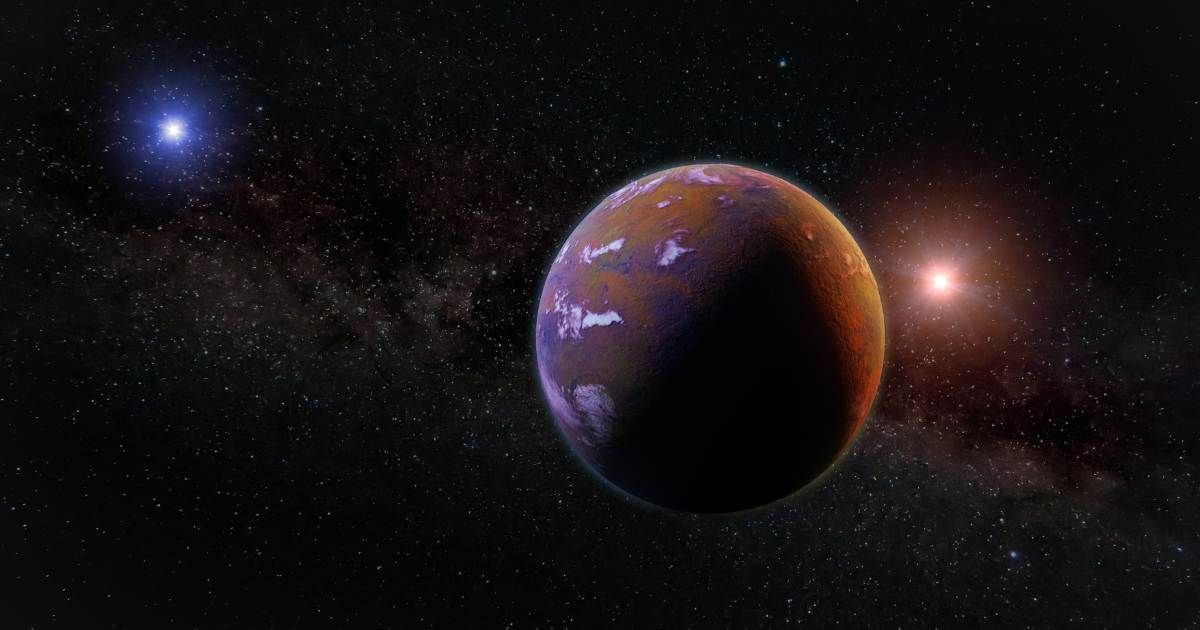
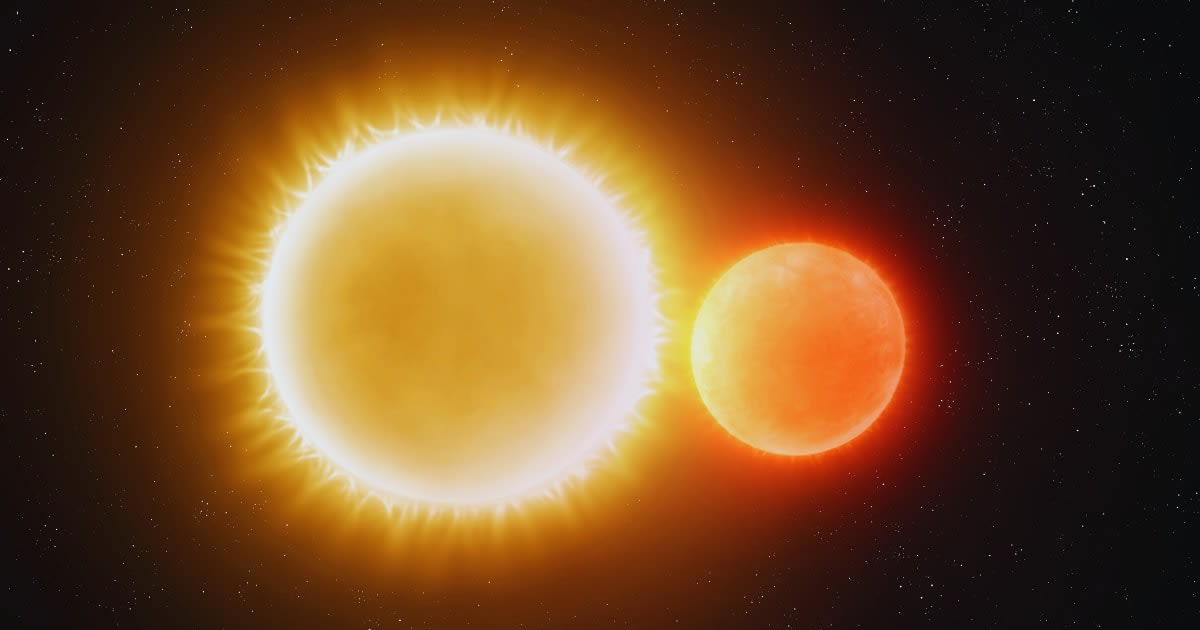
Tatooine-like planets with two suns may be more common than we think. That's because new research suggests that binary star systems could actually offer more favorable environments for planet formation. For decades, scientists thought that the competing gravitational forces created by two stars became too chaotic to allow worlds to take shape. But new research from a team of astrophysicists from the University of Lancashire challenges this long-standing view.
In a galaxy far, far away…
— NASA (@NASA) May 4, 2021
Skywalker’s home planet Tatooine in “Star Wars,” which orbited 2 stars, wasn't just cinematic invention. Thanks to our @NASAUniverse missions, we’re able to learn more about binary stars. Take a look & #MaytheFourthBeWithYou: https://t.co/YR3tVuxE0O pic.twitter.com/Zww4CBFFxX
The study regarding how planets might form and function orbiting around two suns was published in the journal Monthly Notices of the Royal Astronomical Society. The team of scientists resorted to using advanced simulations and analyzed the behavior and evolution of gas disks surrounding young binary stars. The result showed that the system’s strong gravitational pull creates a forbidden zone in the inner region discs, where planets fail to take birth. On the other hand, beyond this unstable region of the inner circle, the scientists noted that gas disks can fragment under gravity, and that in turn creates ideal conditions for the rapid birth of multiple planets.
Speaking to BBC Sky at Night Magazine, Dr. Matthew Teasdale, who led the study as part of his PhD project, said, “Close to a binary star, it's simply too violent for planets to form. But move farther out and the disk becomes an ideal environment for planet formation." The researchers also found that the disks around binary stars can give rise to more planets through fragmentation compared to disks around single stars. Furthermore, the findings suggest that binary systems may be especially efficient at producing massive worlds, including gas giants larger than Jupiter. In a few cases, the gravitational forces can also result in the ejection of some planets into deep space, where they float freely as rogue planets.
Proving that a double-sunset is anything but sci-fi, Kepler-16b orbits a pair of stars. It's like Luke Skywalker’s home planet Tatooine & was one of the first worlds found orbiting a binary star, discovered in 2011 by @NASAKepler. More: https://t.co/XteqkaO23e #Maythe4thBeWithYou pic.twitter.com/F1dUvzcBQe
— NASA (@NASA) May 4, 2019
Dr. Dimitris Stamatellos, the supervisor of the study, said, “Binary stars were once seen as hostile environments for planet formation. What we're finding is that they can actually be extremely productive. Once you get past the danger zone, planets can form quickly and in large numbers.” He continued, "While planets may struggle to survive near their twin suns, further out these systems transform into dynamic planet-forming environments, suggesting that real-life Tatooines may be far less rare than we once imagined.”
While our solar system with just one host star may seem like the norm, it is far from it. We are the minority, as more than half the stars in the sky have either one or more partners, according to NASA. So hypothetically, if you were to travel across the galaxy, chances are you'd come across worlds like Luke Skywalker's home planet more often than planets like ours. In fact, Dr. Teasdale's study notes that more than 50 circumbinary planets have already been discovered in recent years, with several of them being gas giants. On top of that, the team thinks that its results have opened up avenues for future studies with telescopes like the Atacama Large Millimeter/submillimeter Array in Chile, the James Webb Space Telescope, and the upcoming Extremely Large Telescope.
More on Starlust
The universe may be filled with Earth-like planets, new supernova model suggests
NASA’s Hubble finds largest chaotic ‘sandwich’ where planets are born, baffling astronomers