NASA-funded flying robots could soon explore the hidden caves of Saturn's moon Titan

NASA has awarded a new research grant to develop small, ball-shaped flying robots that could one day explore the caves of Titan, one of the most Earth-like worlds and Saturn's largest moon. The project, called SPARK, is led by Daniel Drew, an assistant professor at the University of Hawaii at Mānoa, and it's backed by NASA's Innovative Advanced Concepts program, or NIAC.
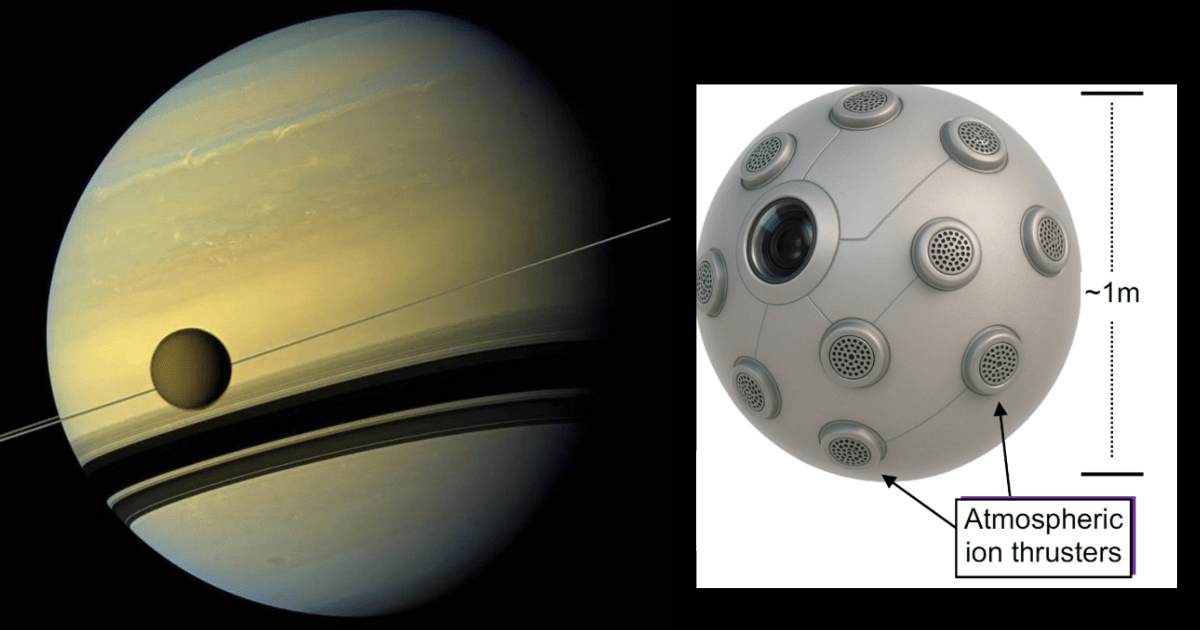
Why does NASA need a flyer, not a roller, for this moon?
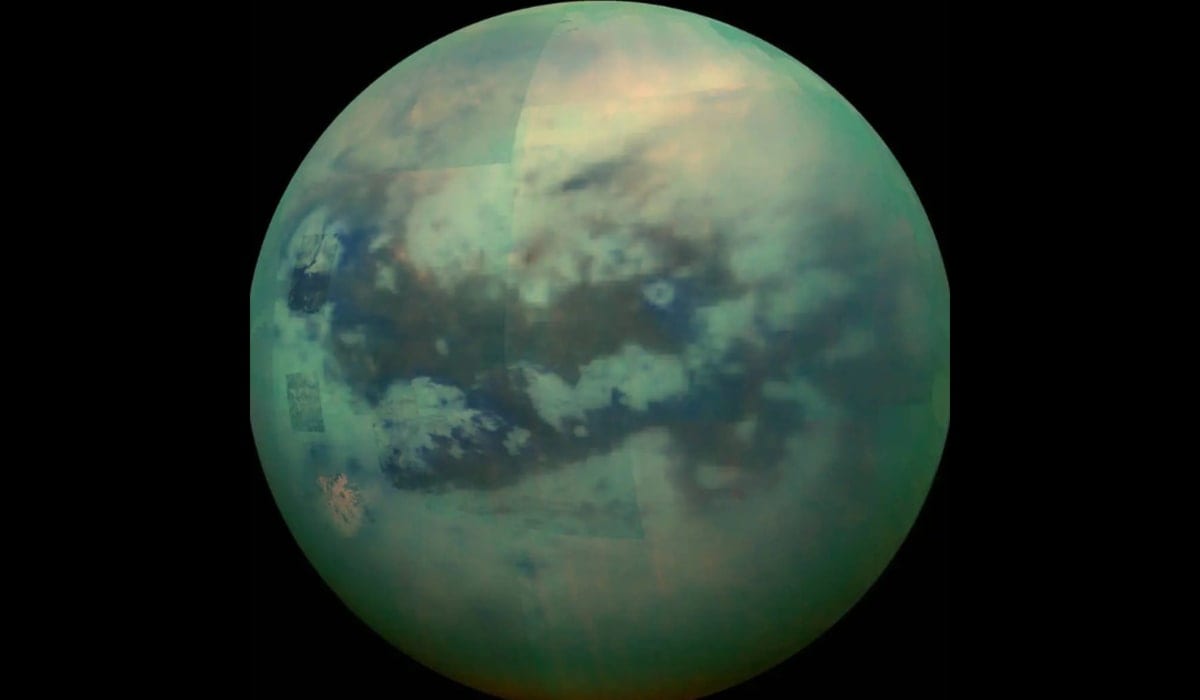
Titan is covered in seas and rivers made of liquid hydrocarbons like methane and ethane, and its surface includes "karst" terrain full of sinkholes and underground caves, similar to formations found in places like Kentucky here on Earth. SPARK's Aerobots are meant to fly over and into that terrain instead, using electrohydrodynamic (EHD) propulsion, a type of ion thruster for a place as cold as Titan where mechanical parts can seize up. Daniel Drew told Space.com that the design could "provide persistence, maneuverability, robustness to the challenging near-cryogenic conditions, and minimize downwash disturbance of scientifically-important hydrocarbon layering."
While exploring different approaches to flight, Drew came across the hobbyist 'lifter' community, he said, “pretty much by chance.” He shared, "These are triangular balsa wood, magnet wire, and aluminum foil prototypes. You connect them to 40,000 volts from a flyback transformer that you rip out of a microwave or CRT monitor or whatever, and they can float above the table. There are plenty of examples of people making these on YouTube." That curiosity turned into years of academic work. "Long story short, I ran with that idea, and wrote a bunch of papers where I created microfabricated centimeter-scale flying robots propelled by atmospheric ion thrusters," Drew said.
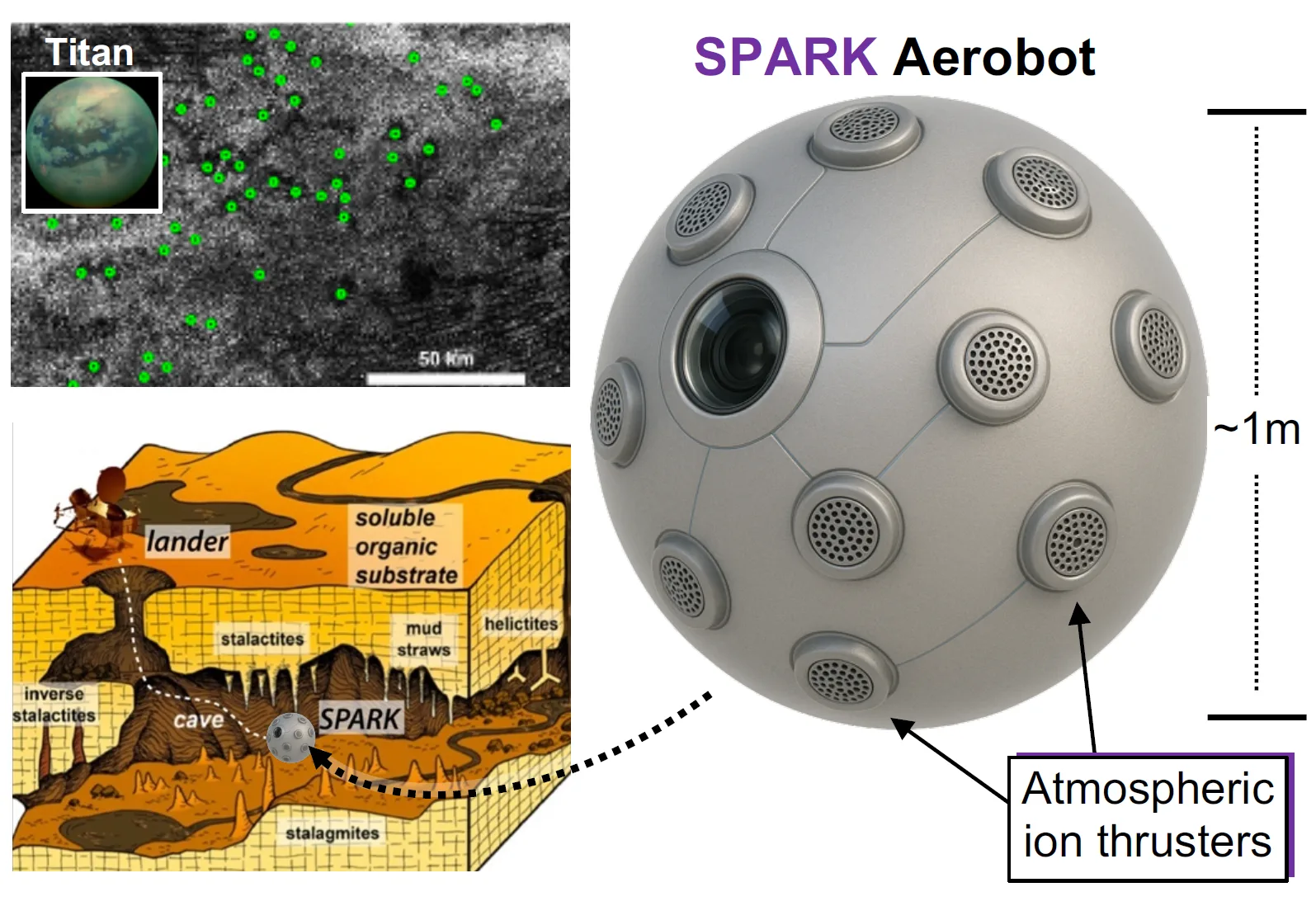
SPARK still has a long way to go before liftoff
SPARK is only in Phase 1 of NIAC funding, a nine-month stage, and would need to clear a Phase 2 lasting up to two years before it's realistically mission-ready. That's a tight fit against Dragonfly, NASA's mission to Titan currently targeted for 2028. "Where does that line up with the current Titan mission timeline, assuming we've missed the window for Dragonfly? I don't know," Drew said.
Still, he's hopeful SPARK could follow in the footsteps of Ingenuity, the Mars helicopter that flew 72 times. Drew also shared, "That may seem like a pretty decent list of significant milestones, but it's really not a crowded space of people working on this topic. I'm mostly racing against myself here."
He also commented on the technology's downside, saying, "The huge weakness is that it just isn't very efficient. Barring a major breakthrough, it will be impossible to really compete with more conventional propulsion techniques, like rotors and jet engines, for the vast majority of terrestrial applications." For now, Drew said the team's major contribution will be a comprehensive, public report, calling the idea of 'standing on the shoulders of giants' something that is 'very much ingrained into the NIAC culture.'
More on Starlust
Saturn's largest moon, Titan, may have formed from the collision of two older moons, study finds
NASA’s Dragonfly rotorcraft gets its main structure delivered, inches closer to exploring Titan