Mars, Jupiter and Regulus to form striking line in October 16 morning sky: Here's how to watch them
Skywatchers can catch a stunning celestial arrangement on Friday, October 16, when Mars, Jupiter, and Regulus, the brightest star in the constellation Leo, appear to form a nearly straight line in the early morning sky. The three objects will offer an eye-catching celestial pattern for observers willing to rise before sunrise, with Jupiter shining prominently between the reddish Mars and the distant star Regulus. Both these planets, which are among the show-stealers in the early morning sky this month, will see their relative positions change as October progresses.
How to watch the stunning event
For the best view, begin observing at least 1.5 hours before local sunrise on Friday, October 16. Look toward the southeastern sky during the pre-dawn hours, when Mars, Jupiter and Regulus will appear to form a line, according to Sky and Telescope. The arrangement will resemble the famous Belt of Orion, although the three objects will differ considerably in brightness, according to BBC Sky at Night Magazine.

Mars will get closer to Jupiter as the month progresses. The two planets, in fact, are scheduled for a close encounter on November 16, when they will appear just 1.2 degrees apart from each other. In case you are wondering, a fist held at arm's length measures 10 degrees against the sky.
What else is visible during October 2026?
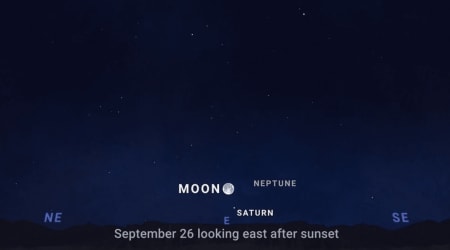
You can also spot a thick crescent Moon lying low in the southwest on the same night once the sky goes completely dark. The Moon will be sitting in the Sagittarius Teapot, a pattern of 2nd- and 3rd-magnitude stars. The Teapot will be tipped steeply, with its triangular spout located below the Moon and its four-star handle to the Moon’s upper left (as seen at nightfall in North America).
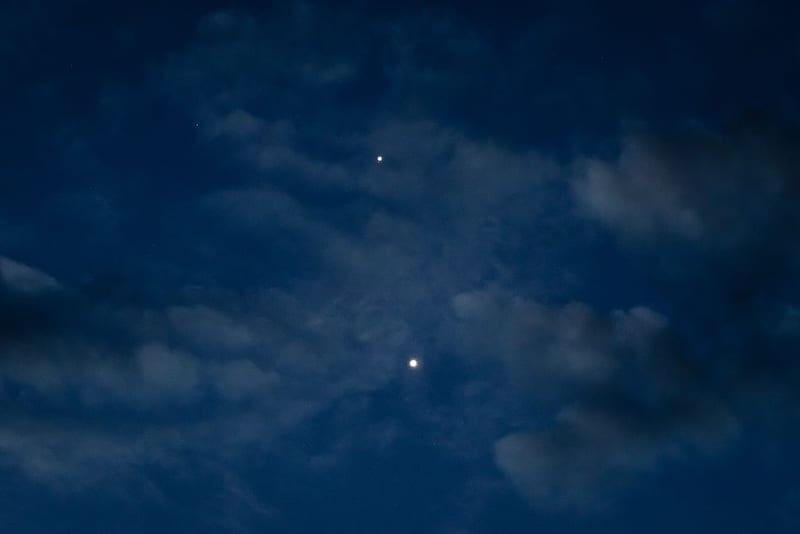
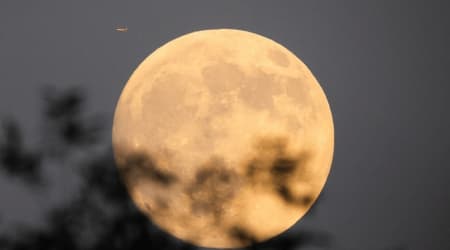
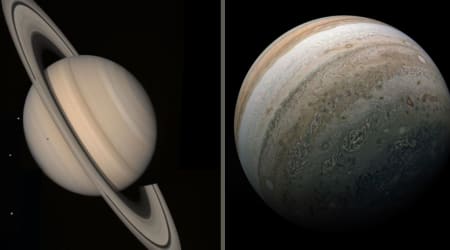
Also, on October 31, Mars will cross into the Leo constellation, where it will be 6 degrees to the west of Jupiter and 12 degrees to the west of Regulus, according to Space.com. Before that, on October 23, Saturn will be visible as a yellow-white bright star to the lower left of the waxing gibbous Moon. Make sure you don't miss the Full Moon three days later—also called the Hunter's Moon this time of the year—which will reach peak brightness at 12:11 am EDT on October 26.
More on Starlust
Don't miss Draconid and Orionid meteor showers this October: Here are peak timings and viewing tips
October's Full Moon 2026: Peak date, city-wise timings and viewing tips for Hunter's Moon