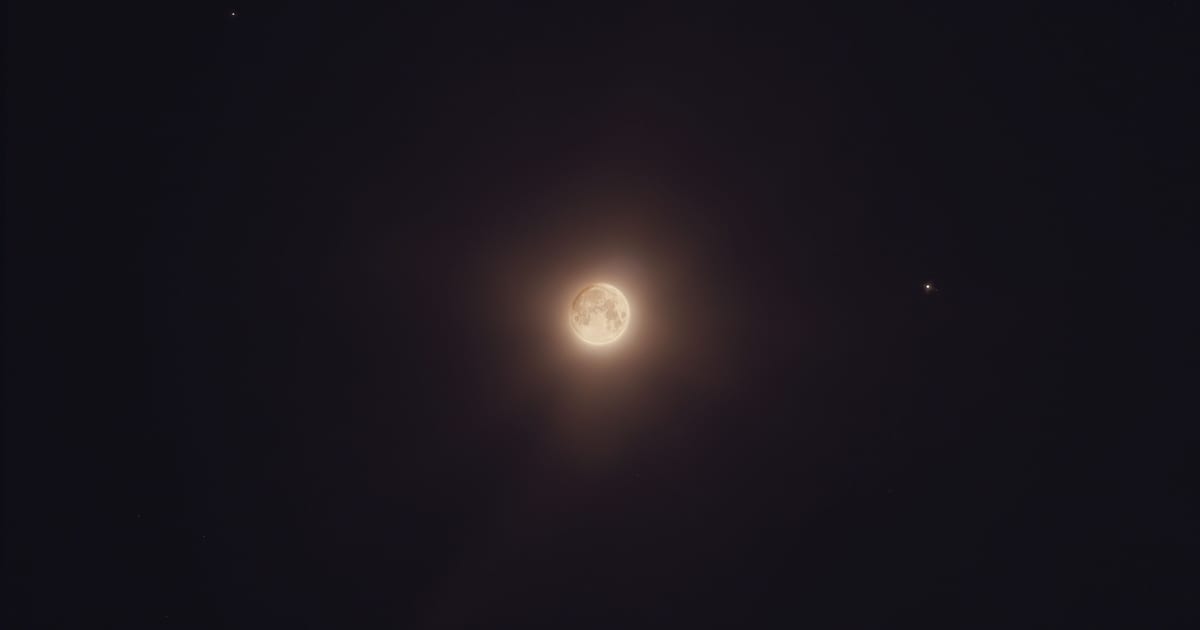
Giant asteroid 2025 RL2 to make closest approach to Earth this week—when and how to watch
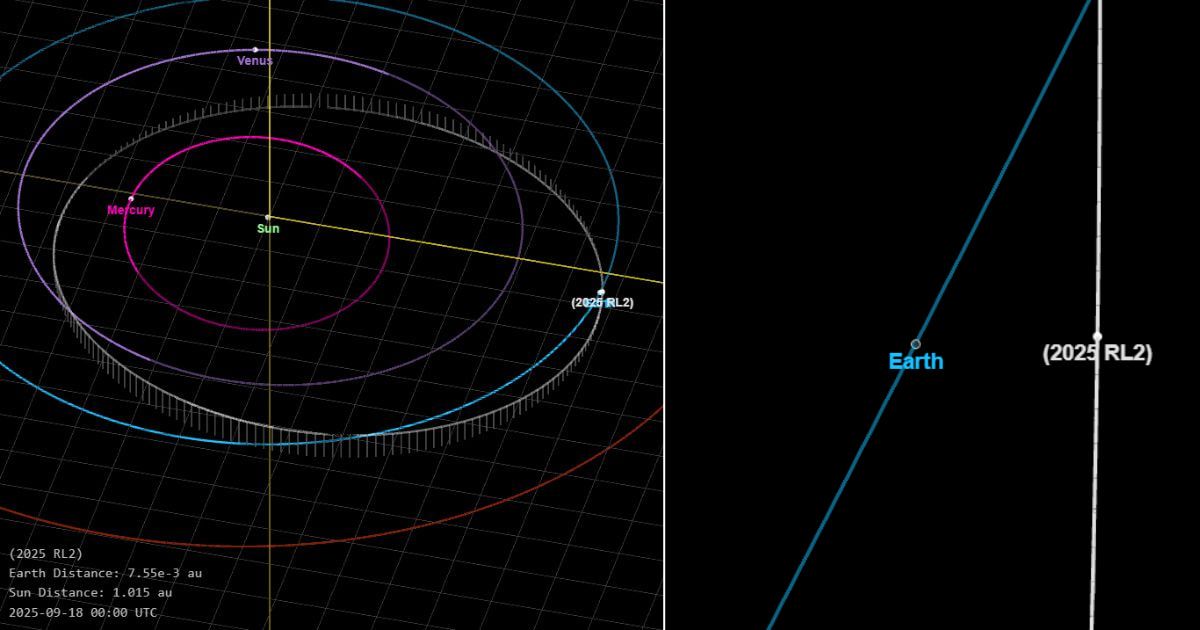
Astronomers are intently tracking a newly found asteroid, 2025 RL2, as it prepares to make a remarkably close flyby of Earth on September 19 at roughly 5:00 a.m. EDT, as per CNEOS. The small space rock will pass within a mere 134,566 miles (about 216,563 kilometers) of our planet's surface. While posing no threat, its high-speed passage, at nearly 6 miles per second, offers a crucial opportunity for planetary defense researchers and astronomers to study an object up close.
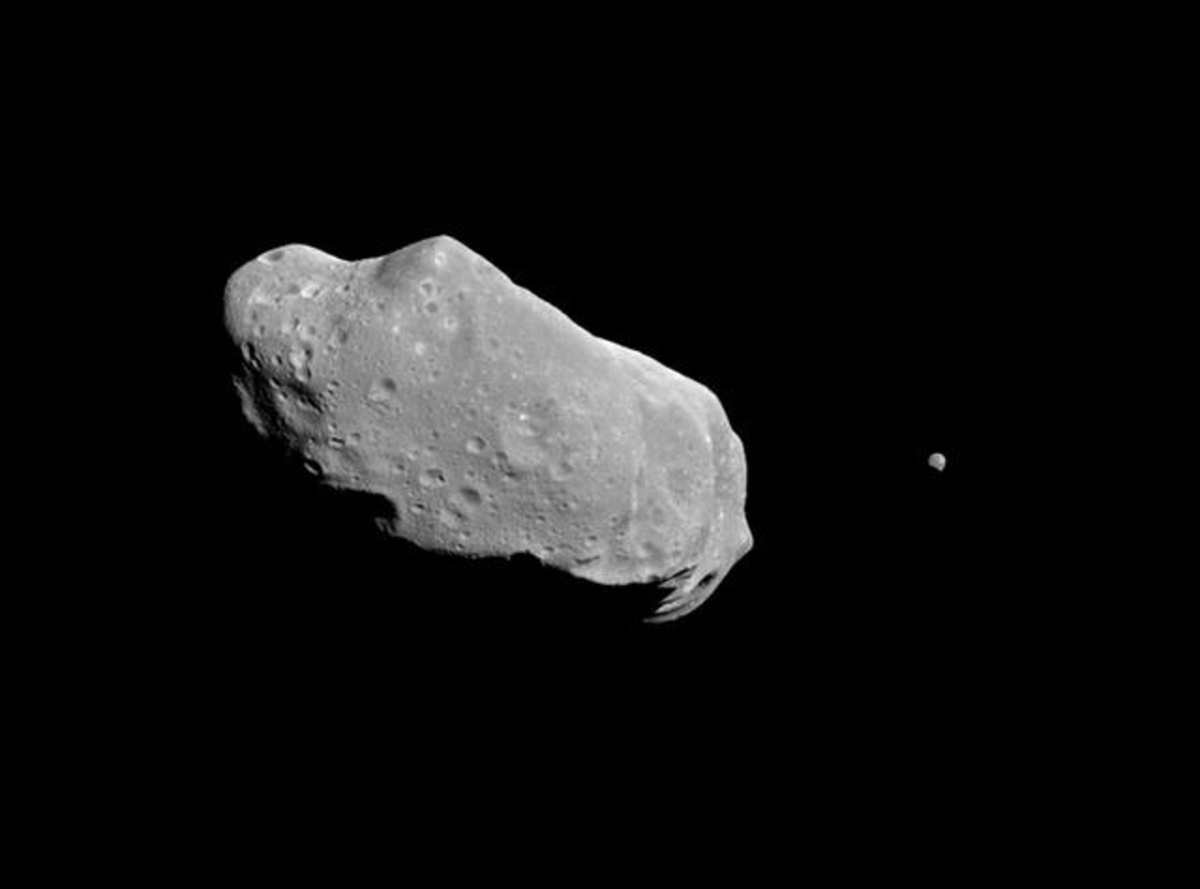
Discovered on September 13, 2025, at the Kitt Peak-Bok Observatory in Arizona, asteroid 2025 RL2 is a member of the Aten group, a class of space rocks with orbits that generally stay within Earth’s path, per NASA JPL. Early estimates, based on an absolute magnitude of 26.0, place its diameter between 17 and 37 meters (56-121 feet), a size comparable to the Chelyabinsk meteor that exploded over Russia in 2013. That event, which caused a significant airburst and injured over 1,500 people, underscores the importance of tracking such near-Earth objects, as mentioned on The Watchers.

Despite its small size, the asteroid's flyby is a high-value event for the scientific community. According to the data from NASA JPL, the brief four-day observation period, from September 13 to September 17, with 49 total observations, means its orbital data is still being refined, as indicated by a high condition code of 7. The upcoming pass will allow for a dramatic increase in observational data, helping scientists to predict its future trajectory more accurately. With an eccentricity of 0.376 and a semi-major axis of 0.829 AU (a unit of measurement used in astronomy to describe distances within our solar system), the asteroid takes just 275.9 days to complete one orbit around the Sun. Its extremely small minimum orbit intersection distance (0.00045 AU) highlights why it is a key object for study.

For planetary defense teams, this event serves as a live-action drill. It allows observatories to test their protocols for detecting, tracking, and characterizing fast-moving near-Earth objects. The data collected from 2025 RL2 will be instrumental in refining the systems designed to identify potential threats, ensuring that future close calls are not a surprise. According to The Watchers, this flyby marks the 100th known asteroid to pass within one lunar distance of Earth since the start of the year. The high-speed visitor is also the ninth such object to make a close approach in September alone.
The lessons learned from this flyby will be crucial in preparing for even more monumental events. Looking ahead, the asteroid 99942 Apophis, once famously dubbed the "God of Chaos," is set to make a historic flyby on April 13, 2029. Scientists estimate that an asteroid of this size, approximately 1,100 feet wide, or the height of the Eiffel Tower, makes a pass this close only once every 7,500 years. The upcoming event is so rare and its approach so close that it will be visible to the unaided eye for billions of people in Africa and Western Europe, appearing as a moving speck of light across the night sky.
More on Starlust
'God of Chaos' asteroid would be visible to the naked eye in a once-in-a-millennium celestial event
New comet SWAN25B discovered in September 2025—here are viewing tips and its likely coordinates