First supermoon of 2025 to light up the sky today—when to spot it in its full glory
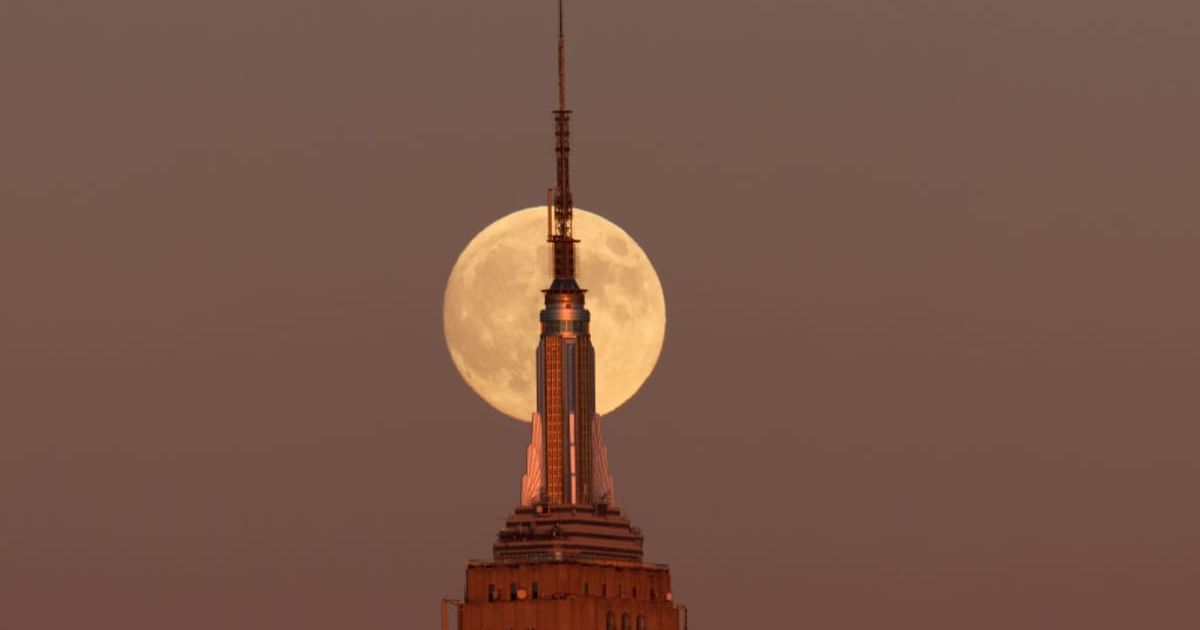
Stargazers are in for a treat as the first supermoon of 2025 is slated to illuminate the night sky this evening, October 6. The celestial spectacle is the result of the full moon's precise alignment with its closest orbital point to Earth, a phenomenon known as perigee, according to NASA.
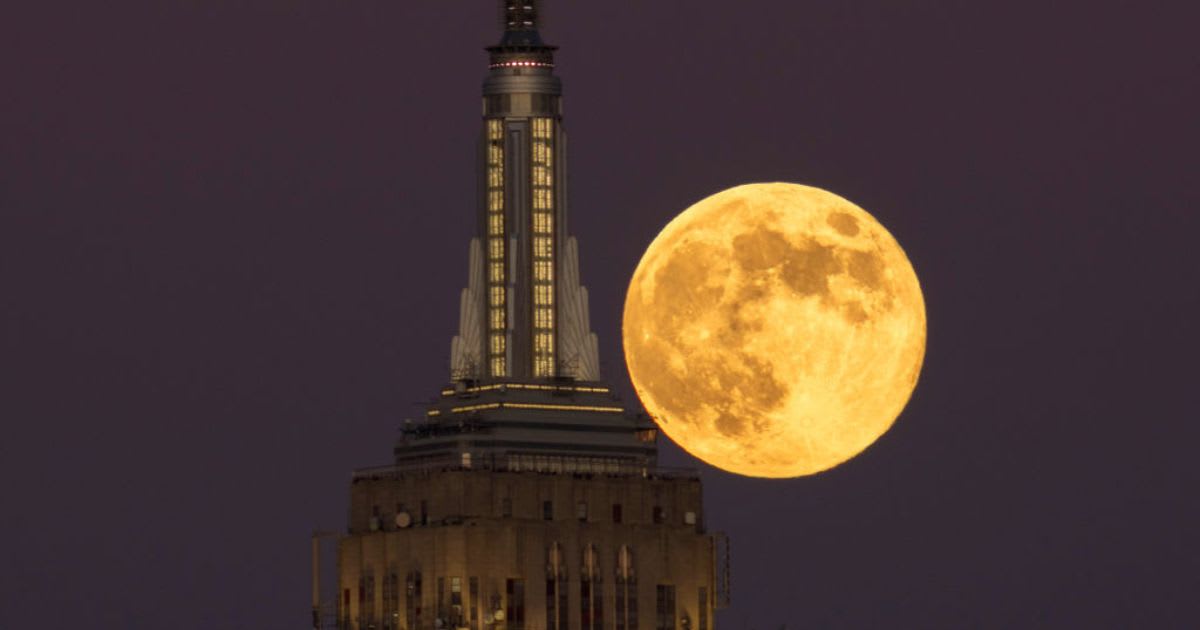
Tonight's lunar display promises to be exceptionally vivid, with the moon projected to appear up to 14% larger and 30% brighter than an average full moon. This dramatic increase in apparent size and luminosity stems directly from the moon's minimal distance from our planet, classifying the event as an exceptionally close full moon.

The peak moment for this month's Supermoon, also traditionally known as the Harvest Moon, is scheduled for 11:48 p.m. ET tonight, Monday, October 6, according to USA Today. While the moon will reach its absolute zenith at this time, it will maintain its visually full appearance throughout the entire night and remain a striking sight for a couple of subsequent days. For viewers across the majority of the U.S., favorable viewing conditions are anticipated. Current weather forecasts predict mostly clear skies between the prime viewing window of 8 p.m. ET Monday and 2 a.m. ET Tuesday, though isolated cloud cover may impact visibility in certain regions.
The October event is just the first in a trio of upcoming supermoons set to happen this year. Two more "perigee" full moons will follow in quick succession, with specific peak times listed below, according to Almanac.
| Full Moon name | Date | Peak Time (ET) |
| Harvest Moon | Monday, October 6 | 11:47 p.m. |
| Beaver Moon | Wednesday, November 5 | 8:19 a.m. |
| Cold Moon | Thursday, December 4 | 6:14 a.m. |

Of the three, the November Supermoon promises to be the most dramatic. With an expected distance of just 221,817 miles from Earth, the November event will be the closest full moon of the year. The December moon follows closely behind at 221,965 miles, with tonight's October moon registering at a still-impressive 224,600 miles.
The spectacular appearance of a Supermoon is rooted in the subtle mechanics of the Moon's orbit, which is not a perfect circle, but rather an ellipse, as per NASA. This elliptical path means the Moon's distance from Earth is constantly shifting. At times, it swings slightly closer than average, appearing marginally larger, and at other times, it moves farther away, appearing smaller.

The term "Supermoon," while not an official astronomical designation, is commonly used when a full moon coincides with perigee, the point where the Moon is closest to Earth in its 27-day orbital cycle. During each orbit, the Moon reaches its closest point, perigee, at roughly 226,000 miles (363,300 km) away, and its farthest point, apogee, at approximately 251,000 miles (405,500 km). Because the Moon's orbital path is subject to gravitational influences from the Sun and Earth, the exact distances of perigee and apogee fluctuate, resulting in some supermoons being closer than others, such as the November event.
More on Starlust
2025 Harvest Moon will make a rare October appearance—when and where to watch the spectacle
October 2025 skywatching guide: Harvest Supermoon, Draconid meteor shower and more