ESA breaks 13-year-old record, launches 36 Amazon Leo satellites aboard Ariane 6
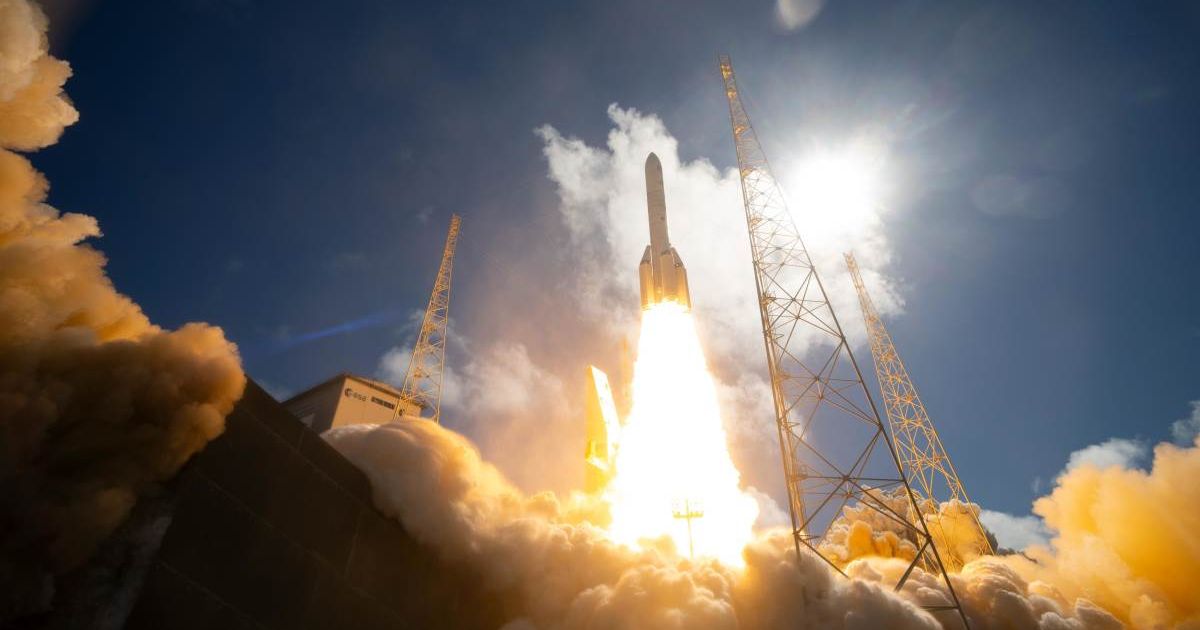
The European Space Agency (ESA) has broken its 13-year record for the heaviest payload it has delivered to space by deploying 36 Amazon Leo satellites to their intended orbits on top of an Ariane 6 rocket on June 17, 2026. The launch took place from ESA's Spaceport in French Guiana at 8:21 am EDT (9:21 am local time) and put the payloads into low-Earth orbits at an altitude of about 289 miles. The combined mass of these satellites exceeds the record held previously by an Ariane 5 rocket, which, in 2013, delivered ESA's automated transfer vehicle called Albert Einstein, weighing 20 tonnes, to the International Space Station.
LIFTOFF! 🚀 Ariane 6 #VA269, in its most powerful configuration yet, launching 36 @Amazonleo satellites.@Arianespace @EuropeSpacePort @CNES @ESA_transport pic.twitter.com/lTvMlgTp3T
— European Space Agency (@esa) June 17, 2026
The mission, dubbed VA269, also marked the debut of the upgraded solid-propellant booster called P160C, four of which featured on the rocket. Overall, this was the eighth successful flight of Ariane 6 and the third carrying four boosters. Standing at 14.5 meters, the P160C is a meter taller than its predecessor, the P120C, and carries 14 more tonnes of propellant.
This launch comes only months after the first-ever four-booster Ariane 6 launch took place in February, followed by another one in April. Since both of these missions featured the older P120C booster, they could only put 32 Amazon Leo satellites into orbit. "Ariane 6 has proven itself yet again, cementing its versatility as a launcher that can deliver all types of missions to all orbits, giving us more confidence and possibilities for Europe’s autonomous access to space," said ESA's Director General Josef Aschbacher in a statement. "Ariane 6 was designed from the outset to be a modular launcher—we have now seen it launch in three versions in just two years—and we are not finished, further evolutions are still to come."
📸 VA269 in pictures.
— Arianespace (@Arianespace) June 18, 2026
Ariane 6's most powerful mission to date. 👇#LaunchingAmbitions #Ariane6 #VA269@Amazonleo @ArianeGroup @esa @CNES @EuropeSpacePort pic.twitter.com/bjCax9CaNe
The 36 Amazon Leo satellites were put into orbit 1 hour and 51 minutes after lift-off. Similar to its Starlink counterpart, the Amazon Leo constellation is designed to fulfill customers' "internet needs with a fast, reliable connection." However, concerns have been raised about the massive rise in the number of such satellites in recent years, with researchers warning that the constellations may soon start interfering with astronomical observations.
ESA has always been at the forefront of space exploration, with contributions such as the Columbus module at the ISS, regular crewed missions to the orbital laboratory, and the European Service Module for NASA's Artemis program. ESA astronaut Luca Parmitano is also set to fly aboard the Artemis III mission, which will set the stage for returning humans to the surface of the Moon.
More on Starlust
Europe’s Ariane 6 rocket successfully launches two new navigation satellites into orbit
ESA to launch dedicated SpaceX Crew Dragon mission to ISS in early 2028