Clumps of apparently 'collisionless' dark matter may explain certain cosmic puzzles
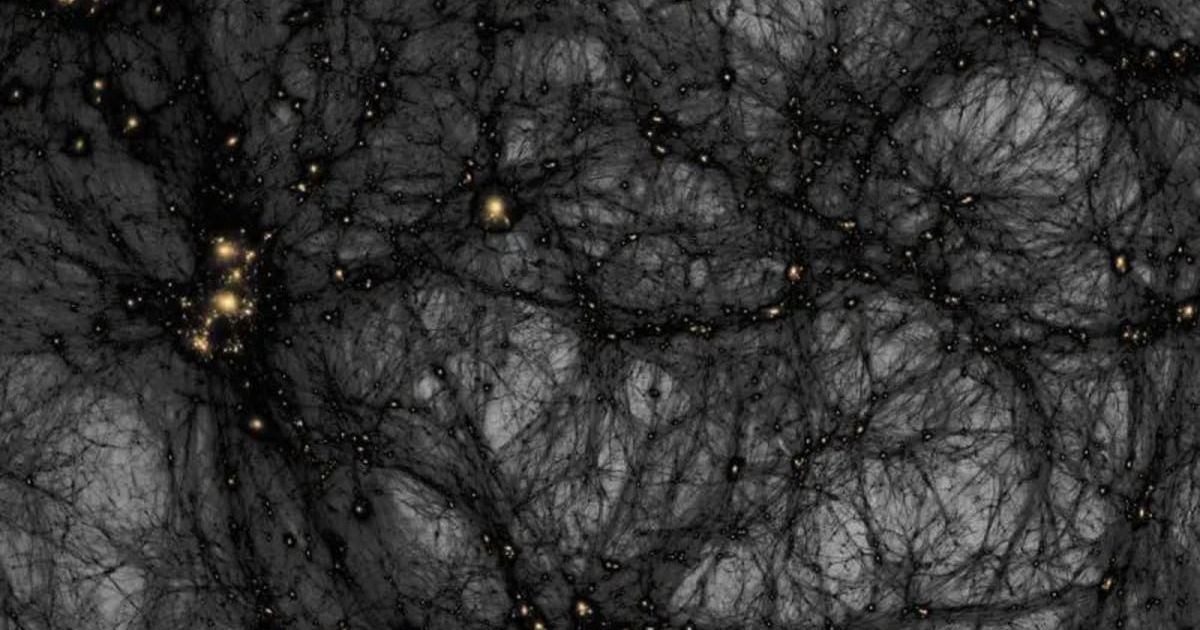
Dark matter has been thought to be cold and collisionless, meaning its particles don't interact with each other. The new study, however, challenges this assumption.
A simulation of the formation of dark matter structures from the early universe until today (Representative Cover Image Source: Ralf Kaehler/SLAC National Accelerator Laboratory, American Museum of Natural History)

Dark matter makes up 85% of the universe’s matter. But dark matter particles are cold and collisionless, meaning they don't interact with each other. Now, a new study, published in Physical Review Letters, proposes that the universe is possibly filled with dense clumps of self-interacting dark matter. Such clumps of dark matter—each about a million times the mass of the Sun—can explain unusual gravitational effects encountered in gravitational lenses, stellar streams, and satellite galaxies. The standard model describes that the inert nature of dark matter particles allows them to pass through each other unscathed. This model, however, finds it hard to explain certain high-density structures in the universe based on that assumption. In the new study, physicist Hai-Bo Yu at the University of California (UC) Riverside propounds a new type of dark matter that could address three astrophysical puzzles across different environments. 
Conceptual illustration of dark matter (Representative Cover Image Source: Getty | MARK GARLICK/SCIENCE PHOTO LIBRARY)
Conceptual illustration of dark matter (Representative Image Source: Getty | MARK GARLICK/SCIENCE PHOTO LIBRARY)

Yu’s work focuses on self-interacting dark matter (SIDM). Such dark matter particles collide with each other and exchange energy, leading to “gravothermal collapse,” which forms extremely dense, compact cores. “The difference is like a crowd of people who ignore each other versus one where everyone is constantly bumping into one another,” said Yu, a professor of physics and astronomy and deputy director of the Center for Experimental Cosmology and Instrumentation, to explain dark matter particles in the standard model and SIDM in a statement. “In SIDM, these interactions can dramatically reshape the internal structure of dark matter halos. Dark matter that interacts with itself can become dense enough to explain these observations.”  
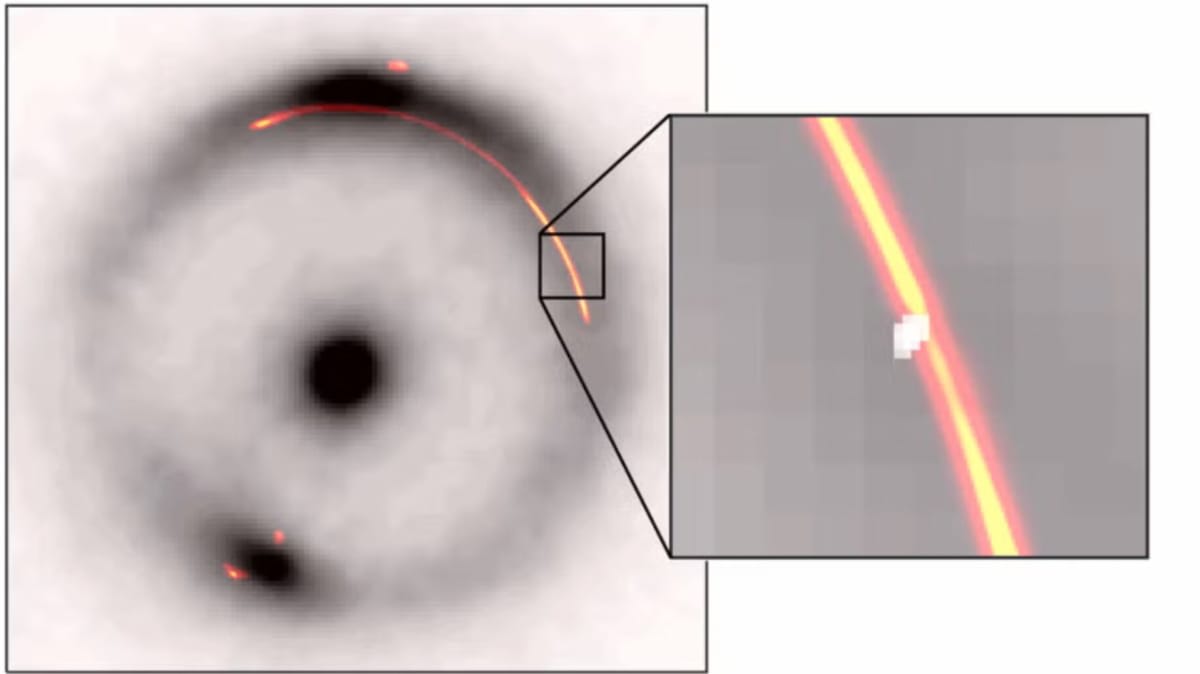
The gravitational lens system JVAS B1938+666. The black ring and central dot show an infrared image of a distant galaxy distorted by gravitational lensing. (Image Source:  Devon Powell, Max Planck Institute for Astrophysics, based on data from Keck/EVN/GBT/VLBA.)
The gravitational lens system JVAS B1938+666. The black ring and central dot show an infrared image of a distant galaxy distorted by gravitational lensing. (Image Source: Devon Powell, Max Planck Institute for Astrophysics, based on data from Keck/EVN/GBT/VLBA.)

As for the three puzzles that Yu's SIDM model can explain, the first one is related to the activity of an ultra-dense object in the gravitational lens system JAVS B1938+666 that came to the fore through a powerful magnifying effect on distant galaxies. Then, sometimes, dark matter clumps can leave their imprint on a cluster of passing stars, acting like an invisible gravitational trap, sweeping them up and locking them into a tight, compact cluster. This was exactly what happened with the unusual star cluster Fornax 6 in Fornax, a satellite galaxy of the Milky Way. 
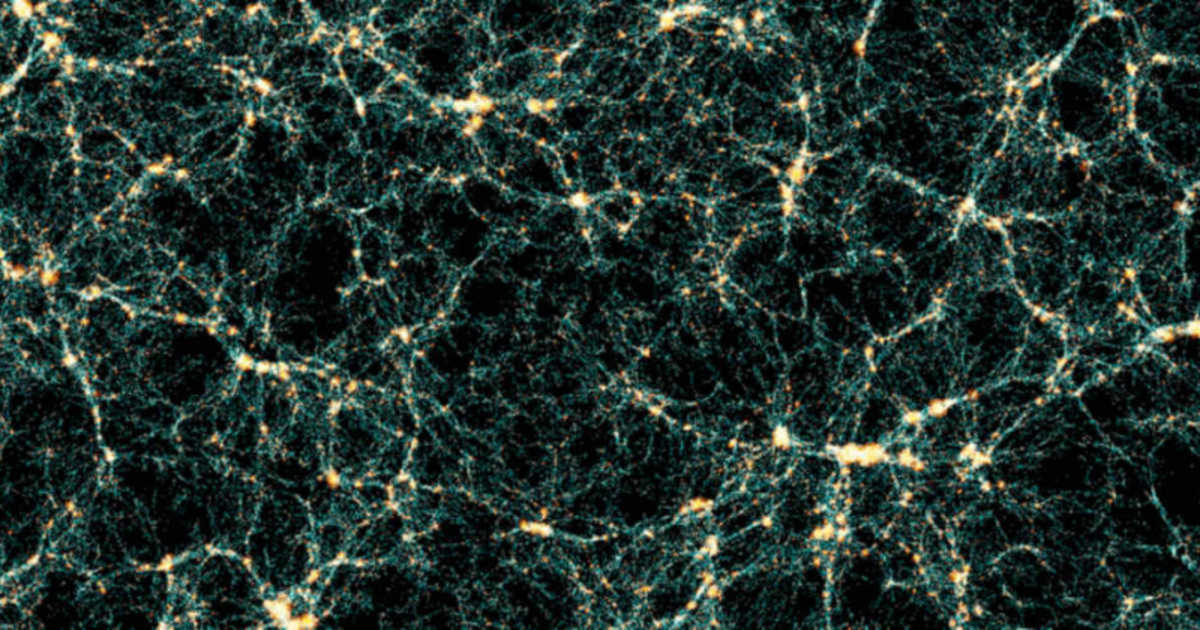
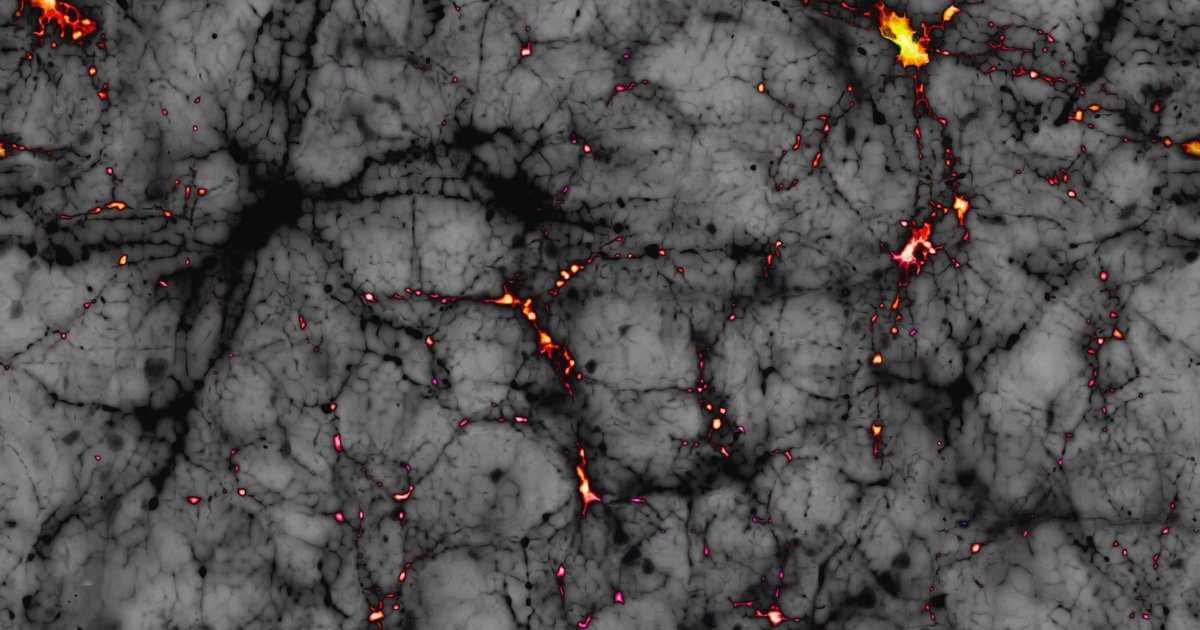
Image extracted from the Euclid Flagship simulations catalogue. Each dot represents a galaxy: blue points mark galaxies at the centers of dark matter clumps, while red points denote satellites within them (Image Source: Euclid Consortium | Jorge Carretero & Pau Tallada)
Each dot in this image from the Euclid Flagship simulations catalog represents a galaxy. Blue points are galaxies at the centers of dark matter clumps. Red points are satellites within them. (Image Source: Euclid Consortium|Jorge Carretero & Pau Tallada)

Yu also analyzed a striking spur-and-gap feature in the GD-1 stellar stream. It looks like a visible scar, as if an unseen, compact object tore through the stream. “What’s striking is that the same mechanism works in three completely different settings — across the distant universe, within our galaxy, and in a neighboring satellite galaxy,” Yu said. “All show densities that are difficult to reconcile with standard model dark matter but arise naturally in SIDM.”

More on Starlust 

Dark matter may not be just one state—new study proposes two versions

Astronomers identify another galaxy missing dark matter, supporting collision theory
MORE STORIES

Magnetic fields protect a planet's atmosphere from stellar winds and are crucial for life.
19 hours ago
The ice giant, now missing, may have disrupted some of the moons of Uranus and Jupiter.
1 day ago
The study of these fast-moving particles provides significant clues about the early universe.
4 days ago
By looking at the Sun's interior, the scientists found that our star's behavior is changing.
6 days ago
A team of scientists looked into impact glass returned by China's Chang'e-5 to understand lunar surface processes at the micro- and nanoscale.
6 days ago
Astronauts could face psychological issues during a long Moon stay. Here's what simulations show.
7 days ago
A new study suggests that water ice on Mercury may have been deposited in one Mercurian day by an impactor larger and slower than previously thought.
May 27, 2026
The technology used by NASA's PUEO could also be used to detect traces of cosmic rays on the Moon.
May 27, 2026
The conditions at Salar de Pajonales, the high-altitude salt flat in northern Chile, are harsh and mimic those that early life on Mars might have experienced.
May 26, 2026
The findings could help scientists better understand dangerous solar events from the past.
May 26, 2026