Astronomers identify another galaxy missing dark matter, supporting collision theory
Dark matter, the invisible matter that holds the galaxies together, is entirely missing in a galaxy, a new study has shown. The study, led by Michael Keim and Pieter van Dokkum at Yale University, has discovered the galaxy called NGC 1052-DF9. They describe their findings in a paper available on the arXiv preprint server. The discovery supports a radical theory of galaxy formation, christened as the “Bullet Dwarf” collision, in which two dwarf galaxies crash into each other, forming new galaxies that are devoid of dark matter.
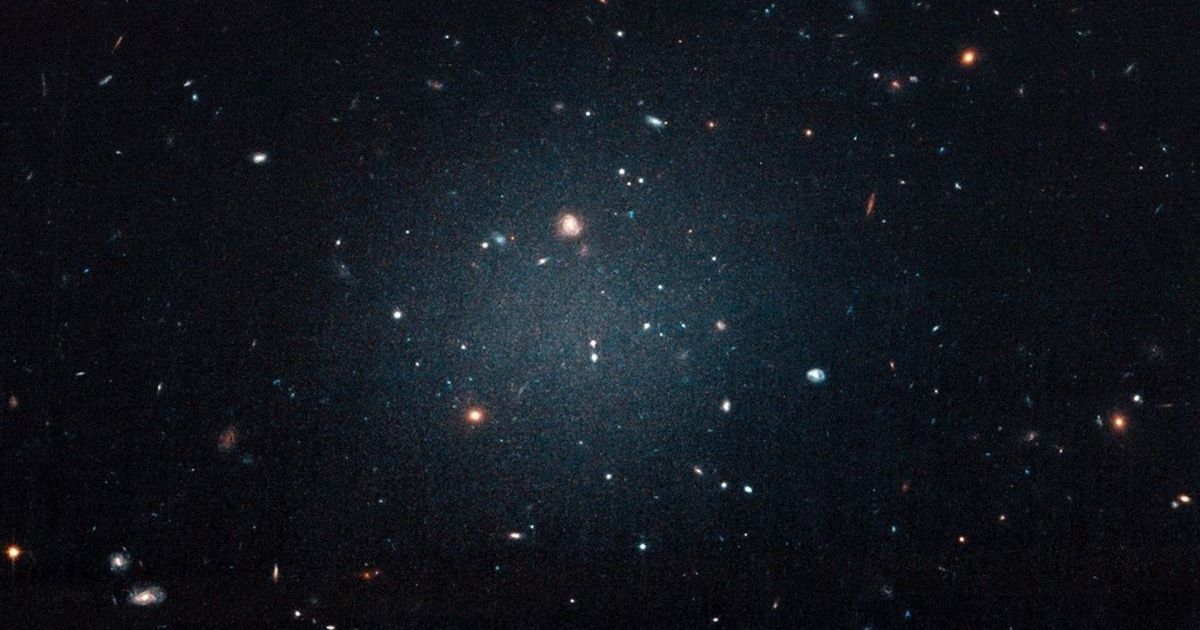
Back in 2018, Pieter van Dokkum and his peers published a paper that depicted an ultra-diffuse galaxy known as NGC 1052-DF2 (DF2). Despite having the size of the Milky Way, it has 500 times fewer stars. It means they are so dispersed that one could literally see other old galaxies through the gaps between the stars. This provided the first hint that galaxies could exist without the gravitational pull of dark matter. It is a physical substance that could be distinguished from normal matter. “This was a severe blow to Modified Newtonian Dynamics (MOND), which was designed to account for why stars at the outer edges of galaxies were moving too fast,” according to a statement. MOND posits that gravity acts a little bit stronger than expected at the edge of a galaxy where stars display extremely low accelerations.
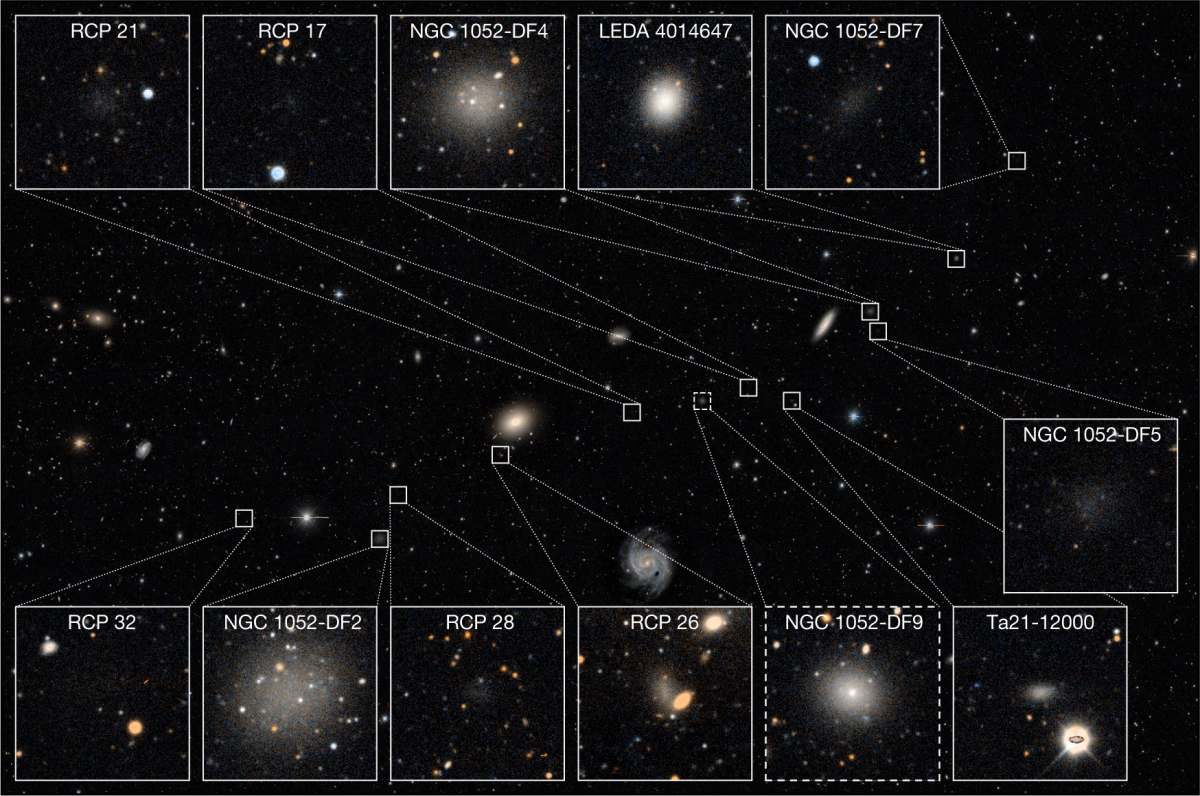
A diffuse galaxy like DF2 would kick in the increased gravity that it predicts for low internal acceleration environments, according to MOND. “So, if MOND were true, DF2's stars would be moving much faster than their visible mass accounted for.” But the researchers uncovered something else. They found that the stars are moving very slowly. This can only be explained by classical, unmodified Newtonian dynamics. So, for MOND, DF2 posed a paradox. If MOND is a fundamental law of physics, it can be applied to all matter. A galaxy simply doesn't opt out of the laws of gravity. “But the 'normal' gravity seen in DF2 proved that the 'extra gravity' seen in other galaxies wasn't a universal rule.” Several papers were published, calling the distance calculations of DF2 into question. Then the Hubble came to the rescue, turning its gaze toward DF2 and confirming its distance. Dr. van Dokkum and his team detected another galaxy, known as DF4, which formed a linear tail with DF2. In fact, DF4 shares many of the properties with DF2.
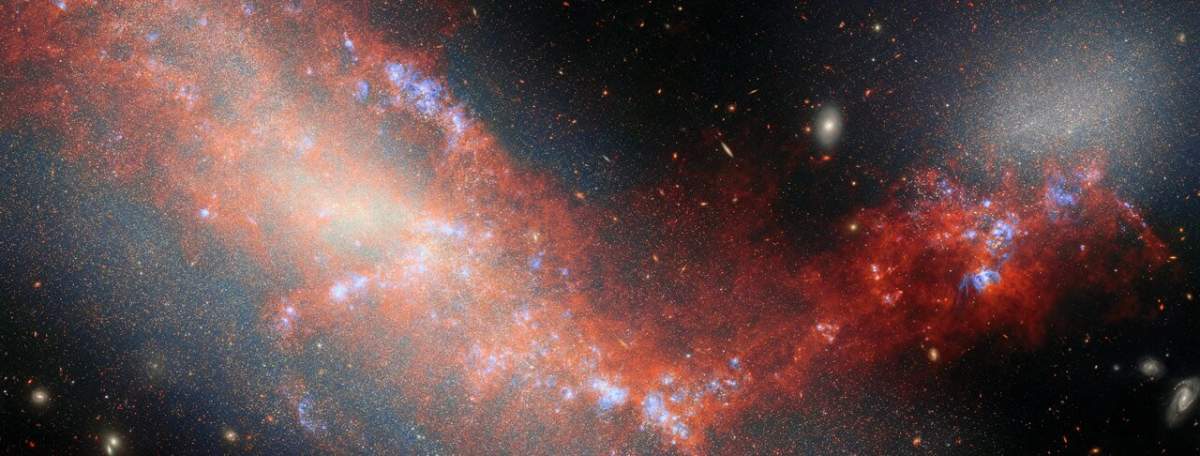
The new galaxy, called NGC 1052-DF9 or DF9, is right in line with the tail between DF2 and DF4. This corroborates a pattern. It points to a string of ultra-diffuse galaxies that lack dark matter. This also raises a question – why don’t they have dark matter? The most likely reason is the “Bullet Dwarf” Collision theory. According to this theory, this happens when two dwarf galaxies hurtle toward each other at blinding speeds. Dark matter only interacts via gravity. When two galaxies collide, the dark matter in them simply passes straight through one another like ghosts. But normal matter in the shape of giant gas clouds runs into each other in massive collisions, triggering a burst of star formation and stripping the galaxies of dark matter. “The trail between DF2, DF4, and DF9 strongly suggests that they were all formed in a single, catastrophic event. And that event is most likely a 'Bullet Dwarf' collision.” Next, the team hopes to find and measure the kinematics of more similar galaxies. “For now, DF9 stands as a testament both to the existence of dark matter and the extreme and violent ways the universe can build galaxies.”
More on Starlust
Scientists simulate how collision of two galaxies will proceed over 200 million years from now
Heavy elements like oxygen help decode a distant spiral galaxy's evolution