Astrophotographer captures stunning image of Horsehead Nebula after over 115 hours of observation
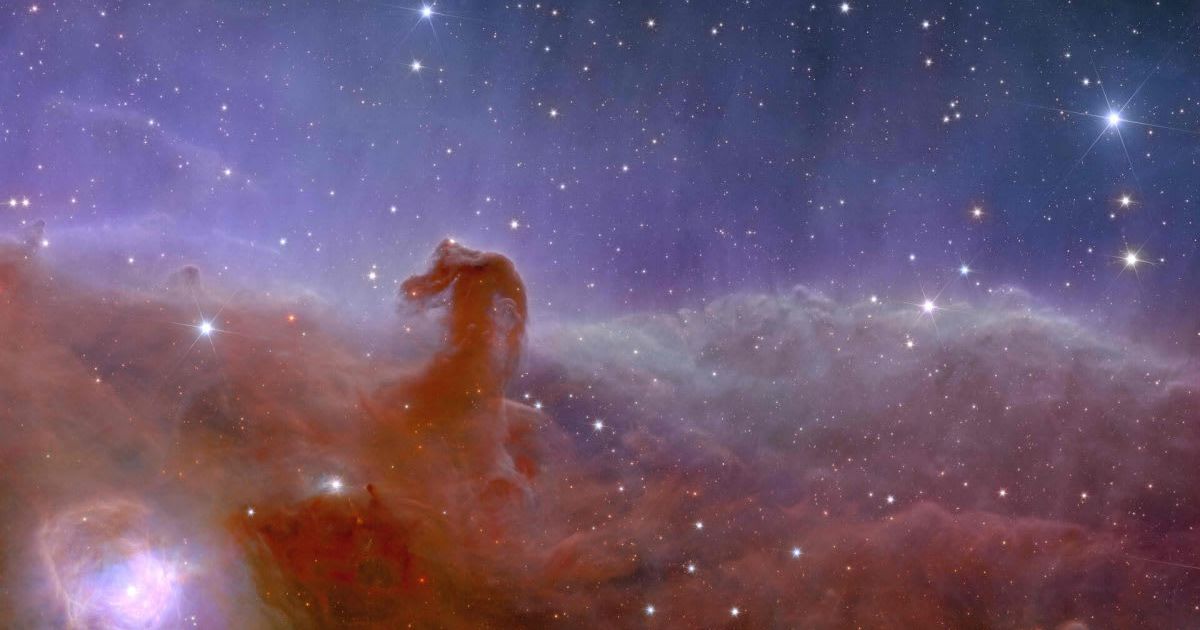
Astrophotographer Greg Meyer managed to capture striking details of the Horsehead Nebula, located 1,600 light-years away, by collecting over 115 hours of image data using a Radian Raptor 61 mm telescope paired with an astronomy camera.
Meyer observed the region between November 2025 and March 2026, whenever the weather cooperated and Orion, the constellation that houses the nebula, was visible. He then stacked all the image data to create the final result, processing the stacked images using astrophotography software PixInsight, Photoshop, and Lightroom to adjust colors and refine details. "I really started going down a rabbit hole," Meyer told Space.com. "I like this color combo with some complementary colors, something different." The final image shows the Flame Nebula (NGC 2024) to the left of the Horsehead, illuminated by Alnitak, the easternmost star in Orion's Belt. Both objects are part of the Orion Molecular Cloud Complex, which lies in the "sword" of the Orion constellation. Alnilam, which is the middle star in the hunter's belt, meanwhile, is seen glowing blue-white in the upper left.
![This image of the Horsehead Nebula from James Webb focuses on a portion of the horse’s “mane.” [Image Source: NASA, ESA, CSA, K. Misselt (University of Arizona) and A. Abergel (IAS/University Paris-Saclay, CNRS)] (Image Edited on Canva)](https://de40cj7fpezr7.cloudfront.net/87647778-1216-4473-829b-7c3c26ff80c6.png)
The Horsehead Nebula gets its name from its distinctive silhouette—a dark cloud of dust shaped like a horse’s head. The light that is visible through the dust cloud comes from glowing hydrogen gas that receives its energy from the ultraviolet radiation of nearby stars. The unusual shape of the nebula was discovered on a photographic plate in the late 1800s, according to NASA, and since then astronomers have targeted it to test out their observation skills.
![Infrared image of the Horsehead nebula captured by the Hubble Space Telescope in 2013. [Image Source: NASA, ESA, and the Hubble Heritage Team (AURA/STScI)] (Image Edited on Canva)](https://de40cj7fpezr7.cloudfront.net/a7b59e22-6050-4d54-93f5-8ca3e8a1ca84.png)
The nebula has also been imaged and examined by some of the world's most powerful observatories, including the James Webb Space Telescope and the Hubble Space Telescope. One of the most memorable images of the nebula, in fact, was taken by Hubble in infrared light back in 2013, when the observatory marked its 23rd operational year in orbit. Having longer wavelengths than its visible counterpart, the infrared light was able to pierce through the dusty material that often hides the inner regions to reveal a beautiful, yet fragile-looking structure made of delicate folds of gas. Last month, Hubble marked its 36th anniversary by releasing a fresh look at another famous nebula: the Trifid Nebula (M20). The space-based telescope had photographed it before in 1997, but the April 2026 image revealed the changes the nebula has gone through in the last 29 years.
More on Starlust
NASA's Nancy Grace Roman Space Telescope to launch in September; will work 1,000x faster than Hubble
Hubble Telescope spots mysterious collisions in nearby star system echoing our solar system's birth