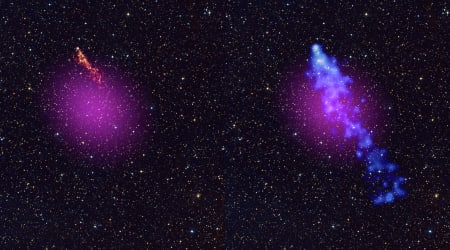
Astronomers surprised after spotting 'Eye of Sauron' in deep space: 'Never seen anything like it'
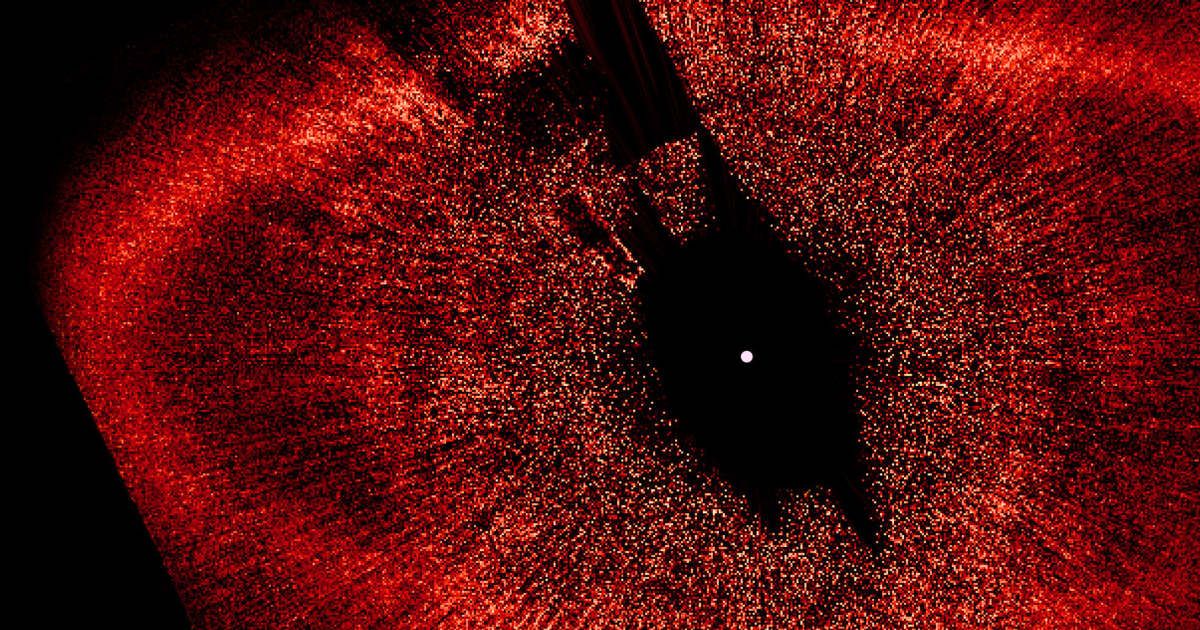
Astronomers have captured a remarkable image of a blazar's jet aimed directly at Earth, a discovery that has solved the long-standing mystery of a distant celestial object's intense high-energy emissions. The international team's findings, published in Astronomy & Astrophysics Letters, reveal a structure resembling the mythical "Eye of Sauron," which has provided a critical breakthrough in understanding how blazars produce powerful gamma rays and neutrinos, as per the researchers at the Max Planck Institute for Radio Astronomy.
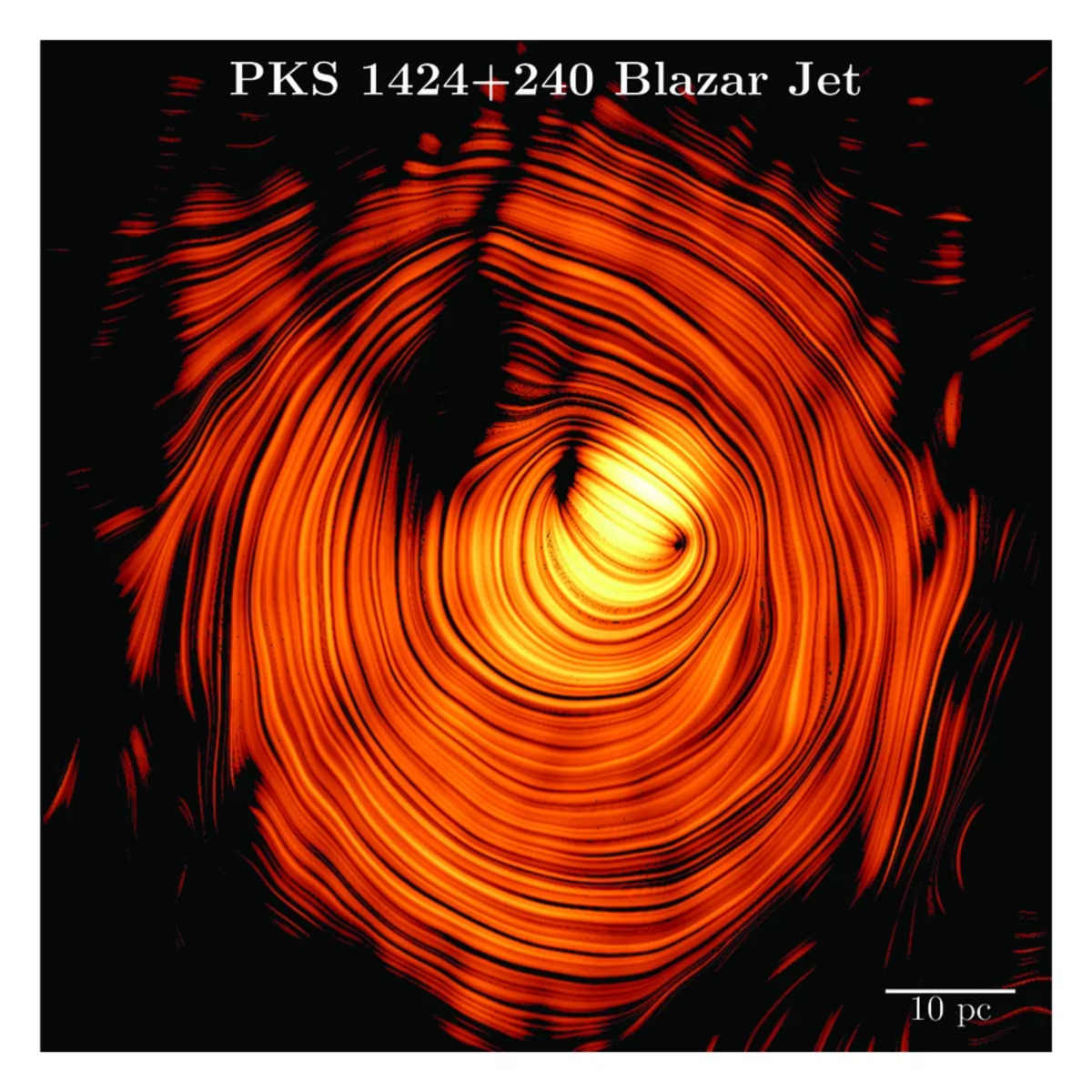
A blazar is a type of active galactic nucleus (AGN), powered by a supermassive black hole. It launches a jet of plasma moving at nearly the speed of light. What makes a blazar unique is its orientation: one of the jets is pointed almost directly toward Earth. This cosmic alignment makes blazars appear exceptionally bright across the electromagnetic spectrum, giving scientists a rare opportunity to study extreme physical processes, such as particle acceleration, in a natural laboratory. "When we reconstructed the image, it looked absolutely stunning,” said Yuri Kovalev, lead author of the study and Principal Investigator of the ERC-funded MuSES project at the Max Planck Institute for Radio Astronomy (MPIfR). He added, “We have never seen anything quite like it — a near-perfect toroidal magnetic field with a jet, pointing straight at us.”
The blazar, known as PKS 1424+240, had baffled scientists for years. Located billions of light-years away, it was one of the brightest known sources of high-energy gamma rays and neutrinos. However, its radio jet appeared to move at an unusually slow pace, seemingly contradicting the expectation that such extreme emissions are powered only by the fastest cosmic jets.
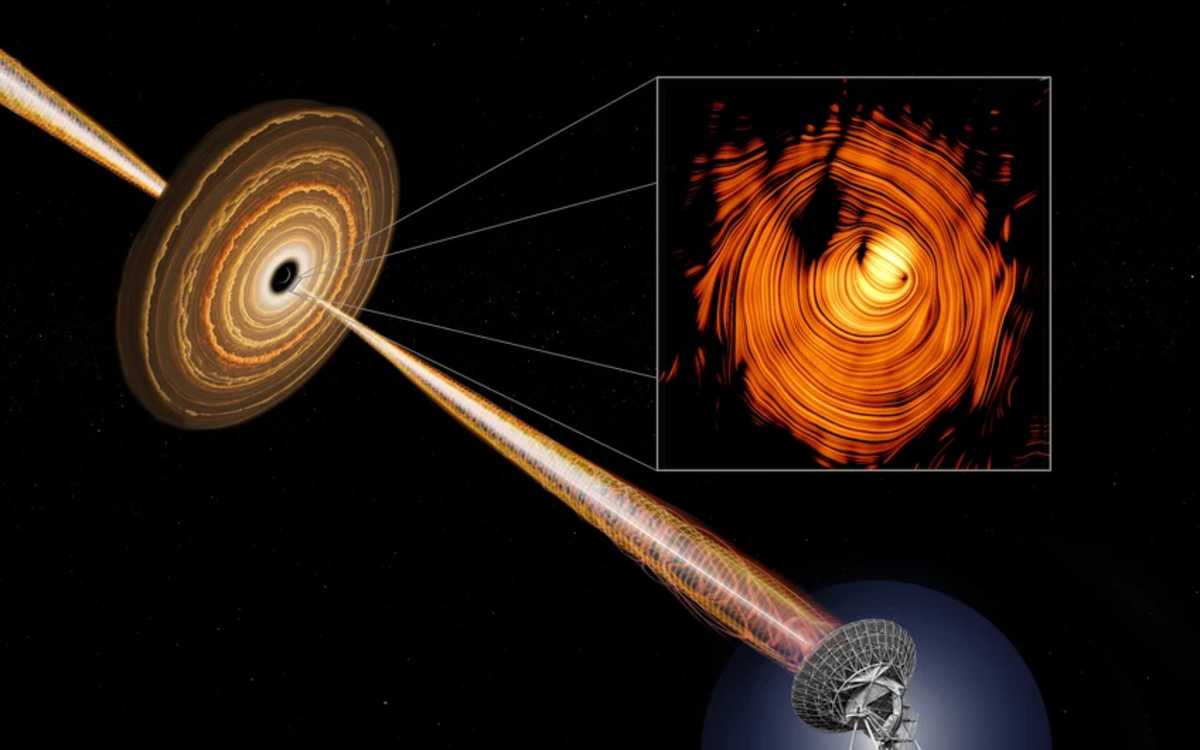
Utilizing 15 years of data from the Very Long Baseline Array (VLBA), researchers were able to create an exceptionally detailed image of the jet. The reconstructed image showed a unique, ring-like magnetic field structure with the jet pointed almost perfectly in Earth's direction. The direct alignment, according to the researchers, explains the blazar's perplexing behaviour. “This alignment causes a boost in brightness by a factor of 30 or more,” co-author Jack Livingston at MPIfR explained. “At the same time, the jet appears to move slowly due to projection effects — a classic optical illusion.”

This rare line of sight allowed scientists to peer directly into the heart of the blazar's jet, revealing a toroidal or helical magnetic field. This structure is believed to be essential for launching and accelerating particles to extreme energies, including the protons that generate the observed high-energy neutrinos. The discovery confirms that the supermassive black hole at the core of these active galaxies is not only capable of accelerating electrons but also protons.
The finding is considered a major success for the MOJAVE program, which uses Very Long Baseline Interferometry (VLBI) to monitor jets in active galaxies with striking resolution. This technique, which links radio telescopes across the globe, allows astronomers to create a virtual telescope the size of Earth. The study marks a significant advance in multimessenger astronomy, solidifying the connection between relativistic jets, high-energy neutrinos, and the crucial role of magnetic fields in these cosmic accelerators.
Another famous example of a blazar is OJ 287, a highly active galactic core located about four billion light-years away. It is so bright that it can even be observed with large amateur telescopes, with a history of observations dating back to the late 1800s. These historical records reveal a peculiar pattern: the galaxy appears to brighten every 12 years. In 2014, a new theory was proposed to explain this recurring phenomenon. According to this model, the periodic brightening is caused by a second, less massive black hole orbiting the primary one. The second black hole’s elongated orbit brings it close enough to the main black hole to cause a surge in brightness only once every 12 years.