NASA's Mars Perseverance rover finds buried river delta in Jezero, improves chances of finding life

The river delta could be between 3.7 billion and 4.2 billion years old.
This image of Jezero Crater, the landing site for the Mars Perseverance Rover, was taken by instruments on NASA's Mars Reconnaissance Orbiter. (Cover Image Source: NASA/JPL-Caltech/MSSS/JHU-APL)

Currently, Mars is hostile to life. But billions of years ago, it was warmer and wetter and could have even supported living organisms. Now, a new discovery that reports the finding of an ancient river delta beneath the fabled Jezero Crater supports this conjecture. Using its ground-penetrating radar, NASA’s Perseverance rover detected the river delta 35 meters below the crater, according to a study published in Science Advances. Perseverance has been exploring the crater and gathering rock samples since it touched down on the Martian surface in February 2021.
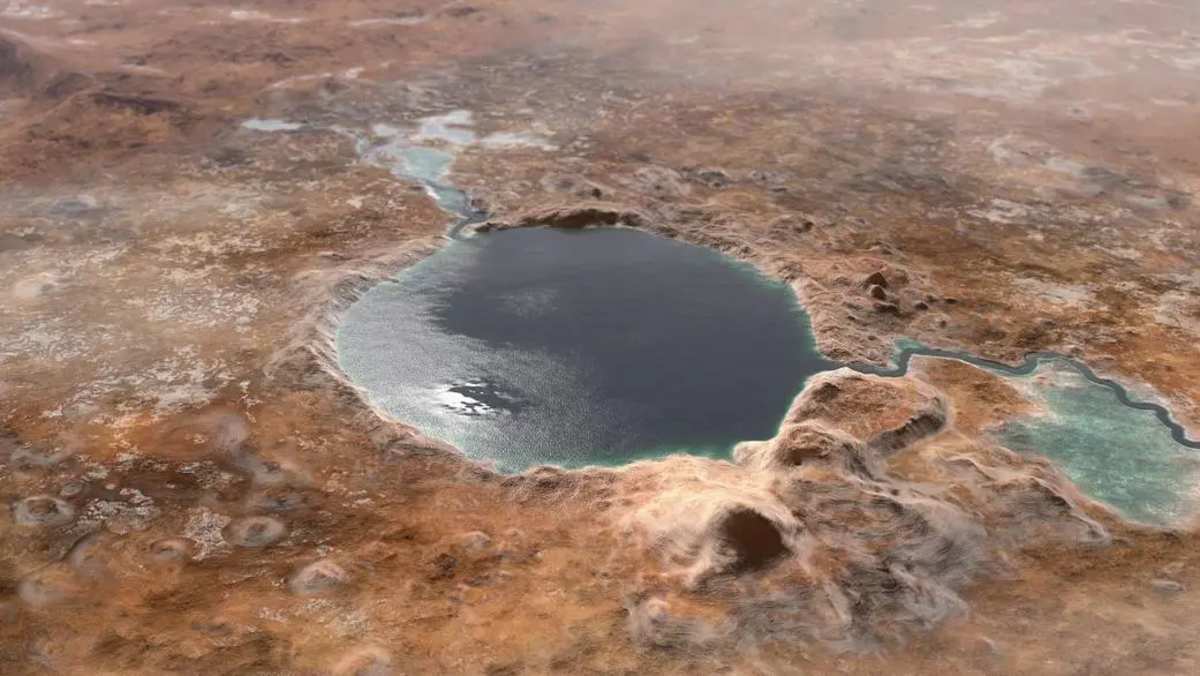
This illustration shows Jezero Crater — the landing site of the Mars 2020 Perseverance rover (Image Source: NASA/JPL-Caltech)
This illustration shows Jezero Crater—the landing site of the Mars 2020 Perseverance rover. (Representative Image Source: NASA/JPL-Caltech). 

An asteroid that slammed into Mars around 4 billion years ago created the Jezero Crater. Located north of the Martian equator, it is 45 kilometers (28 miles) in diameter. The geological features in this crater suggest that water once flowed here and probably harbored life. This is especially true for a region in the crater called Margin Unit. This area is replete with carbonates, which form on Earth in stable watery environments such as shallow seas and lakebeds. The new study in question is based on 78 traverses of the area between September 2023 and February 2024. While making the trips, the rover scanned the crater floor with an instrument called RIMFAX (Radar Imager for Mars' Subsurface Experiment).

In a clean room at NASA's Jet Propulsion Laboratory in Pasadena, USA, engineers observed the first driving test for NASA's Mars 2020 rover on 17 December 2019 (Image Source: ESA)

It probed nearly twice as deep as any other radar study had done previously. Combining this radar data with satellite images and the rover GPS, a team led by Emily Cardarelli from the University of California, Los Angeles, has created a 3D map of the crater. The map reveals the pristine layers beneath the red surface. The radar zeroed in on numerous specific structures called clinoforms, sloping layers of sediment characteristic of deltas. These structures form when a flowing river meets a standing body of water, such as a lake. The river deposits sand and mud there. Analyzing such geological features, the researchers think that this delta formed between 3.7 billion and 4.2 billion years ago. This period predates the fan-shaped expanse of sediment visible on the crater floor, known as the Western Delta. 
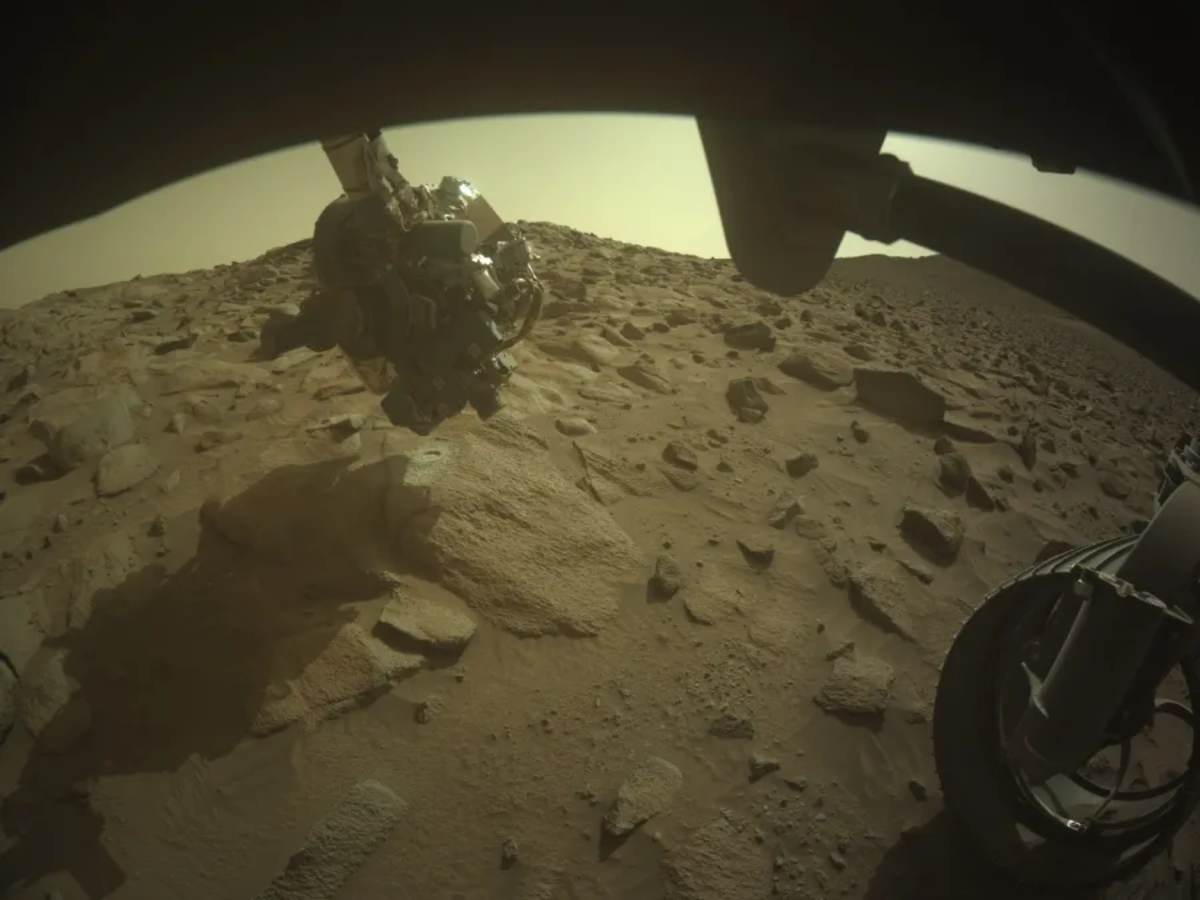
NASA's Mars rover Perseverance conducts proximity science on the Eremita Mesa abrasion patch in the Margin Unit on Sept. 6, 2024, as it continues its traverse up the rim of Jezero Crater. (Image Source: NASA/JPL-Caltech)

The new discovery gives a snapshot of how Mars’s landscape was in the distant past. The fact that the radar device stumbled upon another subsurface deltaic environment under the present one pushes the presence of water further back in time, thereby also extending the time of habitability in the Jezero Crater. "This work also improves the chances of finding evidence for past life, as the formation of the present-day Delta Fan may have been rapid," the researchers wrote in their paper.

More on Starlust

Perseverance rover finds light-colored rocks in Jezero crater, offering new clues about Mars' wet past

NASA scientist says terraforming Mars, at least in the near future, is a pipe dream
MORE STORIES

Back in 2006, the International Astronomical Union (IAU) shocked the world by denying Pluto its planetary status.
3 hours ago
It will detect violent phenomena in our galaxy by directly capturing cosmic rays and gamma rays.
12 hours ago
The orbital period of an asteroid provides clues to the shortest path to the Red Planet.
1 day ago
NASA has invited people from all over the world to help support their Artemis program and future human space exploration through several citizen science projects.
1 day ago
'Binary stars were once seen as hostile environments for planet formation. What we're finding is that they can actually be extremely productive.'
1 day ago
The metal deposits date back to a time when Mars' climate was changing from wet to dry
5 days ago
Scientists have found that liquid-water habitable zones can overlap with ultraviolet habitable zones around low-mass stars.
5 days ago
Although Uranus possesses rings, they are not as structured and bright as the rings of Saturn. They are rather dark, narrow, and tough to study.
6 days ago
ISS Expedition 74 aims to boost space health and future medical breakthroughs on Earth.
6 days ago
Citizen scientists will look for warped spacetime using data from the European Space Agency's Euclid telescope.
7 days ago