NASA's IXPE provides new insight into a 2,000-year-old supernova
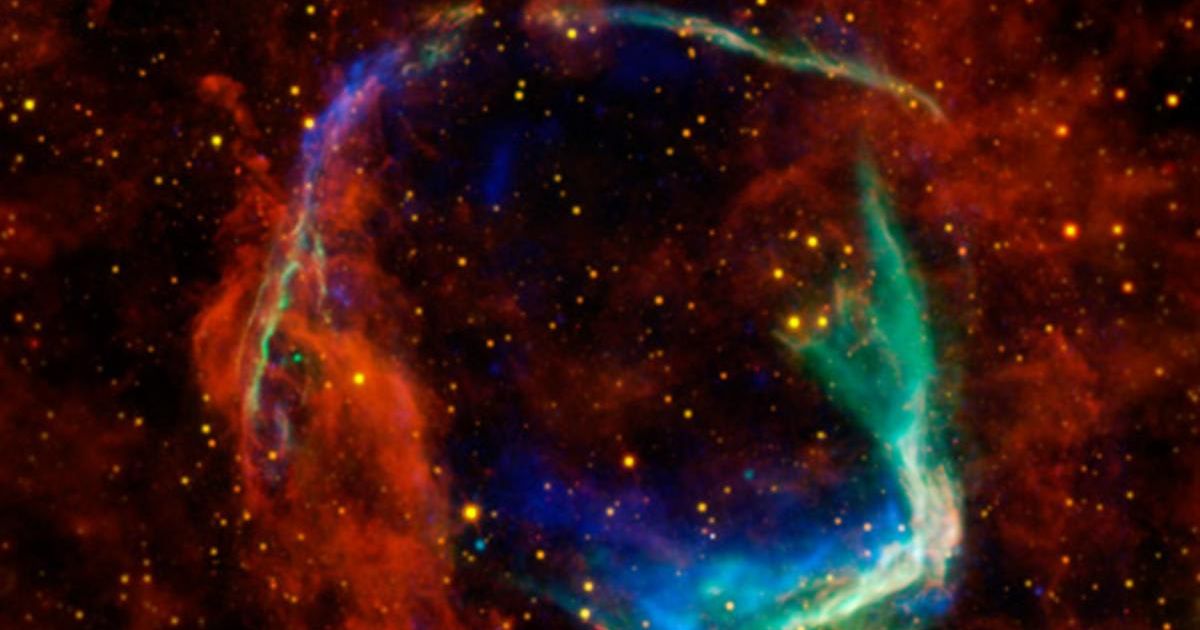
NASA has recently released the latest observations captured through its Imaging X-ray Polarimetry Explorer (IXPE) mission of the 2,000-year-old supernova, RCW 86. This supernova remnant has been a topic of fascination for astronomers for centuries, as it is believed to have formed from one of the earliest stellar explosions recorded by humans, thus serving as the ‘oldest documented’ case of a supernova. The recent findings from the IXPE mission provide us with a deeper understanding of the structure and expansion rate of this ancient cosmic entity. This helps researchers paint a fuller picture by building on the older observations chronicled by other telescopes.
This amorphous supernova remnant, RCW 86, is believed to have been first recorded in 185 AD by Chinese astronomers, as per the Chandra X-Ray Observatory. It appeared as a bright ‘guest star’ in the night sky, where it stayed stationary for around eight months. The astronomers were unaware that what they witnessed was a stellar blast that gave birth to this beautiful supernova. Researchers have determined RCW 86 as a Type la supernova, which is located at a distance of approximately 8,000 light-years away from Earth in the faint southern constellation of Circinus. In size, it is slightly larger than the full moon, while spanning a diameter of about 85 light-years.
Trailing the findings from NASA's Chandra X-ray Observatory, the latest observations from the IXPE provide us with some intriguing insights regarding the large “cavity” region that was discovered on this remnant before. Revealed through the X-ray and infrared imagery of Chandra, this low-density cavity region is considered to be a major factor in influencing the system’s fast expansion rate and unique structure. Scientists are of the belief that by blowing wind prior to the explosion, the white dwarf was able to clear out a vast region of very low density surrounding the system. So, when the explosion took place, it blasted within this huge ‘cavity’, making it expand much faster than it normally would have.
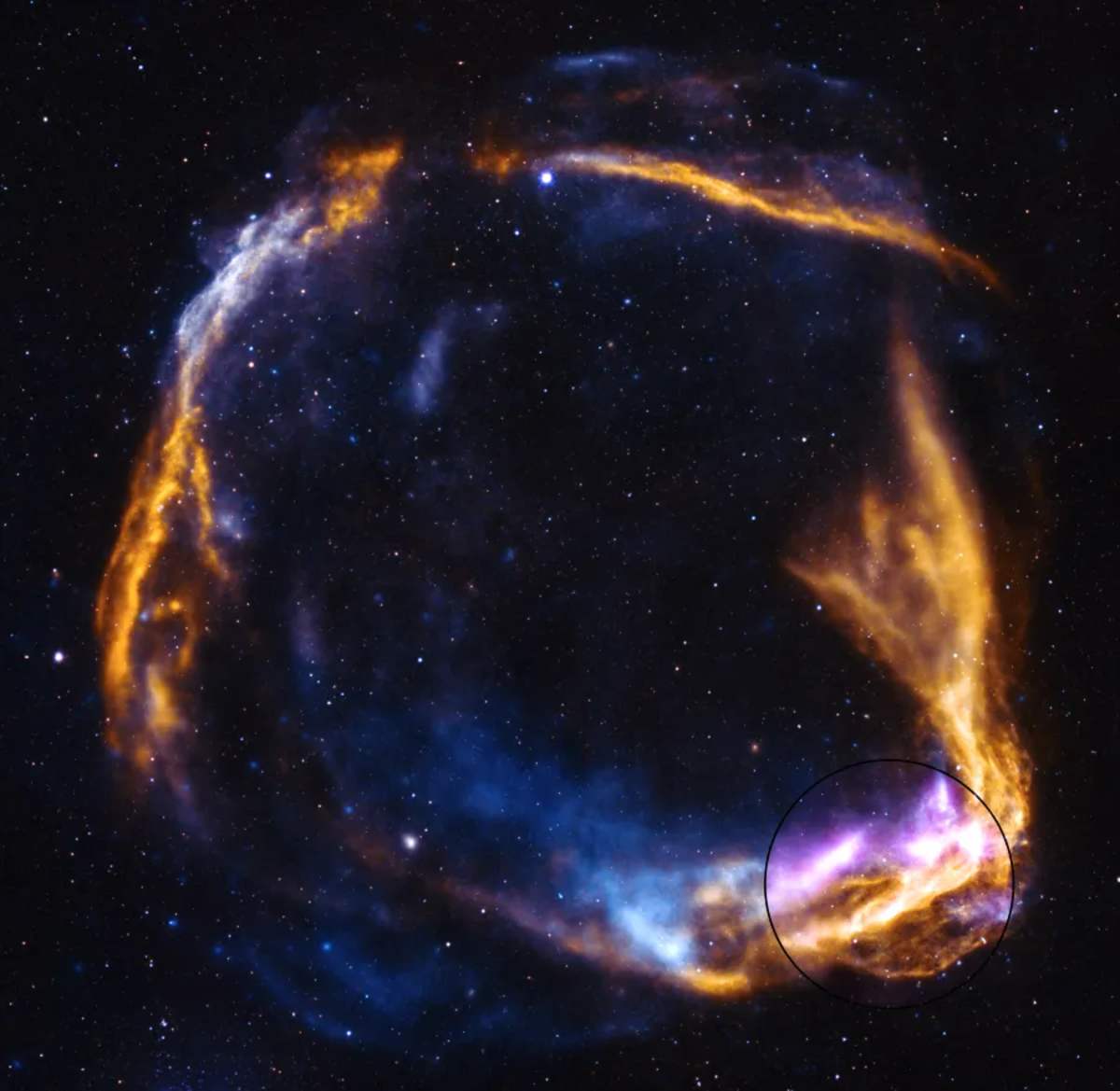
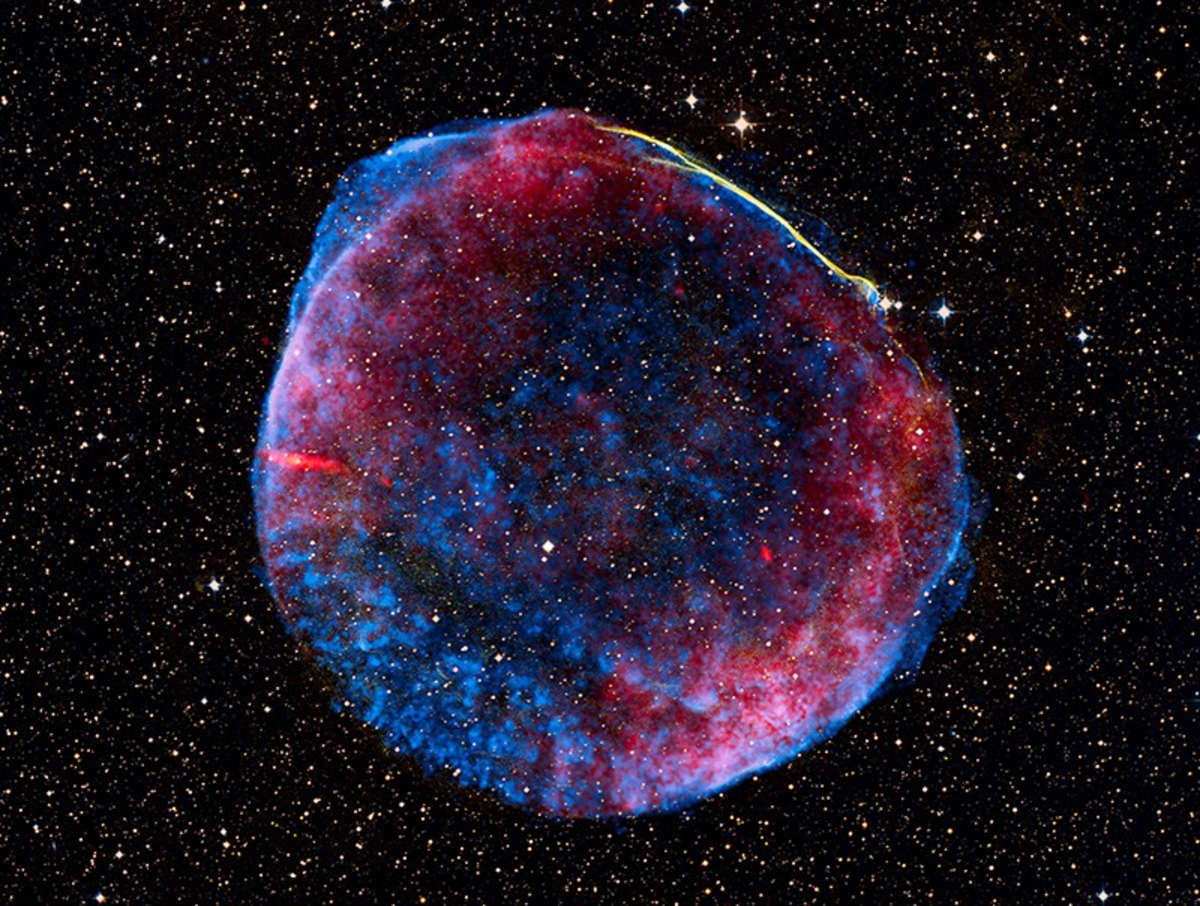
Now, IXPE specifically focused on the outer rim of this supernova, where it observed the expansion of RCW 86 having ceased at the edge of the cavity region. This phenomenon resulted in a reflected shock effect that we can see in the imagery captured by the telescope, highlighted in purple. The full image of this supernova remnant is a combination of IXPE’s data along with preceding observations from two other X-ray telescopes, namely, NASA’s Chandra and the ESA (European Space Agency) XMM-Newton telescope. Within this joint record, the yellow highlights represent low-energy X-rays; on the other hand, blue highlights indicate high-energy X-rays. The beautiful backdrop of the starfield in the image is a contribution of the National Science Foundation’s National Optical-Infrared Astronomy Research Laboratory (NOIRLab).
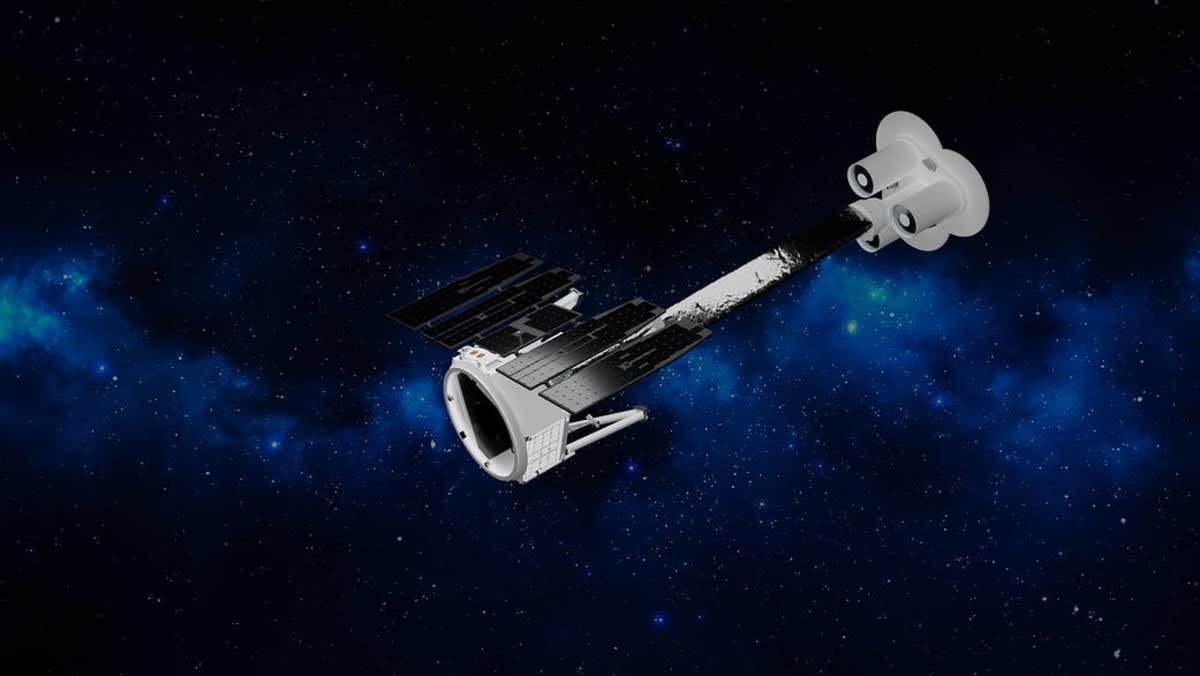
The IXPE mission is led by NASA’s Marshall Space Flight Center, which has been unravelling various mysteries regarding many celestial entities across the universe. Therefore, these new observations are just a signifier of IXPE’s strong capabilities, as it brings us closer to uncovering the past of RCW 86 by opening a window into its evolutionary history.
More on Starlust
Failing to go supernova, an Andromeda supergiant star quietly collapsed into a black hole
Astronomers spot supernovas whose split light could tell us how fast the universe is expanding