NASA’s Carruthers Observatory, designed to study Earth's geocorona, reaches targeted 'halo orbit'
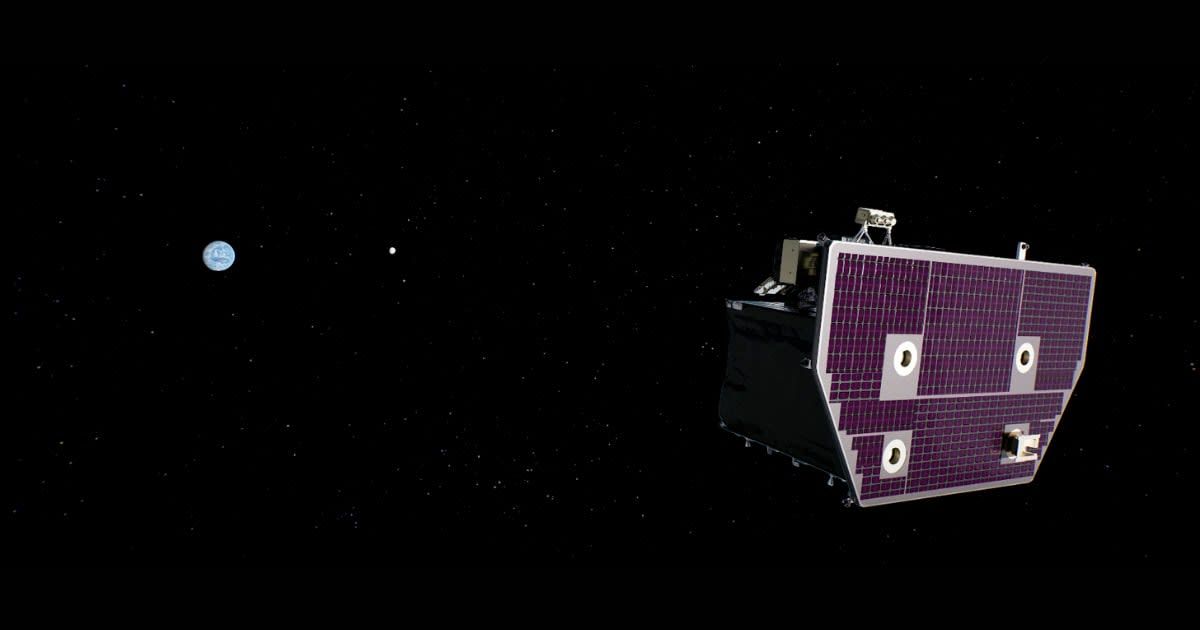
The Carruthers Observatory will capture the most detailed images of the geocorona.
An artist’s concept shows the Carruthers Geocorona Observatory at Earth–Sun Lagrange point 1 (L1). (Representative Cover Image Source: NASA's Conceptual Imaging Lab/Jonathan North)

NASA announced that its Carruthers Geocorona Observatory has reached its intended "halo orbit," putting the spacecraft in a position to record the first repeated observations of the geocorona. The accomplishment was verified after its third and last orbital movement, a two-minute thruster fire on January 8. The spacecraft is around the Sun-Earth L1 Lagrange point, which is about a million miles away from Earth and represents a position of gravitational equilibrium. 
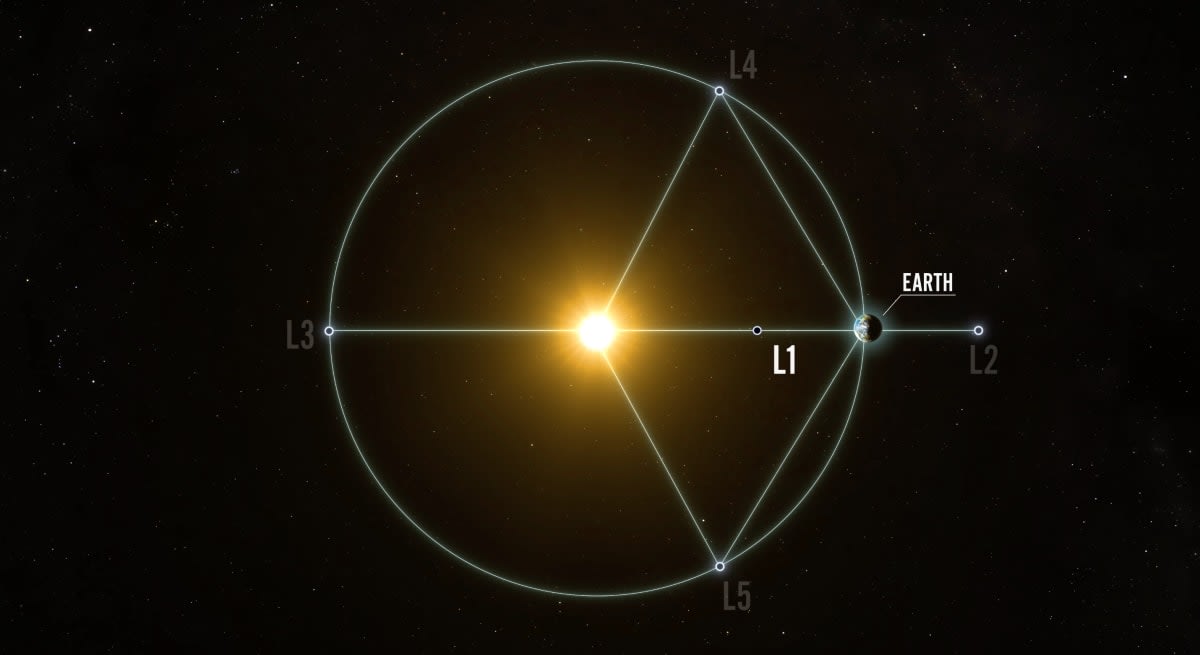
Artist’s concept of the five Sun-Earth Lagrange points in space. (Representative Image Source: NASA's Conceptual Image Lab/Krystofer Kim)

The spacecraft took off from Kennedy Space Center aboard a SpaceX Falcon 9 rocket on September 24, 2025. Ever since launch, the instruments onboard the loveseat-sized spacecraft have undergone repeated testing. The observatory, in fact, took its "first light" pictures on November 17, 2025, thereby confirming that both its Wide Field Imager and Narrow Field Imager were functioning as intended. Two of these images were taken using the Lyman-alpha wavelength, which is the light emitted by atomic hydrogen. It is the faint glow from this atomic hydrogen that is referred to as the geocorona, which is Latin for "Earth Crown. Carruthers will now attempt to complete its final checkout procedures before March, when it will begin its primary science mission, the importance of which cannot be overstated. Capturing the geocorona in detail will be a crucial step forward in forecasting near-Earth space conditions. This, in turn, will help in the protection of the Artemis astronauts, who will travel through the region to the Moon and back. 
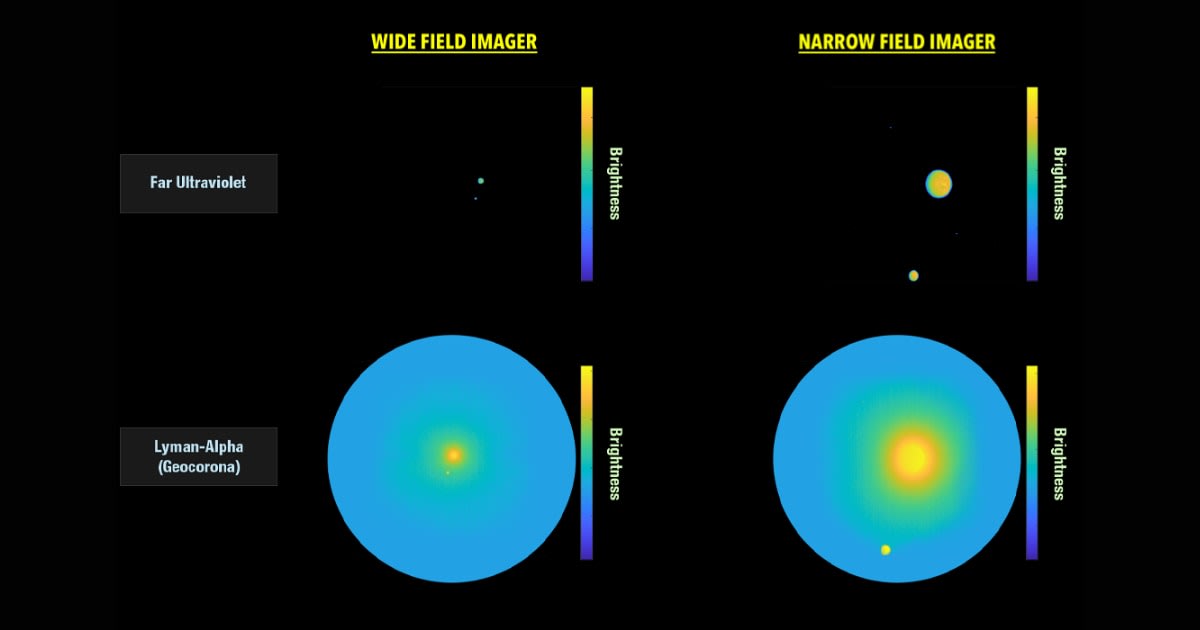
These four images constitute the “first light” for the Carruthers Geocorona Observatory mission. The images were taken on Nov. 17, 2025, from a location near the Sun-Earth Lagrange point 1 by the spacecraft’s Wide Field Imager (left column) and Narrow Field Imager (right column) in far ultraviolet light (top row) and the specific wavelength of light emitted by atomic hydrogen known as Lyman-alpha (bottom row). Earth is the larger, bright circle near the middle of each image; the Moon is the smaller circle below and to the left of it. The fuzzy “halo” around Earth in the images in the bottom row is the geocorona: the ultraviolet light emitted by Earth’s exosphere, or outermost atmospheric layer. The lunar surface still shines in Lyman-alpha because its rocky surface reflects all wavelengths of sunlight — one reason it is important to compare Lyman-alpha images with the broad ultraviolet filter. The far ultraviolet light imagery from the Narrow Field Imagery also captured two background stars, whose surface temperatures must be approximately twice as hot as the our Sun’s to be so bright in this wavelength of light.
NASA/Carruthers Geocorona Observatory
First light images from the Carruthers Geocorona Observatory show Earth and the Moon in ultraviolet and Lyman-alpha, revealing Earth’s glowing geocorona from near Sun–Earth L1. (Image Source: NASA/Carruthers Geocorona Observatory)

Moreover, Carruthers will also be responsible for monitoring the escape of hydrogen, one of the elements found in water, through Earth's exosphere in an attempt to understand why, unlike other planets, Earth is able to retain its water. “We’ve never had a mission before that was dedicated to making exospheric observations,” said Alex Glocer, the Carruthers mission scientist at NASA’s Goddard Space Flight Center in Greenbelt, Maryland. “It’s really exciting that we’re going to get these measurements for the first time.” Studying the geocorona of Earth, the only known planet to support life, can help us figure out what to look for as we keep scanning the universe for fellow living beings. The mission was named for Dr. George R. Carruthers, who invented the ultraviolet camera that the Apollo 16 crew used to take the first pictures of Earth's geocorona in 1972.
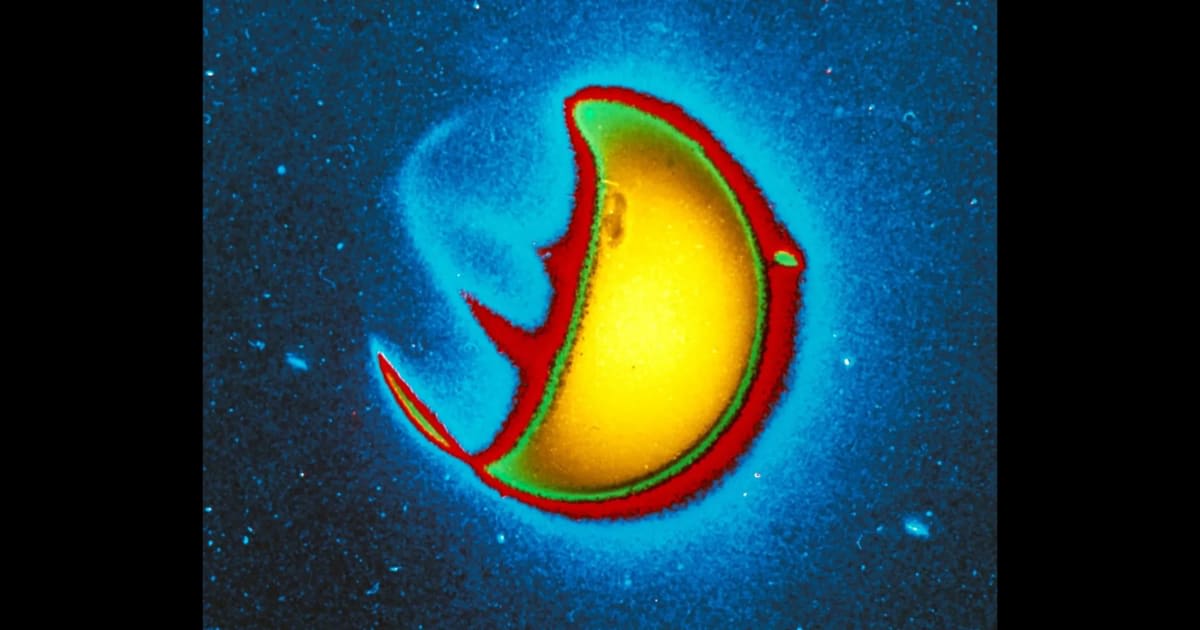
The first image of Earth's outer atmosphere, the geocorona, taken from a telescope designed and built by Dr. George R. Carruthers. The telescope took the image while on the Moon during the Apollo 16 mission in 1972.
G. Carruther (Image source : NASA)
The first image of Earth's outer atmosphere, the geocorona, taken from a telescope designed and built by Dr. George R. Carruthers. The telescope took the image while on the Moon during the Apollo 16 mission in 1972. G. Carruther (Image source: NASA)

Dr. Lara Waldrop of the University of Illinois Urbana-Champaign is in charge of the Carruthers Geocorona Observatory mission. Together with Utah State University's Space Dynamics Laboratory, the University of California, Berkeley's Space Sciences Laboratory oversees mission implementation and operations, payload design, and development. BAE Systems designed and constructed the Carruthers spacecraft. The mission for NASA's Heliophysics Division at NASA Headquarters in Washington is overseen by the Explorers and Heliophysics Projects Division at the organization's Goddard Space Flight Center in Greenbelt, Maryland.

More on Starlust

Vera Rubin Observatory finds asteroid nearly the size of 8 football fields spinning every two minutes

NASA one step closer to launching Artemis II—the first manned lunar mission in over 50 years
MORE STORIES

New study shows abrasive lunar regolith can boost composites, cutting cost for future Moon missions
1 day ago
The modified Nikon Z9 was put through space-like conditions to test if it could hold its own in a radiation-heavy environment.
2 days ago
"This Earth Day, we are reminded that solid evidence is the foundation of effective action to protect our planet." 
6 days ago
"What would take Hubble 2,000 years to process, Roman can do in a year."
7 days ago
"When samples are brought back to Earth, we have to assume that they are hazardous until we can prove otherwise."
7 days ago
The mission will study very low frequency waves to map impact on satellites, GPS, and space weather.
Apr 20, 2026
The Low-Energy Charged Particles (LECP) science instrument was shut down by engineers at JPL to conserve power.
Apr 20, 2026
Rosalind Franklin rover to probe beneath Mars’ surface for signs of life after years of delays.
Apr 18, 2026
The two satellites were launched into orbit at 10:14 a.m. CET (4:14 a.m. EST) and gracefully separated from the launcher an hour later. 
Mar 30, 2026
NASA will host a media briefing on April 21 at the Goddard Space Flight Center, unveiling the Roman telescope to the public.
Mar 27, 2026