ESA’s Hera finally sees Didymos and Dimorphos as two separate asteroids; detailed pictures due November 25
The European Space Agency’s (ESA) Hera spacecraft is now just days away from reaching its destination—a binary asteroid system. It is now close enough to see the space rocks as two distinct objects for the first time and is preparing for a rendezvous to carry out a close-up inspection. “For the very first time we are seeing through Hera’s own eyes the very double asteroid system that the mission was designed and built for,” Hera Mission Manager Ian Carnelli said in a statement.
Our Hera spacecraft can now see Didymos and Dimorphos as two separate asteroids! Coming closer, it will study the effects of NASA's 2022 DART impact and help advance asteroid deflection as a planetary defence technique. The first detailed images of Dimorphos are expected on 25 November. Follow Hera’s journey with the Hera Space Companion 👉 https://t.co/GTkW1fdiMY 🔗https://t.co/Urx7pyL6Fw
— European Space Agency (@esa) October 27, 2026
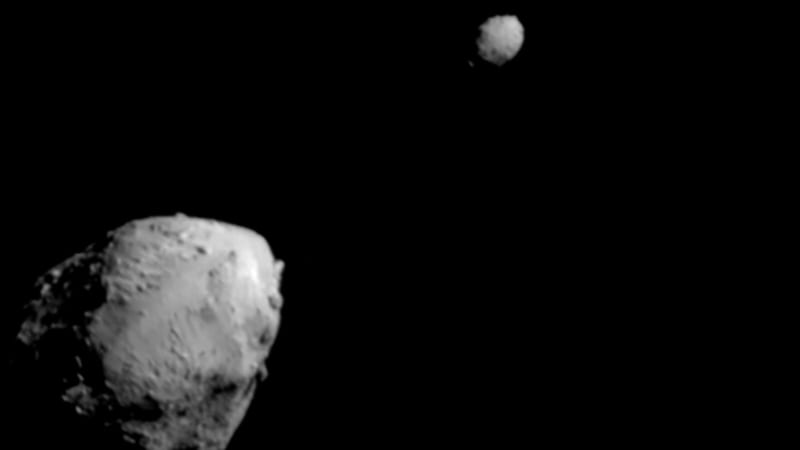
The spacecraft launched on October 7, 2024, to study Dimorphos—an asteroid that orbits a bigger rock named Didymos—which was intentionally struck by NASA during the Double Asteroid Redirection Test (DART) mission. Hera’s objective is to study the aftermath of the impact, which changed Dimorphos’s orbit around Didymos by a half hour. In fact, the impact was so powerful that it even changed the binary system’s orbit around the Sun. The collision also sent out a plume of debris 6,213 miles (10,000 km) across into space. Dimorphos has an estimated width of 495 feet (151 m), whereas Didymos measures 2,559 feet (780 m) wide, and they are separated by a distance of less than a mile.
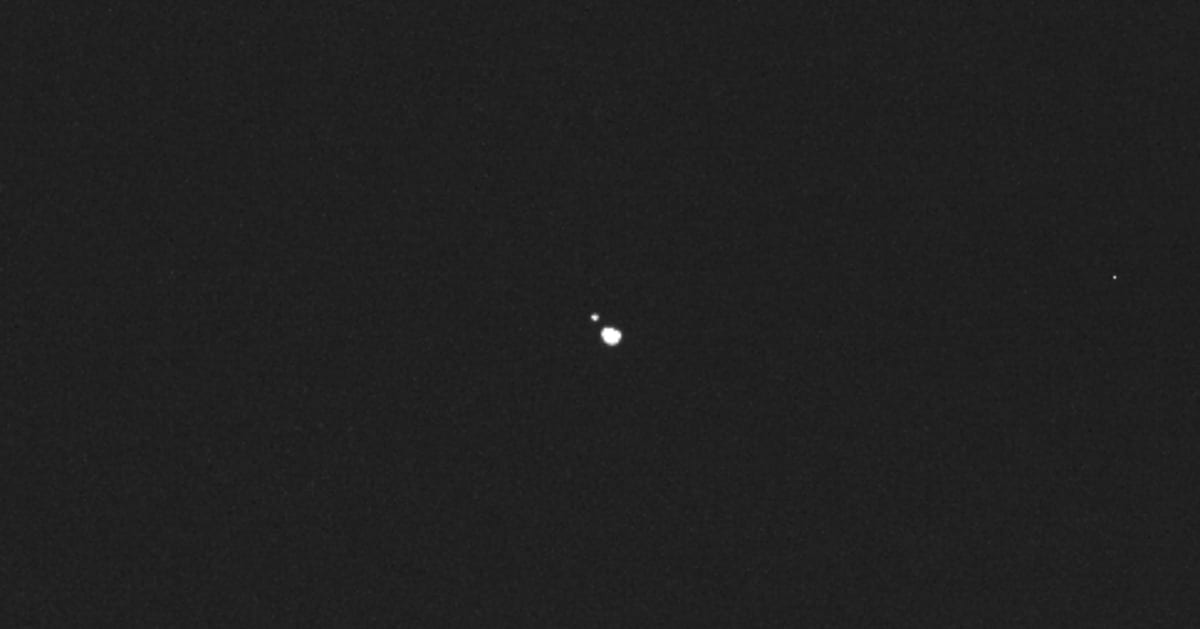
The latest image comes from Hera’s monochromatic Asteroid Framing Camera and was taken on October 18 from a distance of 795 miles (1,280 km). “With this image, the smaller Dimorphos asteroid becomes visible for the first time,” said Michael Kueppers, the project scientist for Hera. “Before this acquisition the spacecraft was still resolving the Didymos system as a single dot. But now, even though Dimorphos is made up of only around one pixel in this initial image, it is clearly well separated from its parent body.” According to Carnelli, the first detailed images of Dimorphos will be unveiled on November 25.
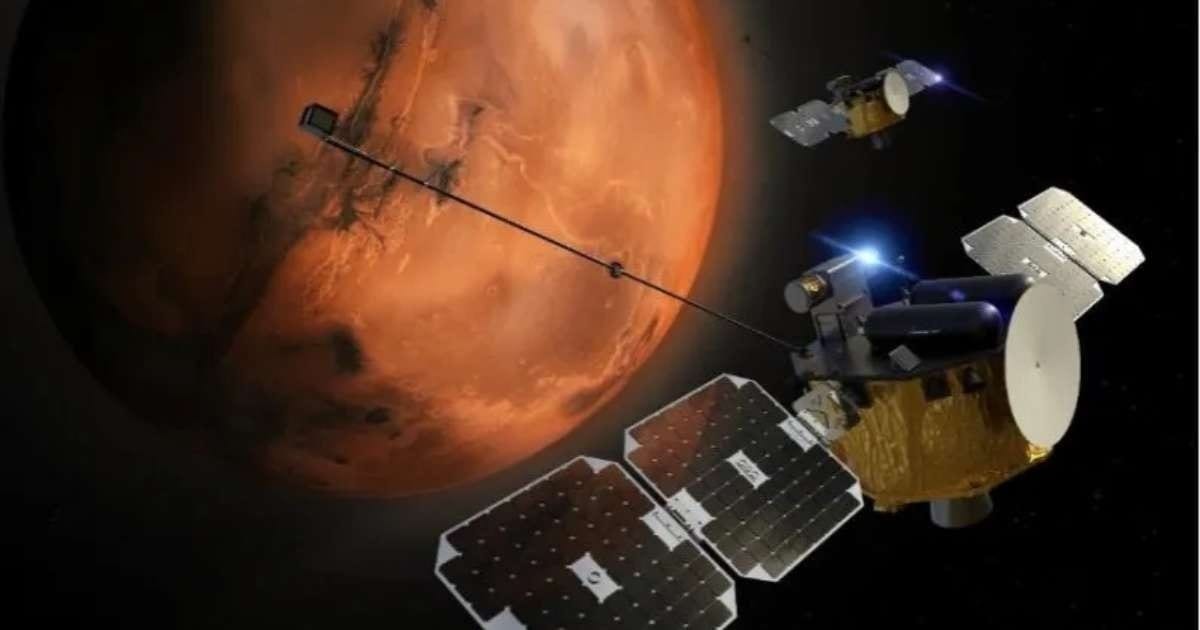
Last week, the Hera spacecraft completed its second braking maneuver, which reduced its relative velocity in preparation for a rendezvous. On October 15, it had executed a 93-minute braking maneuver to slow down and fine-tune its trajectory. Once Hera arrives at Didymos, it will release two shoebox-sized CubeSats to jointly conduct a post-impact survey of the DART collision. The investigation will be carried out in multiple phases, during which the spacecraft and CubeSats will employ a suite of instruments to determine the asteroid’s surface properties, composition, internal structure, and the crater carved by DART. Interestingly, the CubeSats Juventas and Milani will attempt a landing on Dimorphos once their scientific goals are achieved.
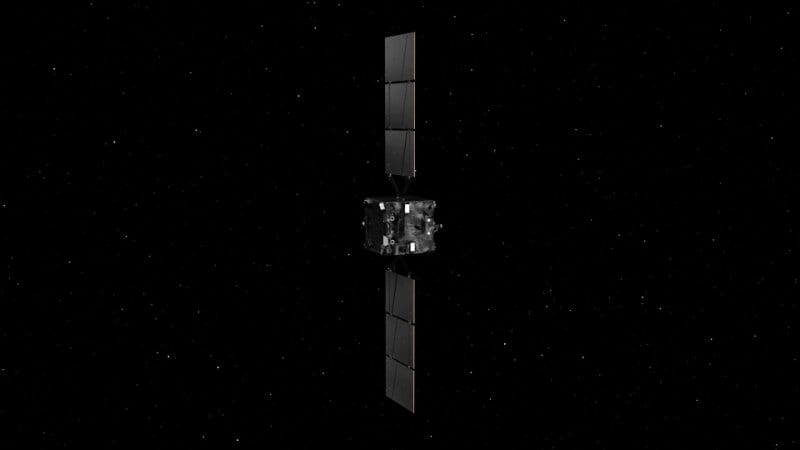
Hera’s objective is to boost planetary defense by determining how effective impactors like DART really are. Lessons learned from this mission could inform future missions to deflect asteroids heading toward Earth—especially ones that can cause mass destruction upon impact. Hera’s primary science phase is expected to last about six months, during which it will study the binary system from varying distances, with the closest being less than a mile away. When the science phase is complete, the mission team will decide whether Hera should also land on the asteroid.
More on Starlust
U.S. government releases clearest image yet of China’s top-secret space plane