Don't miss Mercury's greatest elongation from the Sun on July 4 — here's how to watch it

Skygazers globally have a prime opportunity to spot Mercury, the solar system's innermost planet, as it reaches its greatest elongation from the Sun on July 4, 2025. This celestial event marks Mercury's farthest apparent distance from our star, offering a brief window for observation in the western twilight, as per EarthSky.

On July 4, at 5:00 UTC, Mercury will be positioned 26 degrees from the Sun, making it more easily discernible against the fading daylight. Observers should direct their gaze towards the western horizon shortly after sunset. While mercury will shine with a magnitude of approximately +0.5, appearing brighter than most stars, its proximity to the Sun will still require keen observation before it dips below the horizon. This particular evening apparition of Mercury is considered favorable for the Southern Hemisphere. Following its greatest elongation, Mercury's brightness will diminish rapidly as its illuminated side turns away from Earth. The planet is expected to disappear from the evening sky later in July, reaching inferior conjunction — passing directly between Earth and the Sun — on August 1 at 0:00 UTC.
Also visible in the western sky, at a higher altitude, is the red planet Mars, glowing with the brightness of a first-magnitude star. For those with telescopes, Mercury will present a 41 percent illuminated crescent, spanning 7.9 arcseconds. The planet will be situated within the constellation Cancer, though the dim stars of the constellation may be obscured by the twilight.

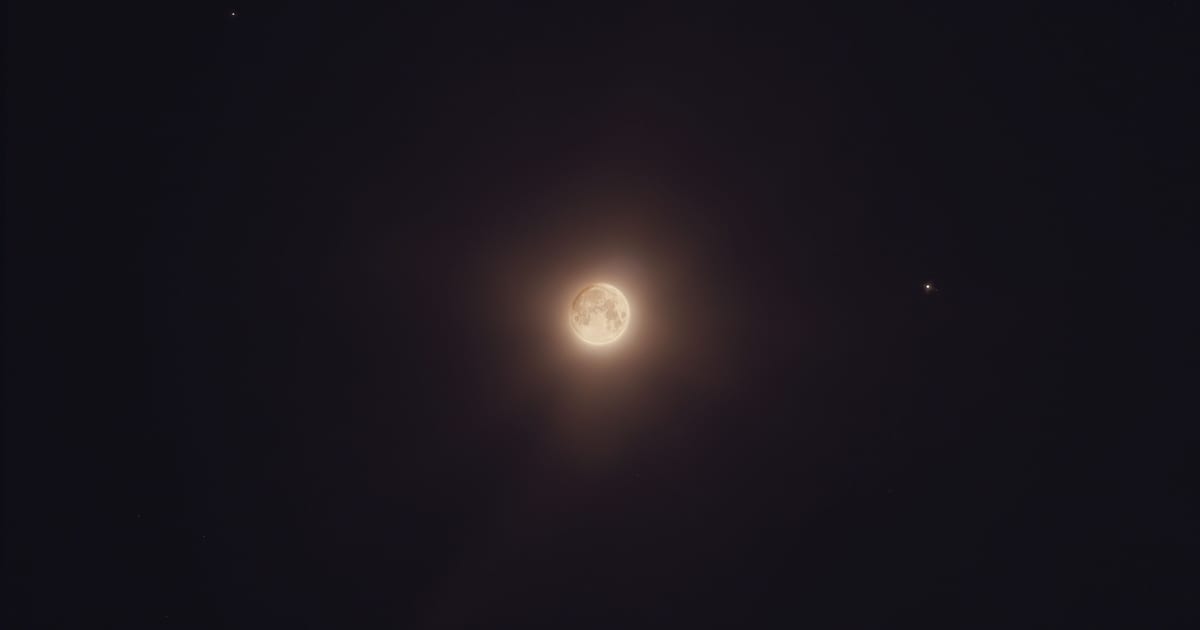
Separately, the predawn hours of July 4 offer a distinct astronomical treat. Venus, blazing at magnitude -4.1, will be the brightest object in the eastern sky, located in western Taurus. Uranus, at magnitude 5.8, will be situated close to Venus, providing a unique opportunity for binoculars or low-magnification telescope viewing of both planets within the same field. Despite its much larger physical size, Uranus will appear as a dim, greenish-gray disk due to its immense distance from Earth (approximately 3.03 billion km), compared to Venus's relatively close 142 million km. Additionally, the Moon will reach its apogee — its farthest point from Earth in its orbit — at 10:29 p.m. EDT, positioned 404,626 km away, as mentioned on Astronomy.com.

Beyond its visibility in the night sky, Mercury holds some surprising secrets, particularly concerning its internal structure and composition. Unlike what its small size might suggest, Mercury possesses a magnetic field, making it the only other terrestrial planet in our solar system, besides Earth, to currently exhibit this phenomenon. This magnetic field, however, is quite unusual: it's only about one percent the strength of Earth's and is significantly offset from the planet's center, differing greatly from our planet's centrally located field.
This distinctive magnetic field constantly interacts with the solar wind, a continuous flow of charged particles streaming from the Sun. This interaction forms a magnetosphere around Mercury, a protective bubble akin to Earth's but far less robust. The shape and size of this magnetosphere are dynamic, shifting as the solar wind's pressure fluctuates. As the solar wind approaches Mercury, it compresses the magnetic field, creating a boundary called the magnetopause. Further out, a bow shock forms, where the solar wind is slowed and deflected around Mercury's magnetic shield.