'At long last': XRISM solves 50-year-old mystery surrounding bright star gamma-Cas

With the help of the XRISM (X-ray Imaging and Spectroscopy Mission), scientists have now detected the true source of unusual X-rays from the gamma-Cas stellar system. Observations carried out by XRISM have shown that gamma-Cas’s strange X-ray emissions come from an invisible white dwarf companion’s orbital motion. The findings have been reported in a study led by Yaël Nazé of the University of Liège, Belgium, published in Astronomy & Astrophysics. Speaking to ESA, Nazé said, “It’s extremely satisfying to have direct evidence to solve this mystery at long last!”
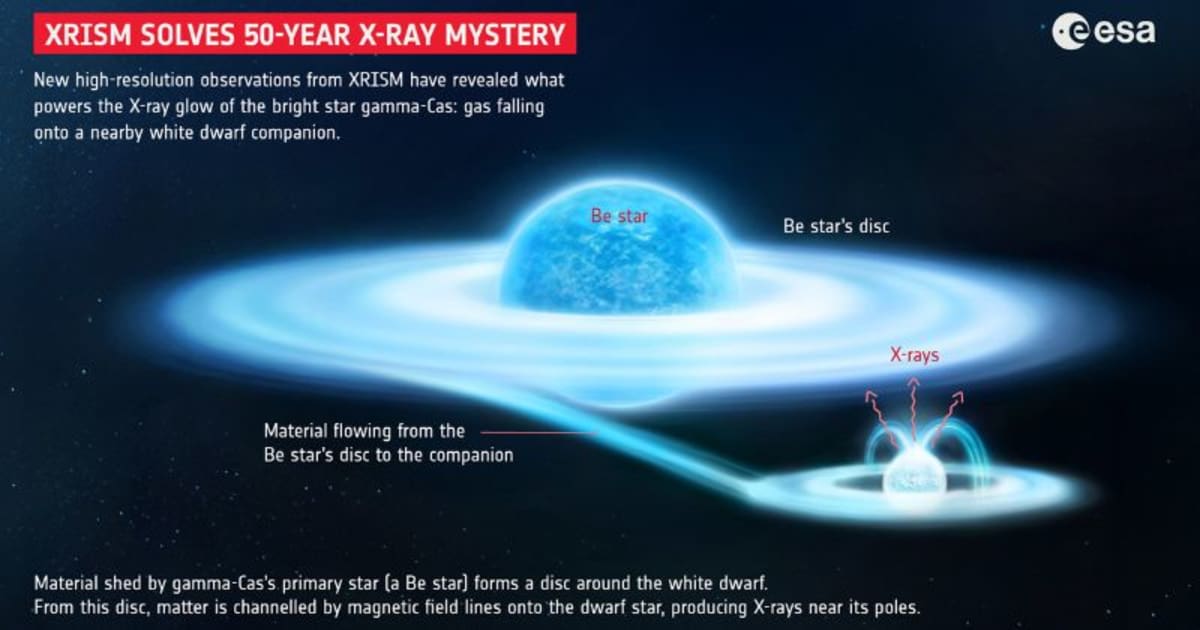
Part of Gamma-Cas’s mystery began as far back as 1866 when astronomers first noticed something unusual in its light. The star, which lies in the constellation Cassiopeia, had a bright hydrogen fingerprint—something that’s usually dark with stars like our own Sun. This feature launched a new class of stars called “Be stars” which are basically hot, fast-spinning stars surrounded by discs of gas. Later, astronomers also found that gamma-Cas had an unseen companion star. This was likely a white dwarf, a compact object with the mass of the Sun but the size of Earth.
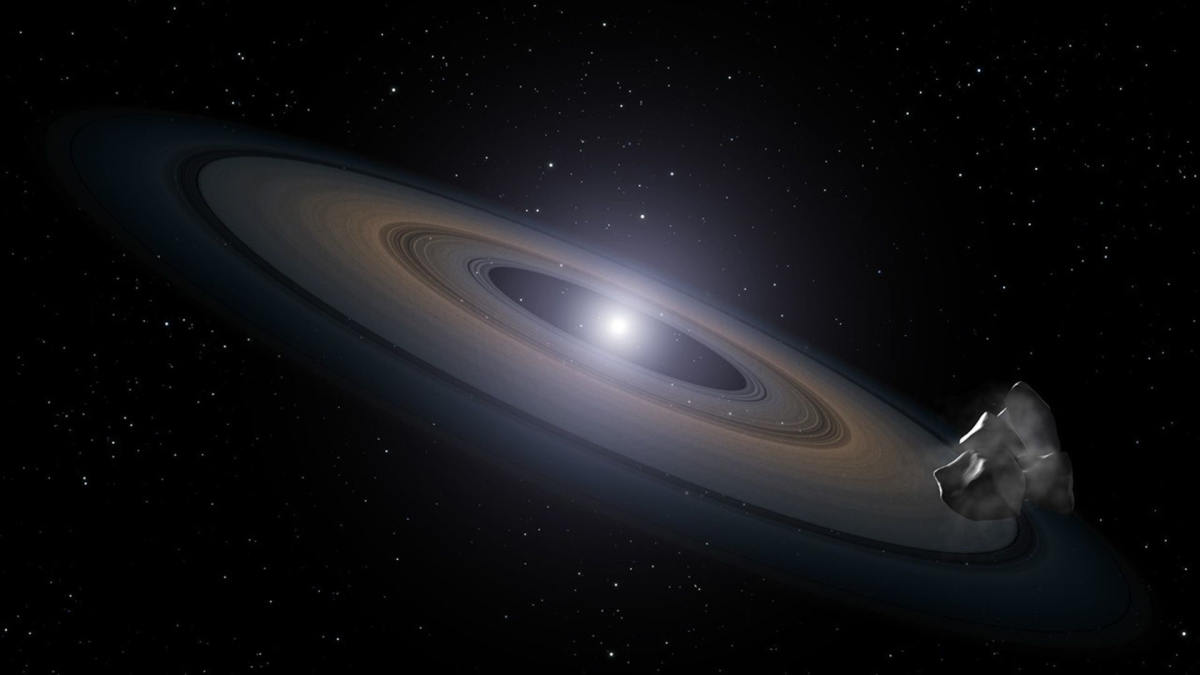
Over time, in the 1970s, scientists found that the gamma-Cas stellar system emitted strong X-rays, coming from hot plasma of about 150 million degrees, shining with a brightness almost 40 times stronger than that of similar stars. As X-ray space telescopes continued to advance, astronomers found around two dozen gamma-Cas-type stars that exhibited the same unusual X-ray behavior. However, keeping this classification aside, they could still not explain what was producing these strange high-energy emissions.

There were two main competing theories that could potentially explain the source of the X-rays coming from gamma-Cas. The first idea was that the hot material was produced as a result of local magnetic interactions between the star and its surrounding disc. The second idea suggests it was due to accretion, where disc material falls onto the companion white dwarf. To confirm either of these two theories, scientists needed telescopes with superior precision, and that’s where the XRISM came in to give them a breakthrough.

XRISM’s Resolve spectrometer is known to measure X-rays with exceptional accuracy, and it finally confirmed that gamma-Cas’s X-ray emissions follow the orbital motion of the hidden companion white dwarf star. Essentially, the white dwarf consumes material from gamma-Cas and produces these strange X-rays. This disproves the first theory on radiation from magnetic activity and provides direct evidence for the second accretion theory—that the source is, in fact, the material falling onto the white dwarf.
XRISM solves the 50-year mystery of a famous star 🌟
— ESA Science (@esascience) March 24, 2026
An invisible companion consuming material from the star gamma-Cas has been revealed as the culprit for curious X-rays coming from the stellar system 👉 https://t.co/B3HEm2w1SY pic.twitter.com/qk1Ngzk1vv
With the five-decade-old mystery finally solved, scientists will now try to understand how Be stars, previously thought to be common among low-mass stars, evolve with their companions. “Now that we know the true nature of gamma-Cas, we can create models specifically for this class of stellar systems, and update our understanding of binary evolution accordingly,” said Nazé.
More on Starlust
XRISM observes a supermassive black hole 'wake up' and fire winds at near-light-speed
JAXA-NASA XRISM mission captures the clearest view of the vicinity of a rapidly-spinning black hole