Astronomers confirm first triple system with actively feeding supermassive black holes
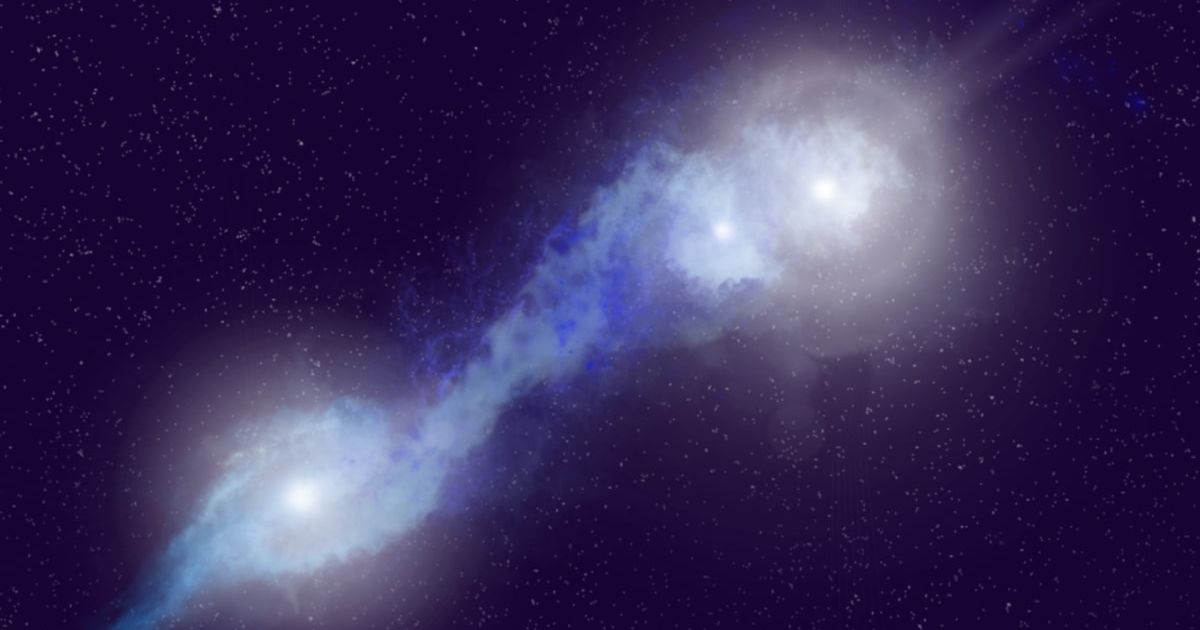
Astronomers have confirmed J1218/1219+1035, located about 1.2 light-years away, as the first known triple system where all three galaxies have radio-bright supermassive black holes that are actively feeding. The detailed study was published in The Astrophysical Journal Letters by astronomers from the U.S. Naval Research Laboratory (NRL) and scientists from the U.S. Naval Observatory (USNO) and NASA Goddard Space Flight Center (NASA GSFC).
![Arp 274, also known as NGC 5679, is a system of three galaxies that appear to be partially overlapping in the image, although they may be at somewhat different distances. [Representative Image Credit: Credit: NASA, ESA, and M. Livio and the Hubble Heritage Team (STScI/AURA)]](https://de40cj7fpezr7.cloudfront.net/85e02250-e386-4045-9160-c30422f79e6f.jpg)
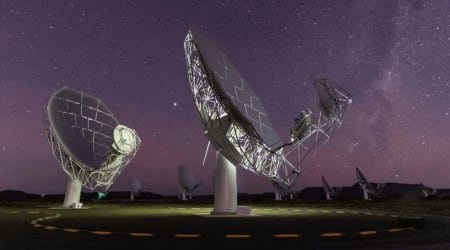
The observation was made using the U.S. National Science Foundation's Very Large Array (NSF VLA) and the U.S. National Science Foundation's Very Long Baseline Array (NSF VLBA). The high-resolution observations revealed compact radio cores that emit synchrotron in each galaxy, as per the National Radio Astronomy Observatory. This confirmed that all three harbor active galactic nuclei (AGN) powered by glowing black holes. J1218/1219+1035 hence becomes the first confirmed “triple radio AGN” and the third triple AGN system in the near universe.
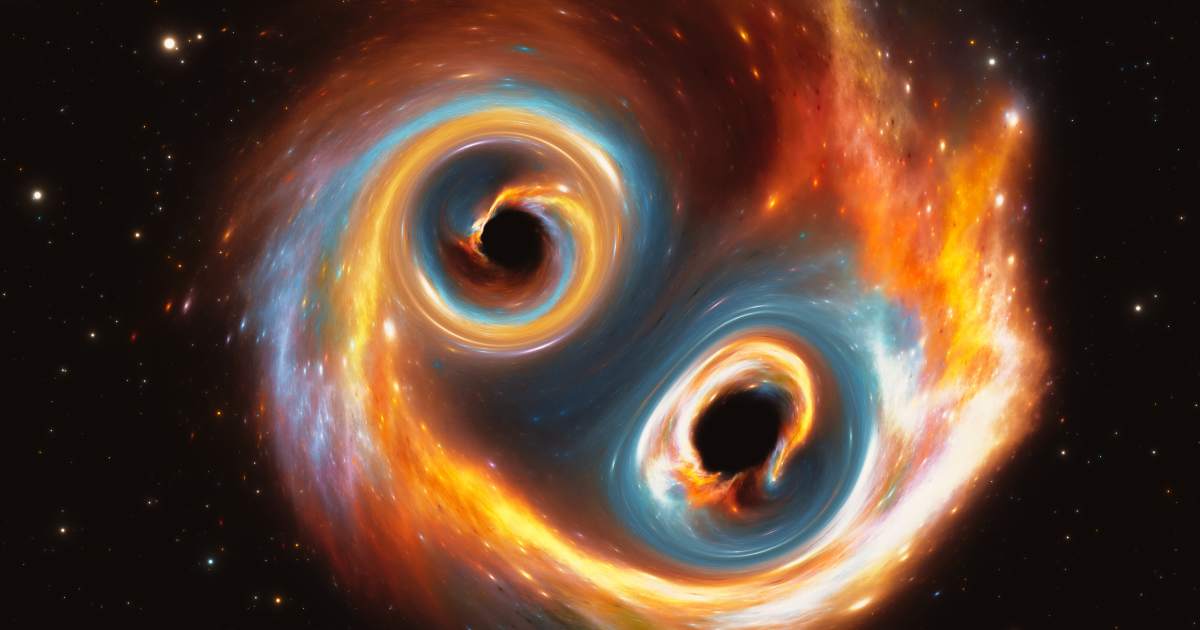
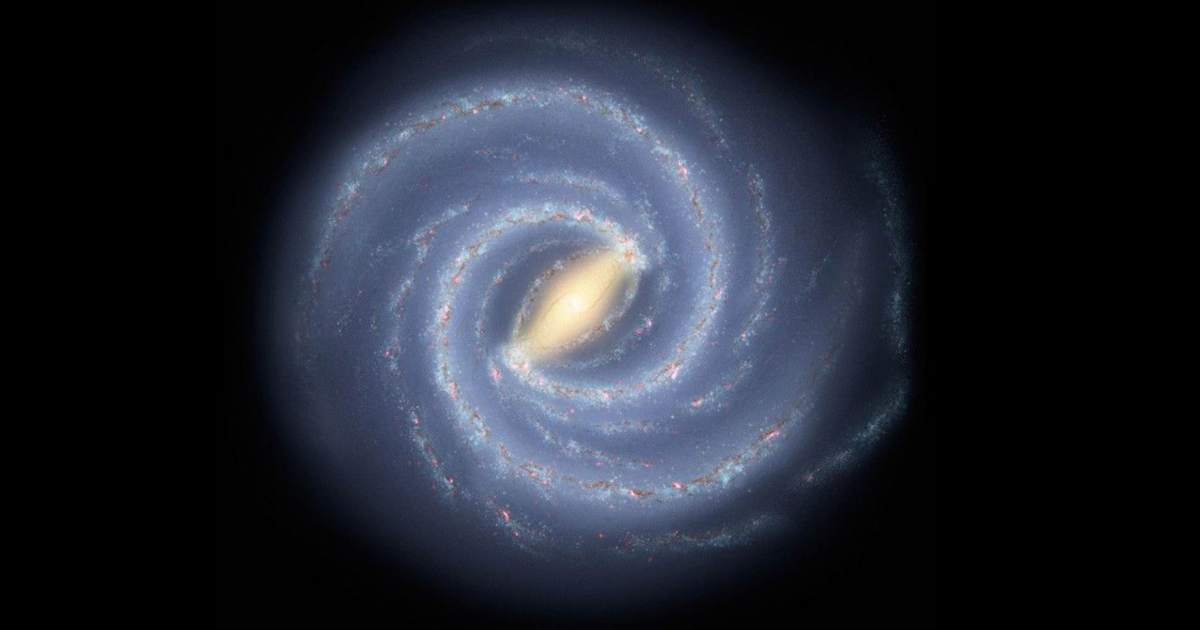
The three galaxies in the system are caught in a merger, forming a dynamically bound group, with their tidal features tracing their interactions. These triple systems are rare but essential tools to observe hierarchical galaxy evolution. This pertains to how large galaxies, such as the Milky Way, grow through repeated collisions and mergers with smaller companions. The new observations of three active accretion black holes in the same merging group are a suitable testing ground that can help study how galaxy encounters drive gas into galactic centers and further black hole growth.
The mid-infrared data from NASA’s Wide-field Infrared Survey Explorer (WISE) was the first to flag the system as unusual. It indicated that at least two AGN were hiding in an interacting pair of galaxies. Optical spectroscopy was conducted to confirm an AGN in one nucleus and discern a “composite” signature in another, but the third remained obscure, as its emission could also be a result of star formation or shocks. Compact radio cores of all three optical galaxies were found by the ultra-sharp radio imaging from the NSF VLA at frequencies 3, 10, and 15 GHz.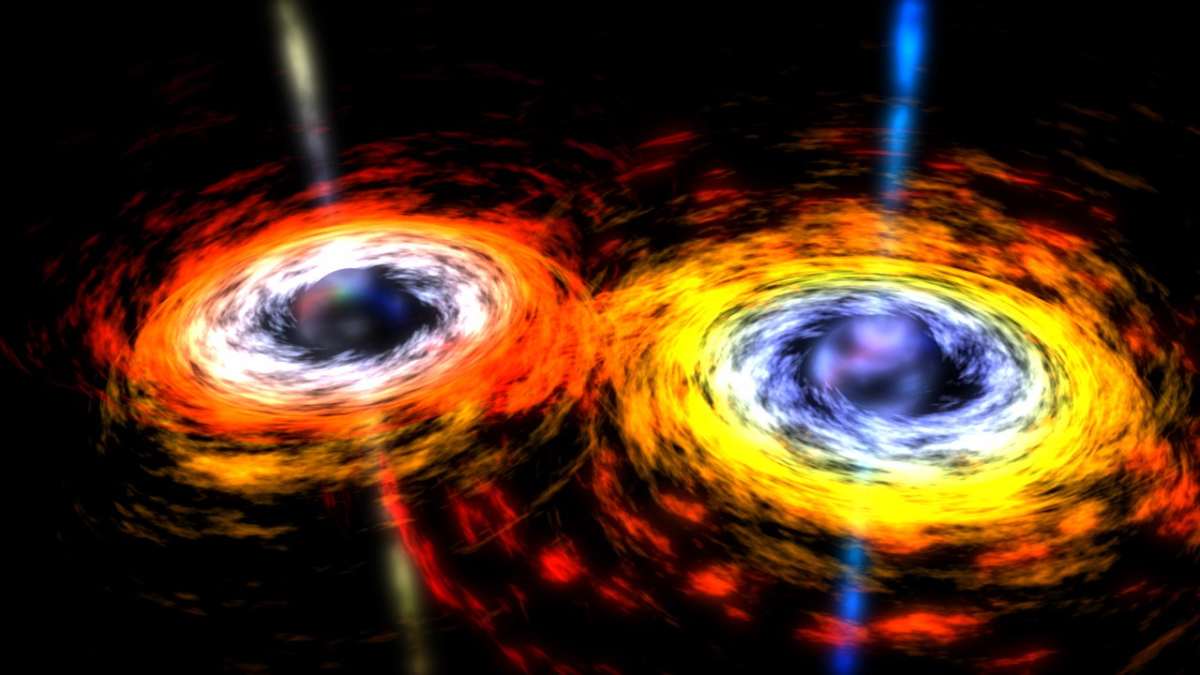
"Triple active galaxies like this are incredibly rare, and catching one in the middle of a merger gives us a front-row seat to how massive galaxies and their black holes grow together,” said Dr. Emma Schwartzman of the U.S. Naval Research Laboratory. “By observing that all three black holes in this system are radio-bright and actively launching jets, we’ve moved triple radio AGN from theory into reality and opened a new window into the life cycle of supermassive black holes.”
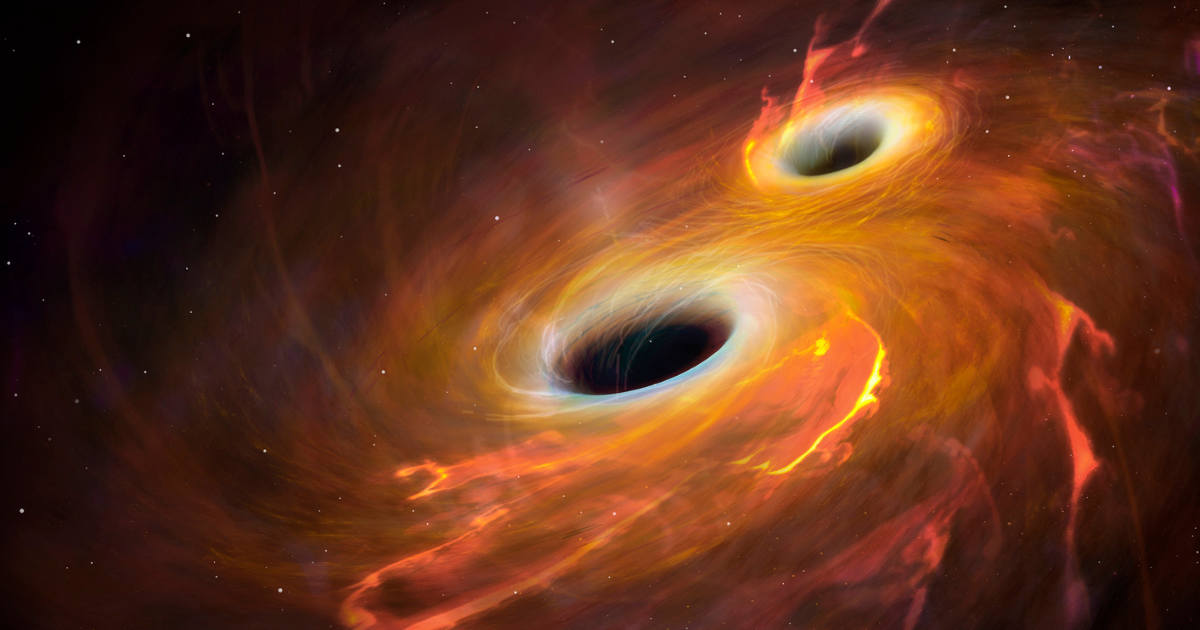
There are only two other confirmed triple AGN systems, and an expanding list helps understand how frequently multiple black holes interact and merge. The observation is only made possible by combining mid-infrared selection with sensitive, high-resolution radio imaging to detect complex AGN systems that may be invisible to optical or X-ray wavelengths. The search for more triple AGN will use facilities like the NSF VLA and NSF VLBA, uncovering how black hole triplets shape the galaxy.
More on Starlust
Scientists discover how black holes acquired 'squashed' orbits just before the merger