NASA 'trailblazer' Sunita Williams retires: Here's a look at her record-breaking career
27 years of service, 608 days in orbit, nine spacewalks—the list goes on.
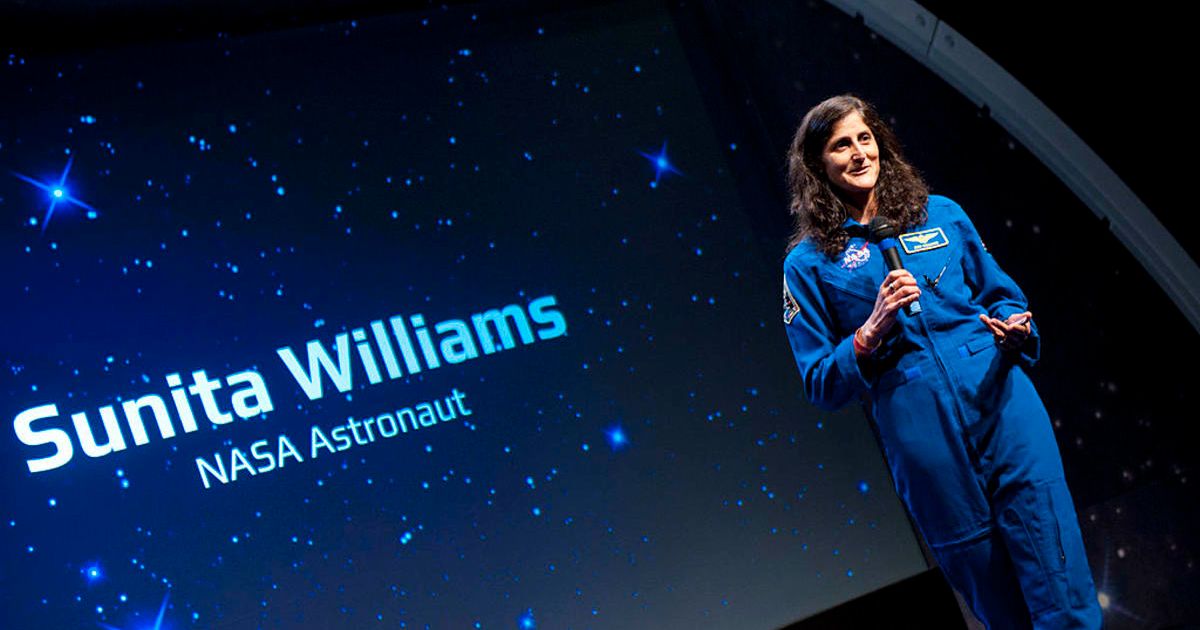
Sunita Williams attends YouTube Space Lab Competition. (Cover Photo by Leigh Vogel/Getty Images for YouTube)

NASA astronaut Sunita “Suni” Williams retired after 27 years of service on December 27, 2025, capping a career with three International Space Station missions, a cumulative 608 days in space—second among NASA astronauts—and nine spacewalks totaling 62 hours and 6 minutes of extravehicular activity (EVA), the most by a woman. Her career spanned shuttle flights, ISS command, and commercial crew tests. She was also the first person to run a marathon in space. Her latest, the Boeing Starliner Crew Flight Test, launched in June 2024 for eight days, extended to 286 days due to technical issues, tying Butch Wilmore for NASA’s sixth-longest single flight during Expeditions 71/72, where she commanded Expedition 72. Williams splashed down on March 18, 2025, off Florida’s Gulf Coast via SpaceX Crew-9 after 4,576 orbits and 121 million miles. 
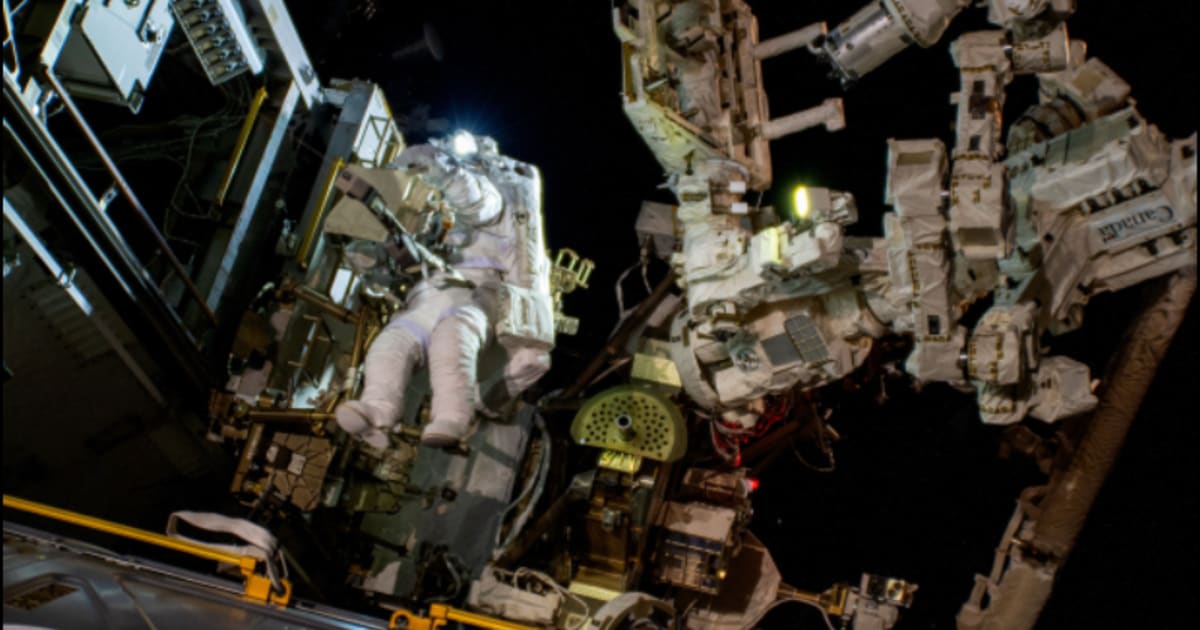
NASA astronaut Suni Williams on one of her EVAs outside the International Space Station during the Jan. 16, 2025, spacewalk where she helped replace a rate gyro assembly that helps maintain orientation. (Image Source: NASA)
NASA astronaut Suni Williams on one of her EVAs outside the International Space Station during the Jan. 16, 2025, spacewalk, where she helped replace a rate gyro assembly that helps maintain orientation. (Image Source: NASA)

Williams’ debut came in December 2006 on shuttle Discovery (STS-116), when she served as flight engineer for Expeditions 14/15 with a record-breaking four spacewalks before returning on Atlantis (STS-117). In 2012, she launched from Kazakhstan’s Baikonur Cosmodrome for Expedition 32/33’s 127 days, commanding Expedition 33 and logging three spacewalks to fix a radiator leak and replace a component that draws power from the solar arrays.


A Needham, Massachusetts, native, Williams graduated from the U.S. Naval Academy with a bachelor's degree in physical science and earned her master's in engineering management from Florida Tech in 1995. She is also a retired U.S. Navy captain and an accomplished helicopter and wing pilot, having flown over 4,000 hours in 40 different aircraft. Selected by NASA in 1998, she trained in T-38 jets and learned water and wilderness survival techniques. Post-first flight, her roles included Astronaut Office deputy chief and Star City operations director in Russia. Recently, she developed helicopter training for Artemis lunar preparations, aiding Moon landing simulations. 
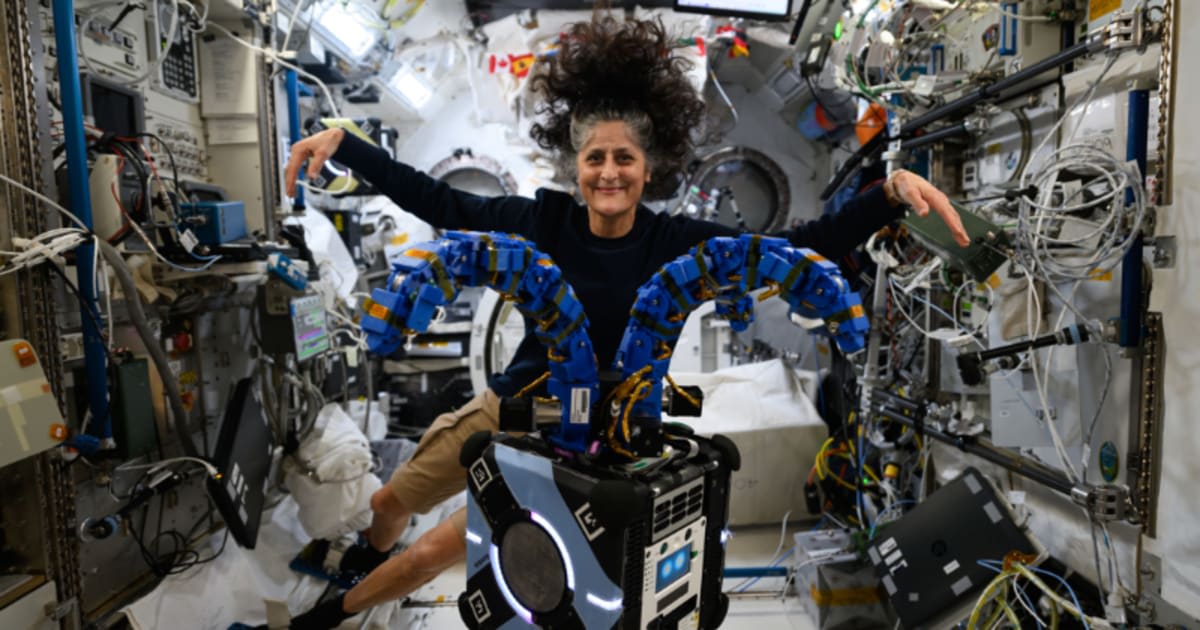
Suni Williams poses with the Astrobee robotic free-flyer in the Kibo laboratory module outfitted with tentacle-like arms containing gecko-like adhesive pads to demonstrate satellite capture techniques. (Image Source: NASA)

NASA Administrator Jared Isaacman hailed her as a “trailblazer… laying the foundations of Artemis to the Moon and Mars.” Williams echoed, “Space is my absolute favorite place… I hope the foundation we set has made these bold steps a little easier,” her words underscoring a career advancing station science and deep-space preparations. 

NASA astronaut Suni Williams is helped out of the SpaceX Dragon spacecraft after she and fellow NASA astronauts Nick Hague and Butch Wilmore, and Roscosmos cosmonaut Aleksandr Gorbunov landed on the water on March 18, 2025 off the coast of Tallahassee, Florida. (Photo by Keegan Barber/NASA via Getty Images)
NASA astronaut Suni Williams is helped out of the SpaceX Dragon spacecraft after she and fellow NASA astronauts Nick Hague and Butch Wilmore, and Roscosmos cosmonaut Aleksandr Gorbunov landed on the water on March 18, 2025, off the coast of Tallahassee, Florida. (Photo by Keegan Barber/NASA via Getty Images)

In a CBS interview from orbit amid mission extension debates during her Starliner days, Williams addressed President Trump’s claim of being “virtually abandoned,” responding firmly: “I don’t think I’m abandoned… We don’t feel abandoned. We feel like we’re part of the team, and that’s a huge honor.” She emphasized ISS obligations: “We're part of something bigger than ourselves. We're part of the International Space Station, and we have obligations to our international partners to do science and exploration while we're up here,” defending the delay and reminding us all of her professionalism.
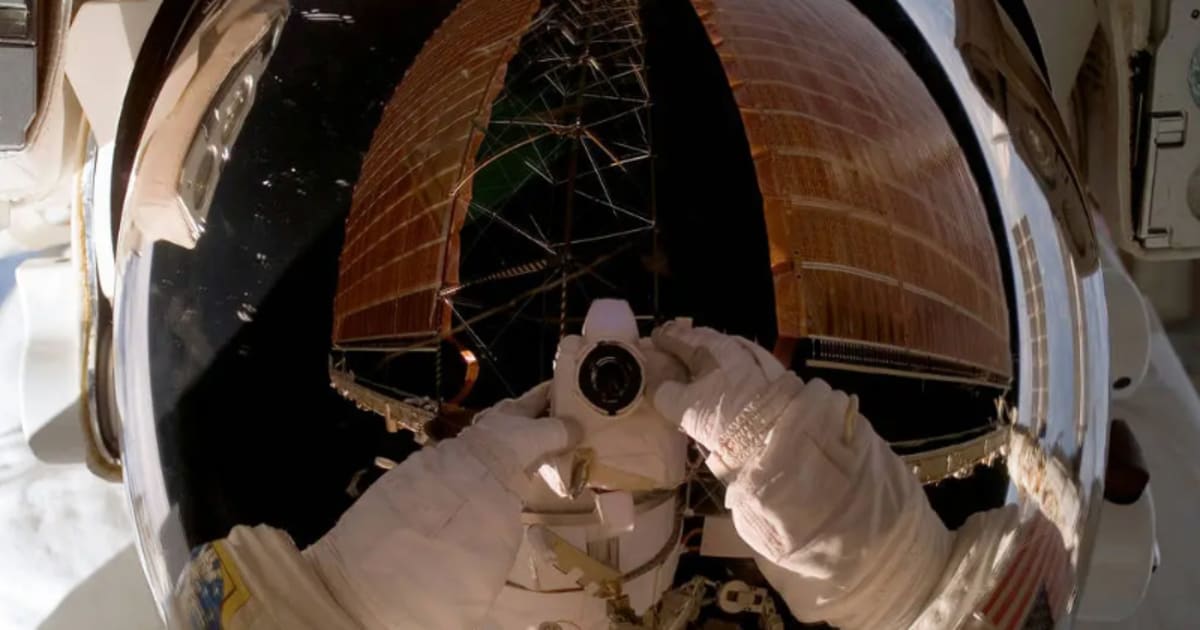
Sunita Williams uses a digital camera to capture a photo of her helmet visor during a February 2007 spacewalk. (Image Source: NASA)

Williams bridged eras, proving human tenacity in orbit. NASA's Johnson Space Center Director Vanessa Wyche called her a “pioneering leader," whose dedication will inspire future explorers. Astronaut chief Scott Tingle added, “She’s inspired so many… We’re all going to miss her greatly.” As NASA eyes Artemis II in the coming weeks, her legacy is set to propel the next generation skyward.
More on Starlust

Retired NASA astronaut reveals how much Suni Williams and Butch Wilmore will be paid for their extended ISS stay

NASA astronaut Suni Williams reveals the epic ‘first meal’ she had at home after nine months in space

MORE STORIES

The nanotube-based composite blocks radiation, survives extreme temperatures, and can be 3D-printed.
2 days ago
"We're going to marry our success from Ingenuity, all that knowledge, all that skill and success, and couple that with an industry capability. We're going to get this done."
2 days ago
The seven-person also did studies in the areas of biomedicine while also upgrading data hardware.
2 days ago
Apollo 17 astronaut Harrison 'Jack' Schmitt explains why exploring the Moon continues to be important.
2 days ago
"The successful performance of our thruster in this test demonstrates real progress toward sending an American astronaut to set foot on the Red Planet."
3 days ago
The Artemis III core stage will be placed horizontally in the transfer aisle of the VAB before being lifted into a vertical position in High Bay 2.
3 days ago
"A well-known metallurgical behavior was found at the surface of the module, which will be fixed by the end of the third quarter of 2026."
3 days ago
The cargo vehicle carrying essential supplies for the Expedition 74 crew docked with the Zvezda module.
4 days ago
SUPARCO's Earth observation satellite reaches space as Pakistan President Asif Ali Zardari praises China's cooperation.
5 days ago
Launch timing, live stream, and more—here's all you need to know about the return of SpaceX's Falcon Heavy rocket.
5 days ago