Why are total solar eclipses so rare, and how can you watch one safely?
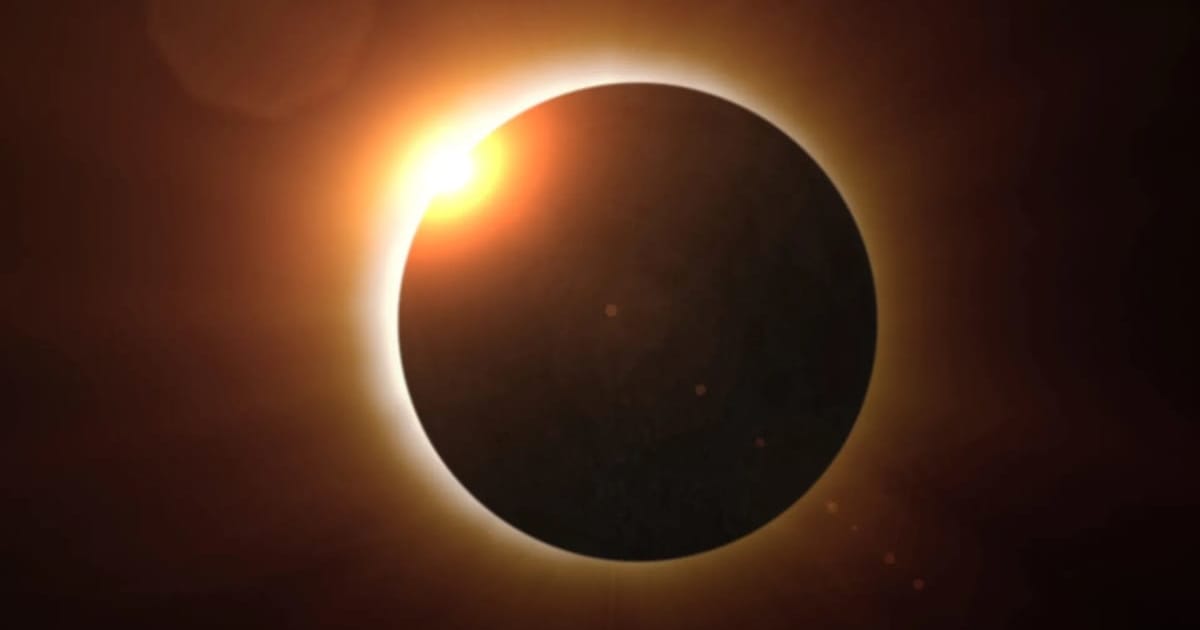
Total solar eclipses rank among the rarest sights in the sky. Here's what makes them so hard to catch.
Illustration of a total solar eclipse. (Cover Image Source: NASA)

This year, the total solar eclipse will happen on August 12, 2026. This event happens when the Moon passes directly between the Sun and Earth and blocks out the Sun's light completely. Many assume that it’s an event that happens more often, mainly because the Moon takes around a month to circle Earth. But that’s not really the case. In fact, a total eclipse is such a rare event that any single spot on Earth only gets to see one about once every 375 years.

Solar eclipse August 21, 2017 at 1:15 pm from Wisconsin, USA 85% Coverage (Image Source: Getty | Matt Anderson Photography)

So why are total solar eclipses so rare?

This is because the Moon's orbit is tilted relative to Earth's equator, and its shadow usually misses our planet. The shadow only reaches the ground when the Moon happens to be perfectly aligned in its orbit. Also, the Moon doesn't circle Earth in a perfect loop. Its path is elliptical, and this means that the distance between the Moon and Earth is always shifting. It changes from about 220,000 miles at its closest to roughly 250,000 miles at its farthest.
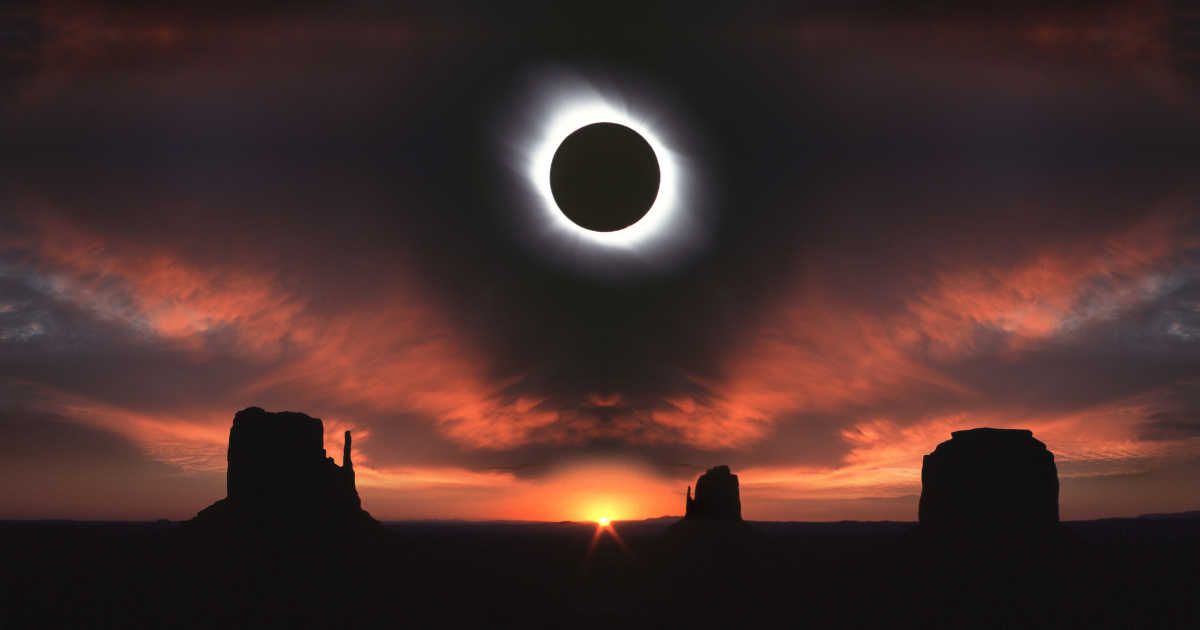
Download authentic, Total Solar Eclipse And Monument Valley At Sunrise Utah Usa, royalty-free stock photos & images. Getty Images offers global use rights & simple pricing with volume discounts.
Total Solar Eclipse And Monument Valley At Sunrise Utah USA. (Image Source: Diane Miller/Getty Images)

Farther out, the Moon looks smaller in the sky, and it can't fully cover the Sun. This is one of the reasons we usually see an annular eclipse, a ring of sunlight rather than a full blackout. On top of that, about 70% of the planet is ocean, so a lot of eclipse paths simply cross open water. Where the path does cross land, clouds can still get in the way and block our view of the total solar eclipse entirely.
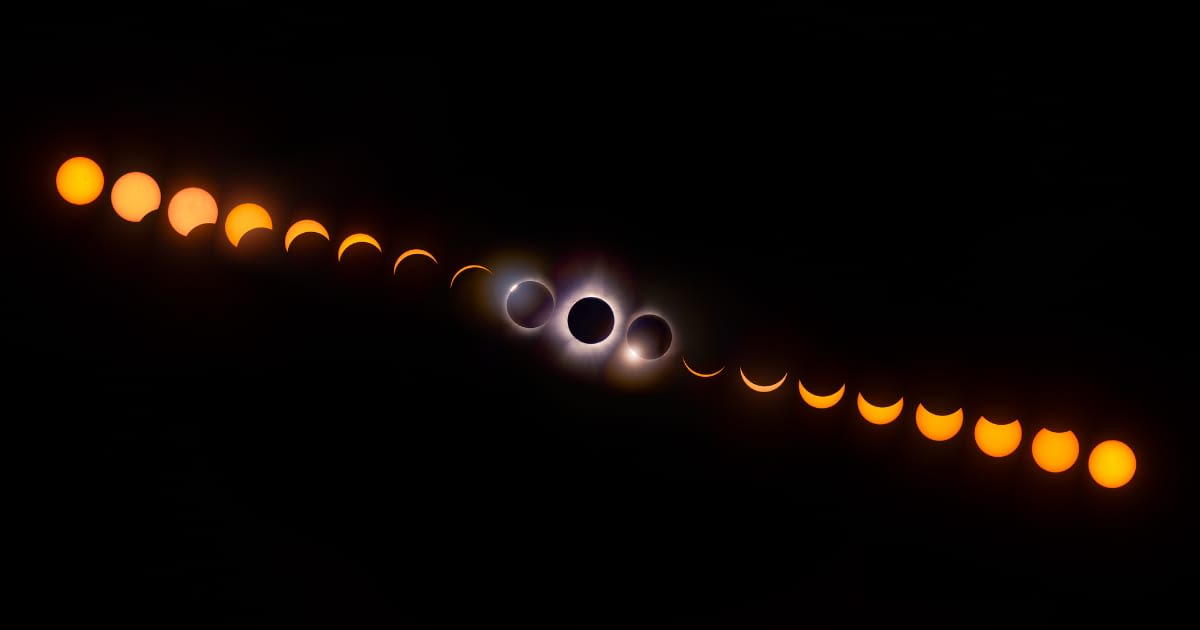
Alignment of phases of the total solar eclipse from first contact to totality. (Cover Image Source: Getty Images | Jesse Thornton)
Alignment of phases of the total solar eclipse from first contact to totality. (Image Source: Getty Images | Jesse Thornton)

How to safely watch an eclipse with your own eyes?

If you are planning on watching a total eclipse, make sure to be careful to not to look at it directly. As per NASA, “Viewing any part of the bright Sun through a camera lens, binoculars, or a telescope without a special-purpose solar filter secured over the front of the optics will instantly cause severe eye injury”. The sun’s surface is bright enough to damage the cells in your retina within seconds. 

Instead, you can view it with solar viewing glasses and telescopes fitted with proper solar filters, as they are designed to block that light down to safe levels. With these, you can watch a total solar eclipse without putting your eyes at risk.

More on Starlust:

Don't miss the century's longest Total Solar Eclipse — here's the exact date
What is a solar eclipse? Types and how to observe safely

MORE STORIES

The comet is named after German astronomer Wilhelm Tempel, who discovered it on July 4, 1873.
4 days ago
The bright Moon may spoil visibility, but skywatchers can still try their luck.
5 days ago
These dancing bands of light have inspired both folklore and extensive research by scientists.
5 days ago
NASA has said that the experiments are to study the Sun’s corona and the impact of the temporary darkness of our skies on the atmosphere.
5 days ago
Despite thunderstorms and rain across much of the US, these 5 states could offer clear views of Buck Moon.
6 days ago
By following a set of simple guidelines, you can begin to capture stunning views of the full face of the Moon.
6 days ago
The position of the Moon in its orbit around Earth will give it a stunning coppery-red color and the western hemisphere is best placed to view it. 
7 days ago
We've tracked eclipses for thousands of years. Here's all you need to know about this phenomenon.
Jul 27, 2026
Dozens of cities will see a partial eclipse, while some will witness a total eclipse. Check details.
Jul 27, 2026
The Buck Moon will rise on July 29, reaching peak illumination at 10:36 a.m. EDT.
Jul 27, 2026