Massive water tank located 600 meters below ground can help deepen understanding of ghost particles
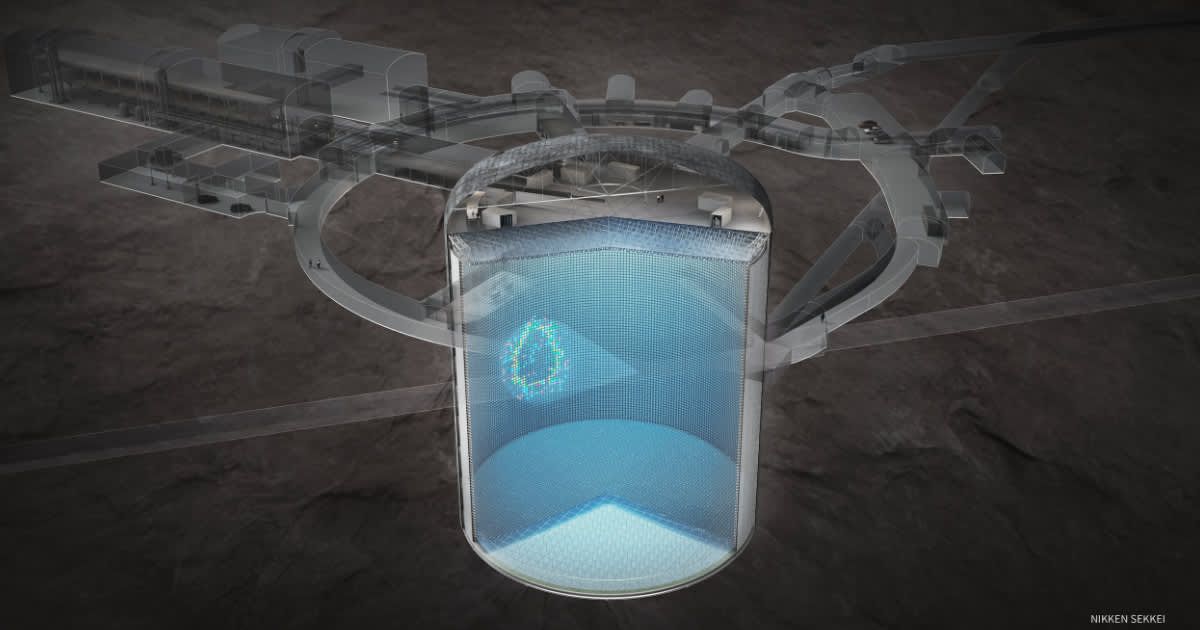
Thanks to the Hyper-Kamiokande project by the High Energy Accelerator Research Organization (KEK) and the University of Tokyo, scientists will soon be able to study neutrinos with greater depth. Often called ghost particles because of their minuscule nature and their property of passing straight through almost anything without interacting, neutrinos are extremely difficult-to-detect sub-atomic particles. This pursuit of their detection and study will receive a major boost in 2028 when Hyper-K becomes operational. Last month, Kamioka Observatory released a 3D virtual tour of its under-construction facilities in the city of Hida, Japan. The Hyper-K detector is located 600 meters underground so that it is shielded from background cosmic radiation. The excavation of the underground cavern was completed last year.
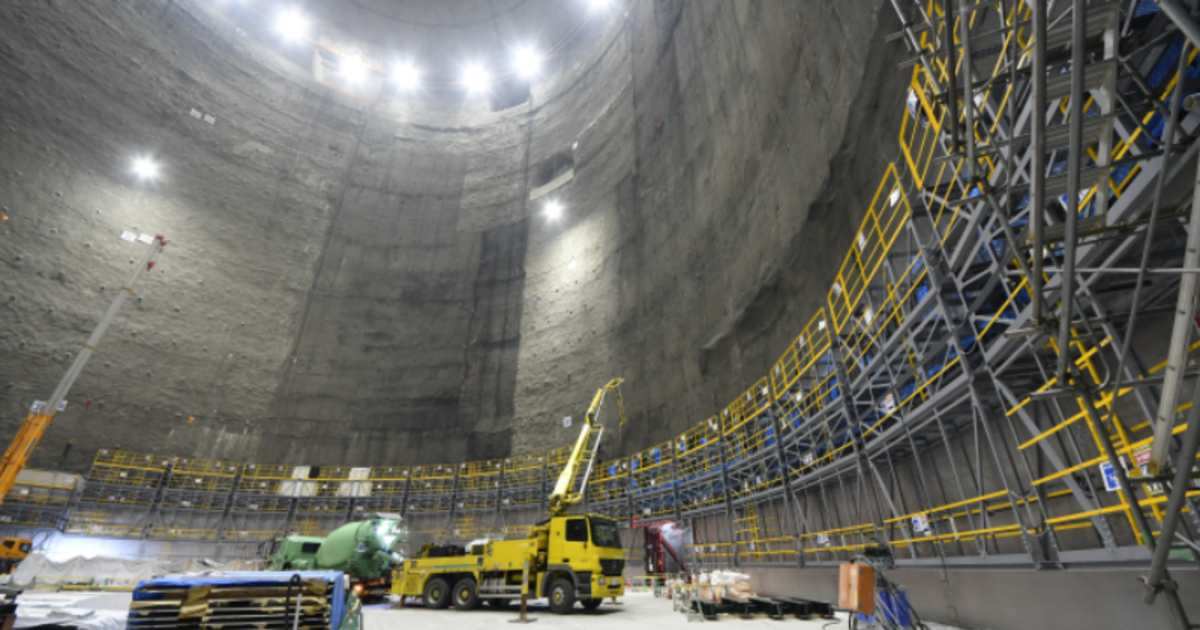
Hyper-K is the third iteration of its type, each making use of photomultiplier tubes (PMTs) for sensing Cherenkov light generated from nucleon-decays and neutrino interactions. As the world's largest underground water tank, Hyper-K will be filled with 260,000 metric tons of ultrapure water, with its walls lined with about 40,000 PMTs. The first Kamiokande detector, operational between 1983 and 1996, used the same principle, though the tank was much smaller. It helped in the creation of neutrino astronomy and detected the first neutrinos coming from distant supernovae. It also made observations of ghost particles coming from the Sun. The second iteration, Super-Kamiokande, operational since 1996, advanced the study of neutrinos even further thanks to its much larger size and more PMTs. The Super-K aided in the discovery of neutrino oscillations, showing that neutrinos also have mass, which led to Takaaki Kajita winning the Nobel Prize in Physics in 2015.
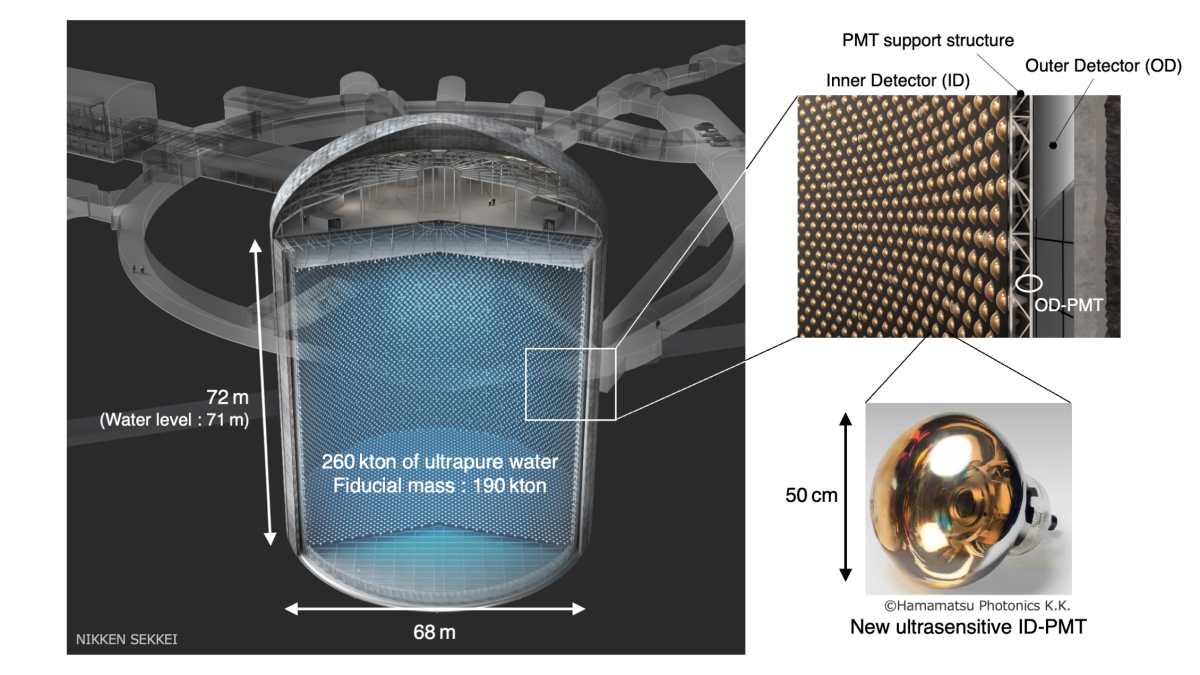
While Super-K is still in operation, the future Kamiokande is expected to provide even more breakthroughs in the field of neutrino astronomy owing to Hyper-K’s proposed 8-fold increase in fiducial mass. It could help discover the differences between neutrino and anti-neutrino oscillations and precise measurements to explain how matter in the universe came to be. It could also provide proof of the “unification of elementary particles” and “unification of electromagnetic, weak and strong force” by discovering proton decay.
The Super-K has already demonstrated significant improvements over its predecessor, and Hyper-K is expected to do the same. Director of Kamioka Observatory of the Institute for Cosmic Ray Research (ICRR), The University of Tokyo, Masato Shiozawa, was quoted to have said, “We are looking forward to the success of the large-scale construction and the new challenge of solving the great mysteries of elementary particles and the universe with the Hyper-Kamiokande experiment." Thanks to recent studies linking neutrinos with dark matter, the detections of the forthcoming Kamiokande could also lend themselves to studies examining the forces that drive the expansion of the universe. Besides, it's not just Japan that is seeing the development of a next-generation neutrino experiment. Such endeavors are being undertaken across the world.
More on Starlust
NASA's Roman Telescope to map dark matter and dark energy more precisely than ever
NASA's Hubble Space Telescope confirms first-ever failed starless galaxy made of dark matter