Heart of Butterfly Nebula in the constellation Scorpius reveals clues to Earth's creation
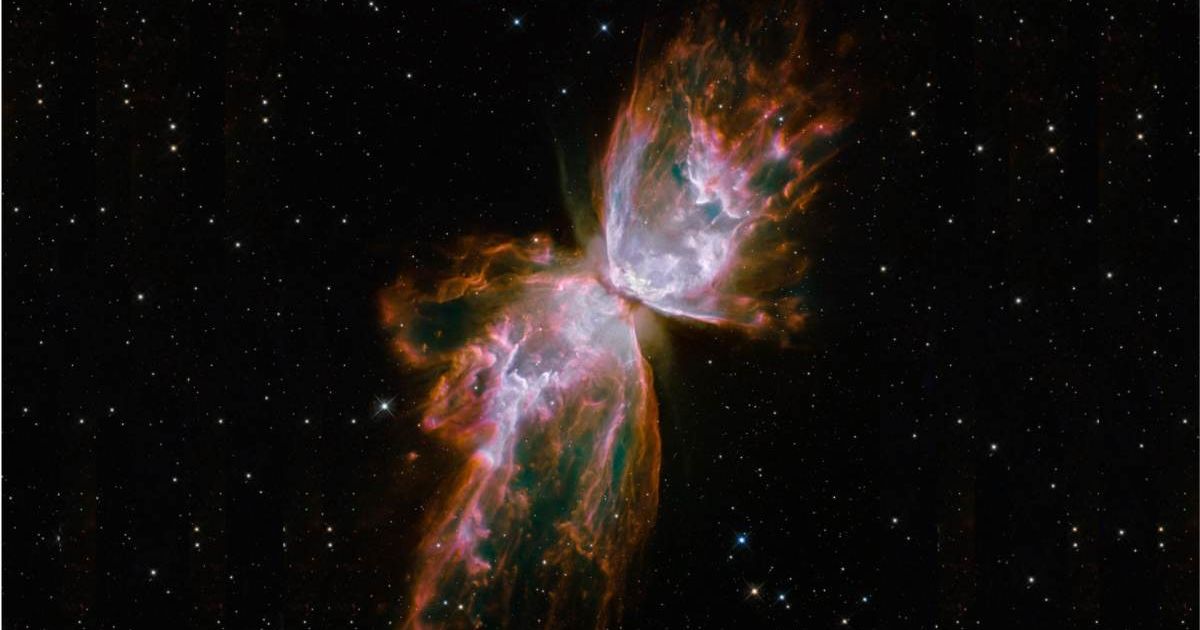
The Butterfly Nebula is located around 3400 light-years away in the constellation Scorpius. This stunning nebula was one of the best-studied planetary nebulae. In recent observations, NASA’s James Webb Space Telescope released gorgeous images of this nebula, as per the European Space Agency. These beautiful and elusive objects form when stars shed most of their weight towards the end of their lives. The new images brought in researchers who looked into the cosmic dust at the core of the Butterfly Nebula, NGC 6302, and found interesting cosmic data.
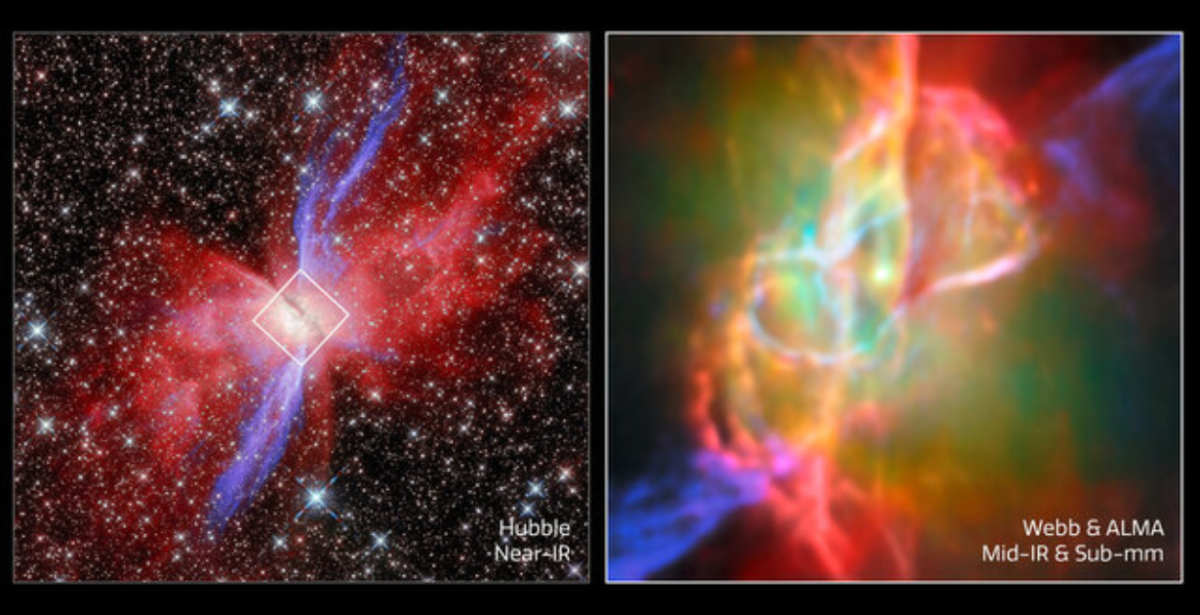
This new Webb image focuses on the centre of the Butterfly Nebula and its dusty torus, giving us a view of its complex structure. The Webb’s Mid-InfraRed Instrument (MIRI) in integral field unit mode captured the images. This mode uses a camera and a spectrograph to capture visuals at various wavelengths at the same time. Webb’s data is published in the journal Monthly Notices of the Royal Astronomical Society. This included details on the dense, dusty torus surrounding the star hidden at the centre of the nebula and its outflowing jets, providing us with new insights.
Tell me ‘bout the first time you saw me 🦋💍
— NASA Webb Telescope (@NASAWebb) August 27, 2025
Webb got close in with the inner workings of the Butterfly Nebula, previously captured by @NASAHubble in 2009, giving us a new and unprecedented view.https://t.co/8Sq6BBiEMO pic.twitter.com/wH3my1S1m4
According to the Royal Astronomical Society, most cosmic dust has a random atomic structure, but some carry crystalline shapes. "For years, scientists have debated how cosmic dust forms in space. But now, with the help of the powerful James Webb Space Telescope, we may finally have a clearer picture," explained lead researcher Dr Mikako Matsuura, of Cardiff University. This is a massive step in understanding how basic planetary materials are combined. The central star has a temperature of 220,000 Kelvin and is one of the hottest known central stars in our galaxy.
🆕 Webb has looked into the heart of a cosmic butterfly ✨🦋
— ESA Webb Telescope (@ESA_Webb) August 27, 2025
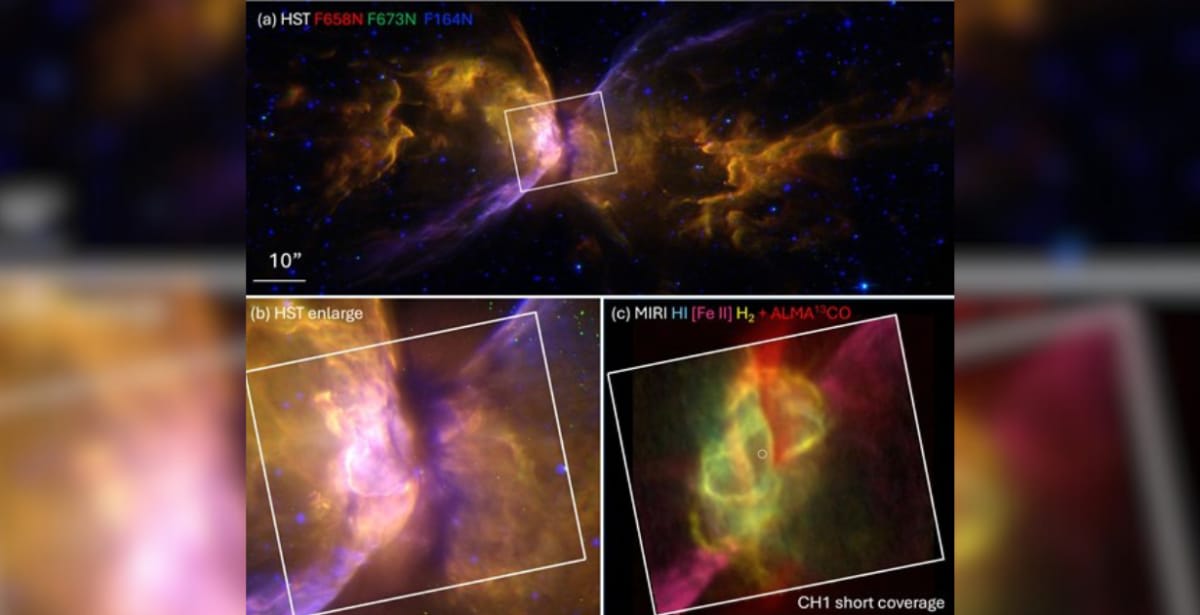
This image set showcases three views of a planetary nebula known as the Butterfly Nebula.
Read more: https://t.co/2A0DCZho7D or 🧵👇 pic.twitter.com/UEEbTE3Pve
This is responsible for the nebula's glow, but its maximum power could be directed by the dense band of dusty gas around it, the torus. This feature contains crystalline silicates like quartz and irregularly shaped dust grains. The dust grains are large with sizes on the order of a millionth of a metre. This suggests that the particles have been growing for a long time. The structure outside the torus is multilayered, with emissions from various atoms and molecules. The ions needing the most energy to form are concentrated in the centre, while those with less energy are farther.
A pair of jets can be traced blasting outwards in opposite directions, which are traced by iron and nickel. The team also found light emitted by carbon-based molecules known as polycyclic aromatic hydrocarbons, or PAHs. This formed flat, ring-like structures resembling a honeycomb or a beehive. PAHs are found on Earth in smoke from campfires, car exhaust, or burnt toast. It is suspected that these molecules are the result of a 'bubble' of wind bursting from the central star into the gas. This might be the first-ever proof of PAHs in an oxygen-rich planetary nebula.
Webb investigates complex heart of a cosmic butterfly Webb joined forces with ALMA to bring you this unprecedented view into the heart of the nebula – seen here alongside optical & near-infrared images from Hubble. pic.twitter.com/u4t7Xht9gN
— Black Hole (@konstructivizm) August 27, 2025
This data provided significant insight into how these molecules formed and under what kind of circumstances. The Butterfly Nebula is a bipolar nebula; it has two lobes that spread in opposite directions. This formed the butterfly's "wings," while a dark band of dusty gas turned into the butterfly's ‘body.’ The location of this nebula evaded researchers, but the central star lit up the shroud of cloud around it. This made the cloud shine brightly at the mid-infrared wavelengths that MIRI is sensitive to. The enshrouding dust made the object invisible at optical wavelengths.