The Moon will occult the Seven Sisters on July 20 — here's how to watch it

The crescent moon is set to make a close pass with the Pleiades star cluster, also known as the Seven Sisters (M45), on July 20. This alignment promises a stunning visual, particularly for those with binoculars. The Pleiades, a vibrant open cluster, boasts over a thousand stars, though most observers typically discern only six with the unaided eye. The impending proximity of the Moon and the cluster will create an exceptionally photogenic tableau, ideal for binocular viewing, which allows for simultaneous observation of both celestial bodies.

For optimal viewing, observers should focus on the eastern horizon in the early pre-dawn hours. An unobstructed vantage point is crucial to witness this phenomenon. Specific viewing times for individual locations can be determined using a "Night Sky tool." Users are advised to search for Alcyone, the brightest star in the Pleiades, set the date to July 19-20, and adjust the time slider to pinpoint the prime viewing window. While the complete occultation, where the moon passes directly in front of the cluster, will be primarily visible from North America, other regions globally may still experience a conjunction. During this, the moon appears close to the Pleiades, offering a captivating sight for astronomy enthusiasts worldwide, according to Time and Date.

Contrary to popular belief, lunar occultations of the Pleiades are not uncommon. These events have been occurring monthly since September 2023 and are slated to continue until July 2029. This recurring phenomenon is attributed to the moon's orbital tilt relative to the ecliptic (Earth's orbital plane around the Sun). This alignment causes the moon to cross paths with the cluster approximately once a month. Therefore, while these lunar occultations are a consistent occurrence, their visibility is contingent on the observer's specific geographical location.
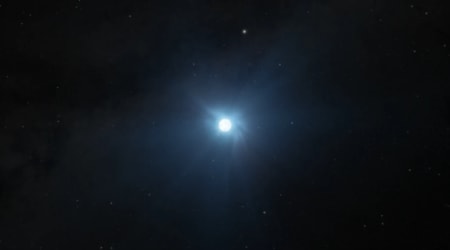
Also designated as M45, the Pleiades is an open star cluster comprising over a thousand stars loosely bound by gravity. Visually, its brightest members dominate the cluster. Notably, the star Merope, situated just outside the cluster's main visual frame, exhibits fascinating optical phenomena when observed through a telescope. Distinctive colorful light rays and blue-white dust streams emanating from Merope are a result of interactions between the star's radiation pressure and surrounding dust particles of varying sizes, as per NASA.

This ancient cluster, visible since antiquity, has no single known discoverer. However, Galileo Galilei, renowned for his astronomical observations and advocacy for a heliocentric solar system, was the first to study the Pleiades through a telescope. Located in the constellation Taurus, M45 is estimated to be 445 light-years from Earth, though this distance remains a subject of ongoing scientific discussions. With an apparent magnitude of 1.6, the cluster is readily visible to the naked eye and is optimally viewed in December.
Fun Fact: The Pleiades hold a prominent place in Greek Mythology, often depicted as the seven daughters of the Titan Atlas and the sea nymph Pleione. Their names, Maia, Electra, Taygeta, Celaeno, Alcyone, Asterope, and Merope, are enshrined in both literary and astronomical contexts. One prevalent legend recounts the relentless pursuit of the sisters by the hunter Orion. To safeguard them, Zeus transformed them into stars, where they perpetually appear to be chased by Orion's constellation across the night sky, as mentioned on Time and Date.