Scorching 'lava world' detected by James Webb Telescope surprises scientists with a thick atmosphere

In a groundbreaking discovery that challenges long-standing planetary science models, researchers using NASA's James Webb Space Telescope have found the strongest evidence yet for a substantial atmosphere surrounding a rocky, ultra-hot exoplanet called TOI-561 b, says NASA.

The finding indicates that even small, extremely hot planets can have a dense blanket of gas and, quite possibly, above a global ocean of magma. NASA, which leads the international Webb mission, announced the results this week, detailing observations of the ultra-hot "super-Earth."

TOI-561 b is an extreme object: With a radius about 1.4 times that of Earth, it belongs to a rare class of "ultra-short period" exoplanets that complete an orbit in less than 11 hours. It is in such a tight gravitational bind with its star, less than a million miles away (that's like one-fortieth the distance between Mercury and the Sun), that its permanent dayside is almost certainly a blazing ocean of molten rock. “What really sets this planet apart is its anomalously low density,” said Johanna Teske, a staff scientist at Carnegie Science Earth and Planets Laboratory and the lead author on the paper published in The Astrophysical Journal Letters. “It’s not a super-puff, but it is less dense than you would expect if it had an Earth-like composition.”
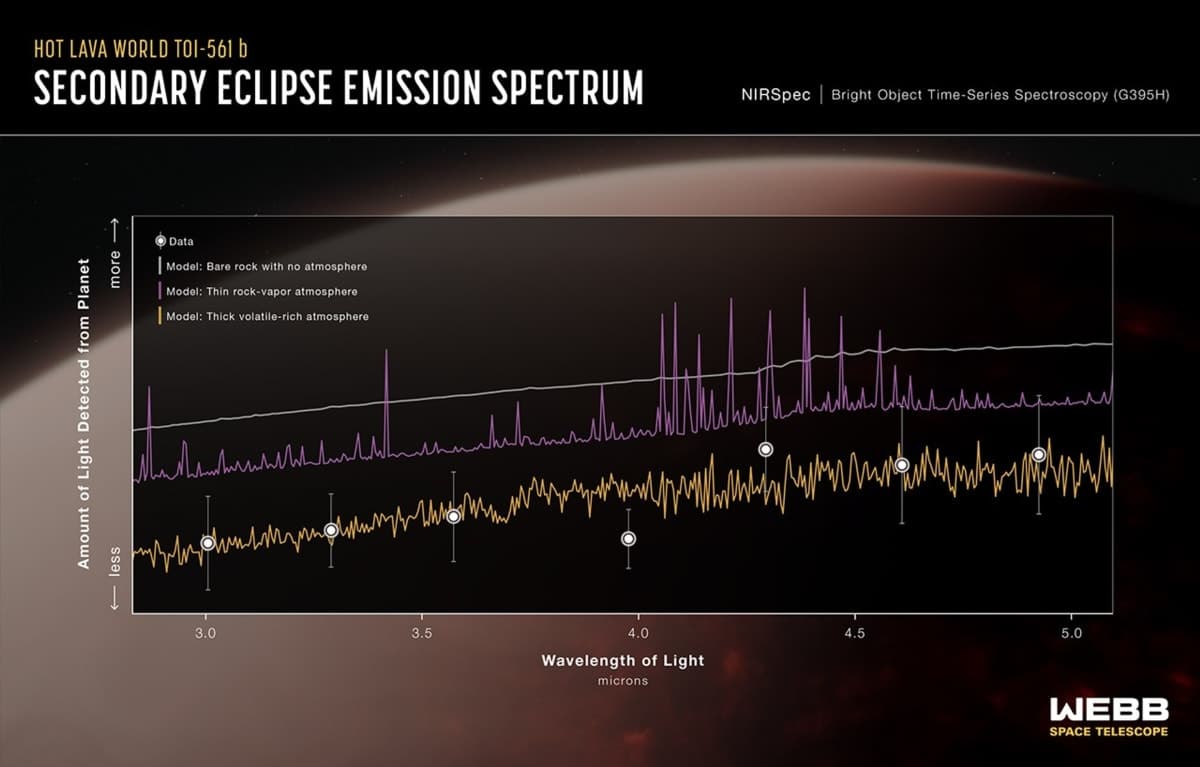
Initial hypotheses centered on a less-dense interior, possibly linked to the star's ancient age and low iron content. But the team suspected a different reason: a thick atmosphere inflated the apparent size of the planet beyond its true dimensions. That went against expectations, as strong radiation from the star should have blown such an atmosphere away long ago.
To test their hypothesis, researchers pointed Webb's Near-Infrared Spectrograph (NIRSpec) at the planet. They measured the dayside temperature based on the light emitted in the near-infrared spectrum. If TOI-561 b were a bare, rocky sphere with no way to distribute heat, its dayside temperature should have approached an unbearable 4,900 degrees Fahrenheit (2,700 degrees Celsius). The NIRSpec observations, however, revealed a dayside temperature closer to 3,200 degrees Fahrenheit (1,800 degrees Celsius). While still incredibly hot, this 1,700°F difference was startling.

“We really need a thick volatile-rich atmosphere to explain all the observations,” said Anjali Piette, a co-author from the University of Birmingham, United Kingdom. According to her, strong winds in the atmosphere would chill the dayside by carrying heat over to the nightside. Water vapor and other gases, meanwhile, would absorb some of the bright near-infrared light emanating from the surface, making the planet look cooler to the telescope.

The findings mark the first results from a large Webb observation program focused on the study of the atmospheric and interior properties of a massive, heavily irradiated ultra-hot super Earth exoplanet. Scientists are now analyzing the full data set to better map the planet's surface temperature and determine the exact makeup of its protective gas layer.
Webb detected the strongest evidence yet for an atmosphere on a rocky planet outside of our solar system! Findings suggest ultra-hot super-Earth TOI-561 b is surrounded by a thick blanket of gases above a global magma ocean. https://t.co/d6g3z4pnUr pic.twitter.com/2VdiyU8LMs
— NASA Webb Telescope (@NASAWebb) December 11, 2025
Correction in the article published on December 13, 2025: The distance between TOI-561 b and its star is approximately one-fortieth the distance between Mercury and our Sun, not one-fourth. The correction has been made and is reflecting now.
More on Starlust
NASA just confirmed 6,000 alien worlds—and 8,000 more waiting to be verified
Scientists find new way to spot life beyond Earth using clouds on distant exoplanets