Saturn's auroras are the reason why the planet appears to change its spin, new study finds
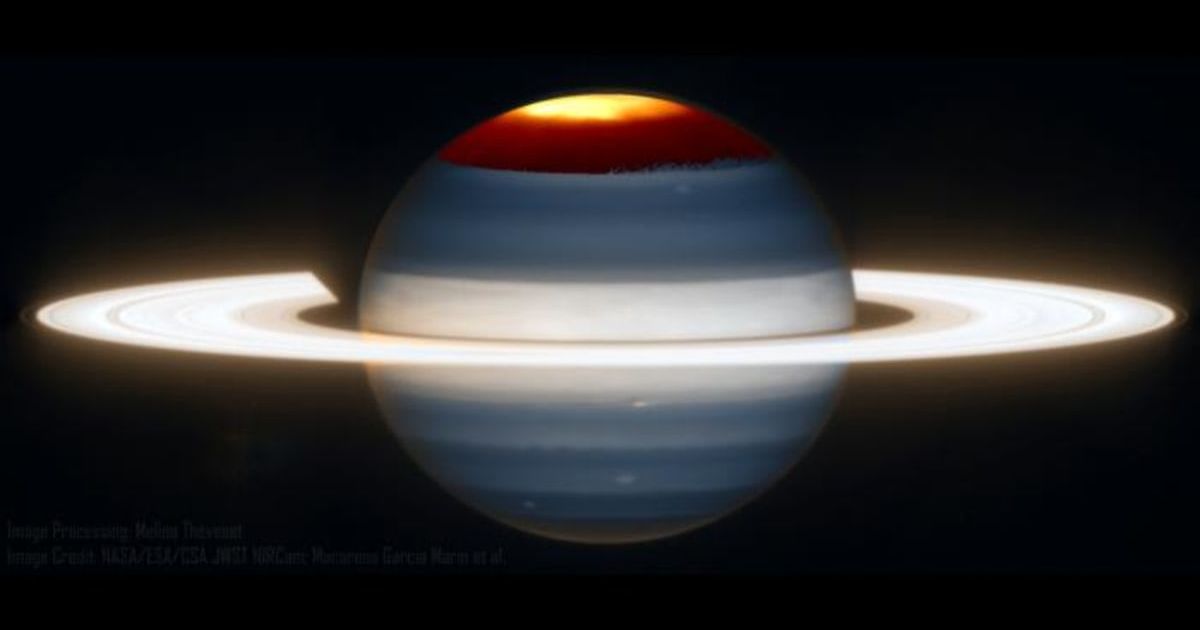
NASA’s James Webb Space Telescope has provided new insights into the generation of winds and electrically charged particles in Saturn’s aurora. The study, published in the Journal of Geophysical Research: Space Physics, reveals that aurora-generated winds may be at the heart of this planet’s apparent changes in rotational speed, with the entire system being driven by a self-sustaining feedback loop. “What we are seeing is essentially a planetary heat pump. Saturn's aurora heats its atmosphere, the atmosphere drives winds, the winds produce currents that power the aurora, and so it goes on. The system feeds itself,” said lead researcher Professor Tom Stallard of Northumbria University in a statement.
![Asymmetric density structure of Saturn's auroral region, revealing where auroral current was flowing into (as darker) and out of (as brighter) the planet.[Image Source: NASA/ESA/CSA, Tom Stallard (NU), Melina Thévenot, Macarena Garcia Marin (STScI/ESA)]](https://de40cj7fpezr7.cloudfront.net/0ecda102-75fe-4de5-9c27-1d8a4d6368c2.png)
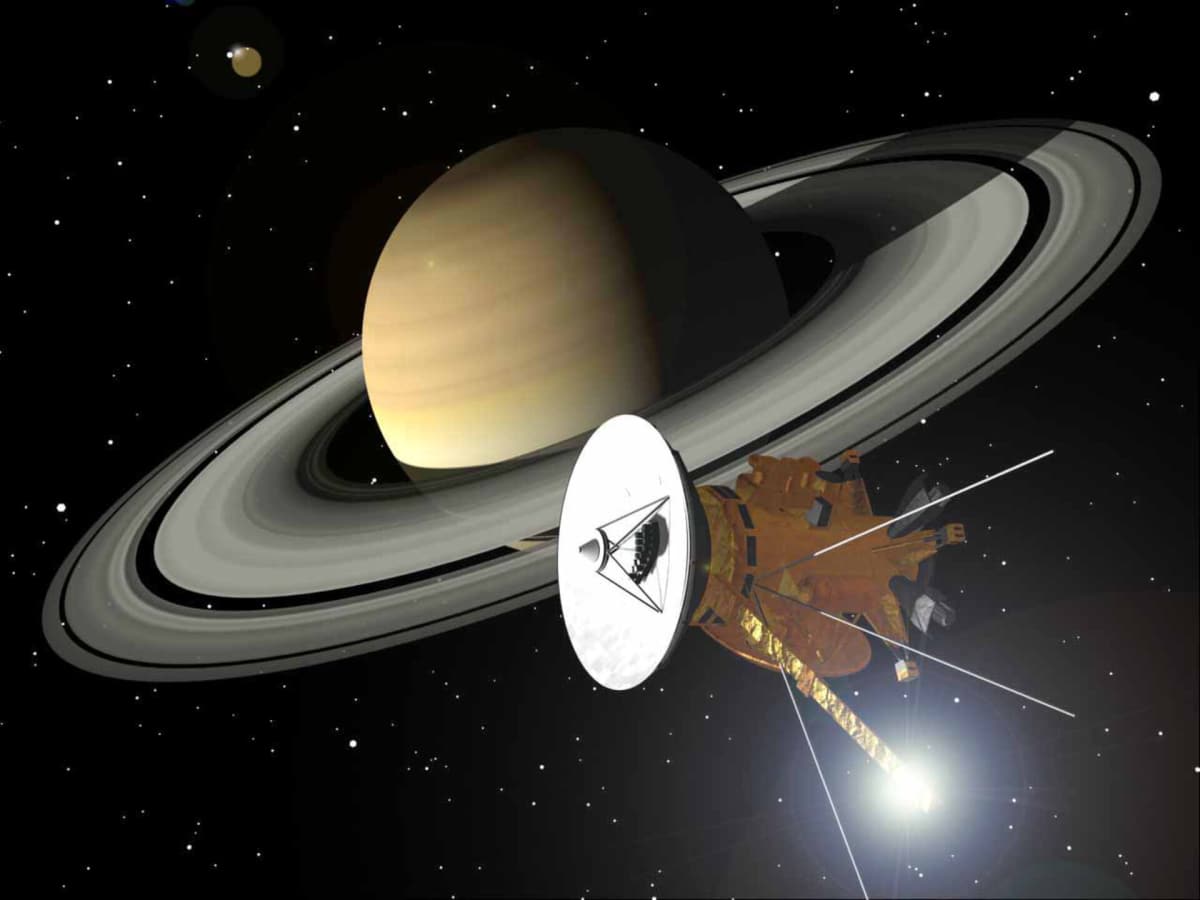
During its fly-bys in 2004, NASA’s Cassini spacecraft hinted that Saturn’s rotation rate was changing slowly over time. But a planet cannot speed up or slow down its spin on its own. In 2021, a study led by Stallard himself found that Saturn was, in fact, not changing its rotation speed at all. The visible changes were driven by winds in the planet's upper atmosphere instead. These winds were producing electrical currents that, in turn, were responsible for misleading auroral signals. But how were the winds being generated? To find an answer, Stallard and his team took a fresh look at the gas giant with the JWST for a full Saturnian day. They monitored Saturn’s northern lights, akin to the ones on Earth. They measured the infrared glow from an ionic molecule called trihydrogen cation in the upper atmosphere.
Based on the measurements, the researchers created high-resolution maps of temperature and particle density across Saturn’s auroral region. The new data reduced errors, producing measurements that were ten times more accurate than the previous ones. Such data gave fine details of heating and cooling across the auroral region. The temperature and density patterns matched remarkably with predictions made by the previous studies based on computer models, but only if the heat source is where the main auroral emissions enter the atmosphere. This made it clear that the auroras on Saturn are actively heating a specific location in its atmosphere, creating winds that generate electric currents responsible for the production of auroras.

“For decades, we knew something strange was happening with Saturn's apparent rotation rate, but we could not explain it,” said Stallard. “We then showed it was being driven by atmospheric winds, but we still did not know why those winds existed. These new observations, made possible by JWST, finally give us the evidence we needed to close that loop.” The findings have thrown new light on Saturn’s atmosphere, implying that changes in the planet’s atmosphere also affect the conditions in its surrounding magnetosphere—the region of space shaped by the planet's magnetic field—which channels the energy back into the system. The researchers think that this relationship can explain the stability of the effect as well as its long-lasting nature.
More on Starlust
NASA's James Webb teams up with Hubble to image Saturn's atmosphere in unprecedented detail
Scientists recreate the ocean of Saturn's icy moon Enceladus in lab