Russia to revive Venus exploration with Venera-D mission planned for 2036

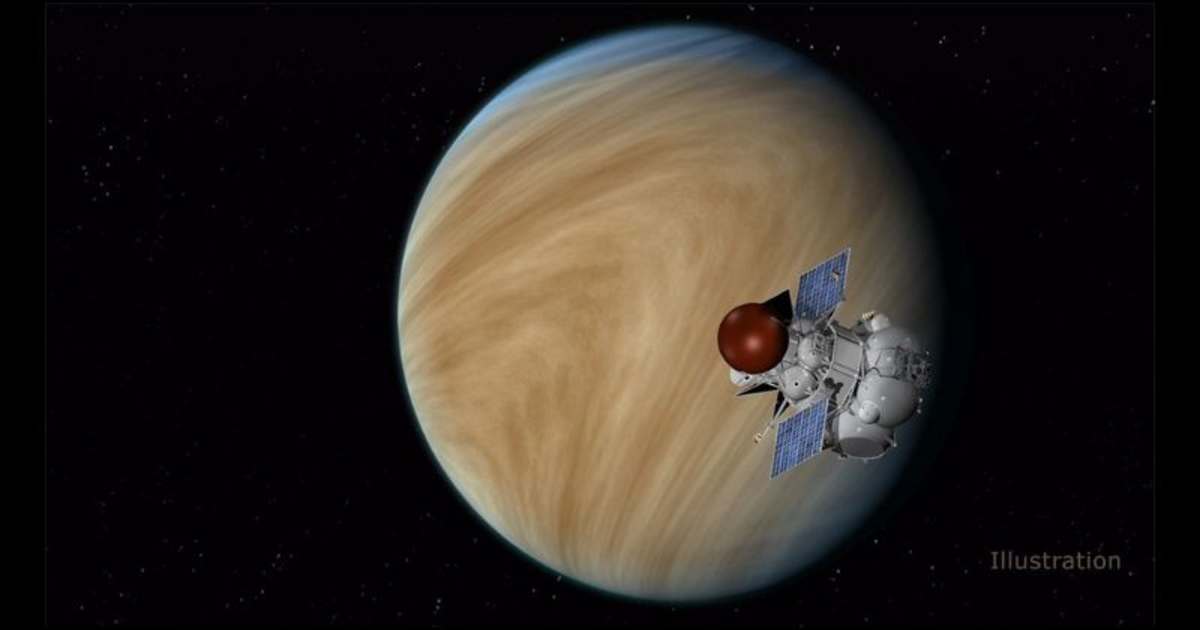
Russia is all set to begin efforts toward Venera-D or Venera-17, a renewed Venus landing mission. Expected to launch around 2036, Venera-D would include multiple vehicles and elements like a lander, a balloon probe, and an orbiter. Speaking to Russian state media, First Deputy Prime Minister Denis Manturov said that Venus and the Moon are currently the main targets of Roscosmos and the Russian Academy of Sciences. The mission would mark Russia’s return to Venus after decades, for the first time as the Russian Federation, and not the former Soviet Union.
The historic Venera program marked the first-ever successful Venus landing achieved by any space agency. So, Venera-D was arguably inevitable, but it had been facing several hurdles right from its origins in 2003. Now, Russia seems to be going forward with this mission — a clear message that Venus takes priority over other planets in their space exploration strategy. “Let me remind you that back in 1970, our country succeeded in successfully landing a spacecraft on another planet in the Solar System. And that was Venus,” said Manturov. “Therefore, we will probably move in this direction first.”

The upcoming Venera mission’s architecture would allow scientists to study Venus from all vantage points — from orbit, inside the atmosphere, and on the surface. Finding microbial life in the Venusian atmosphere is one of the primary scientific goals. Lev Zeleny, the scientific director of the Space Research Institute (IKI) of the Russian Academy of Sciences, said the mission would check Venus’ cloud layers and surface for biomarkers of primitive life. This builds on preliminary findings around possible traces of phosphine and ammonia in the atmosphere, both potentially chemical evidence of life. These detections still lack validation, and the Venera-D mission would help clear the air.

Earlier, Corresponding Member of the Russian Academy of Sciences Oleg Korablev had stated that preliminary design work for Venera-D was planned to begin in January 2026. At one point, a potential NASA collaboration had been in the works for this mission, but the Russia-Ukraine situation in 2022 put an end to this idea before it even began. Regardless, Venera-D aims to build on Russia’s legacy (as the former Soviet Union) as the only nation to successfully land and operate spacecraft on the surface of Venus. In 1970, Venera 7 marked the first ever soft landing on a different planet, and the first exchange of data from that planet to Earth.

Some may label Venus as Earth’s sister planet, but its hostile, unforgiving conditions suggest completely otherwise. All Venera missions had to withstand and operate, braving the planet’s surface temperature around 900°F (480°C) and over 90 times more pressure than Earth’s atmosphere. The now-iconic images sent by the Soviet landers show the harsh surface of Venus with a yellow tint thanks to its thick sulfuric-acid clouds.
VERITAS = Venus Emissivity, Radio science, InSAR, Topography, And Spectroscopy
— NASA JPL (@NASAJPL) August 11, 2023
It's an orbiter designed to peer through Venus’ thick atmosphere with a suite of powerful instruments, creating global maps of the planet’s surface and detecting its changes. https://t.co/ek4emfAhyc
The Venera series of missions went on for nearly 22 years, until Venera 16 in 1983, and the upcoming 2036 launch would mark Russia’s return to Venus for the first time in over half a century. However, it’s unlikely that they would be going at it alone. NASA has two Venus missions on the radar — VERITAS and DAVINCI, both surviving cancellation in the latest U.S. budget. India, too, plans to launch one in 2028. On the private front, the Venus Life Finder mission by Rocket Lab and MIT could launch as early as this year.
More on Starlust
Soviet Spacecraft failed to land on Venus and is plummeting back to Earth after 53 years
Russia reveals plan to build a new space station using recycled modules from the ISS