New observations from Hubble reveal insights into a spiral galaxy's supernova history

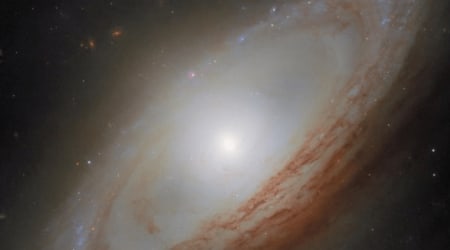
A recent image captured by the NASA/ESA Hubble Space Telescope reveals the spiral galaxy IC 758, located 60 million light-years away in the constellation Ursa Major. It appears remarkably still, peacefully located far from reach. Scientists have witnessed its arms curving around its unclear core, as per NASA. Standing as a picture of grace today, IC 758 was much bigger than it now seems, with astronomers marking its daunting explosion in 1999. Kathryn Kreckel, a team member from Heidelberg University in Germany, noted the brilliance of the hyper-detailed image, "We can zoom in to study individual regions where stars form at nearly the scale of individual stars, but we can also zoom out to study the galaxy as a whole."
Shining serenely in this new #HubbleFriday view, IC 758 might look calm – but it hides a cataclysmic past.
— Hubble (@NASAHubble) June 13, 2025
Researchers are using Hubble to gather clues about a previous supernova explosion in this galaxy: https://t.co/uoUYwqxZSf pic.twitter.com/jaCKYJbMlD
A powerful supernova, SN 1999bg, had pushed IC 758 — a star bigger than the Sun — towards its end. While the exact mass of the progenitor star remains unknown, researchers will leverage these new Hubble observations to measure the masses of stars in SN 1999bg's vicinity. This data is expected to help estimate the original mass of the supernova-generating star. Furthermore, the Hubble imagery may offer crucial insights into whether SN 1999bg's progenitor had a companion star, which would in turn provide additional clues about its life cycle and dramatic end.

A supernova is more than just the spectacular death of one single star; it's a force that profoundly shapes its cosmic surroundings. When a massive star collapses and explodes, its outer layers rebound violently from its dense, shrunken core. The colossal explosion dramatically stirs the vast expanse of gas and dust from which new stars are born. This "interstellar shakeup" can have dual effects: it can either scatter and heat nearby gas clouds, thereby preventing new star formation, or it can compress them, triggering a sudden burst of new stellar births. Moreover, the material ejected by the supernova enriches the interstellar medium with heavy elements forged deep within the star's core, providing essential building blocks for subsequent generations of stars.
Building on our understanding of complex galactic systems, astronomers have also released a remarkable new image of the Sculptor Galaxy, also known as NGC 253. Located approximately 11 million light-years away, the image offers an unprecedented view of the galaxy's complex structure, showcasing the dynamic interplay of stars, gas, and dust that define these vast cosmic islands.

The image was captured using the Multi Unit Spectroscopic Explorer (MUSE) instrument at the Very Large Telescope (VLT) in Chile. Scientists anticipate that these observations will offer crucial insights into the still-mysterious intricacies of galactic systems. Enrico Congiu, team leader at the Universidad de Chile, noted in a statement that the Sculptor Galaxy is "in a sweet spot" because it's both close enough for them to examine its internal structure and individual components in incredible detail, yet large enough to be viewed as a complete system.

Initial review of this image has already yielded significant discoveries. Scientists identified an astounding 500 new planetary nebulae — shells of gas and dust ejected from Sun-like stars after they "die." Finding so many is particularly noteworthy, as such detections are rare beyond our galactic boundary. As Fabian Scheurmann, a researcher at Heidelberg University, explained, "Beyond our galactic neighborhood, we usually deal with fewer than 100 detections per galaxy." This highlights the power of advanced telescopic observations in expanding our knowledge of the universe's dramatic processes.