NASA's Hubble Space Telescope captures the 'clearest' image yet of Egg Nebula
![NASA's Hubble Space Telescope reveals the clearest view yet of the Egg Nebula. [Cover Image Source: NASA, ESA, Bruce Balick (UWashington)]](https://d3hedi16gruj5j.cloudfront.net/791204/uploads/17301ef0-080e-11f1-8446-a72e5374434f_1200_630.jpeg)
NASA’s Hubble Space Telescope has captured a breathtaking view of the Egg Nebula, showing beams of light that pierce through a dying star’s dusty shroud. Located about 1,000 light-years away in the Cygnus constellation, this structure features a central star hidden inside a thick dust cloud, like a yolk in an opaque egg white, except the yolk appears to have many layers of its own. Twin beams from the star illuminate fast-moving polar lobes that cut through slower, concentric bubbles of dust, hinting at gravitational tugs from a hidden star, or a multitude of them, buried within the density of the disk. This latest image combines data obtained in 2012 from Hubble’s WFC3 (Wide Field Camera 3) camera with additional observations from the same program, which helped achieve the "clearest" view yet of the nebula’s intricate patterns.
![Rainbow image of the Egg Nebula taken with Hubble's Advanced Camera for Surveys in September and October 2002. [Image Source: NASA and The Hubble Heritage Team (STScI/AURA); Acknowledgment: W. Sparks (STScI) and R. Sahai (JPL)]](https://de40cj7fpezr7.cloudfront.net/9b633df7-f38a-48c4-98cb-4489bb41f87d.jpg)
The Egg Nebula is unique in that it happens to be the first, youngest, and closest pre-planetary nebula known, according to NASA. A pre-planetary nebula is a precursor to a planetary nebula, which forms out of the ejected layers of a dying Sun-like star and has nothing to do with planets despite its name. This nebula’s presence provides a unique window into the final stages of a star’s life, which is said to be very similar to our own star, the Sun. In this phase, it is the light from the central star, escaping through the polar "eye," that makes the nebula shine. Judging by how symmetrical its patterns are, it is unlikely that they resulted from a supernova explosion. Instead, scientists attribute the lobes, arcs, and the central dust cloud to sputtering events in the carbon-rich core.
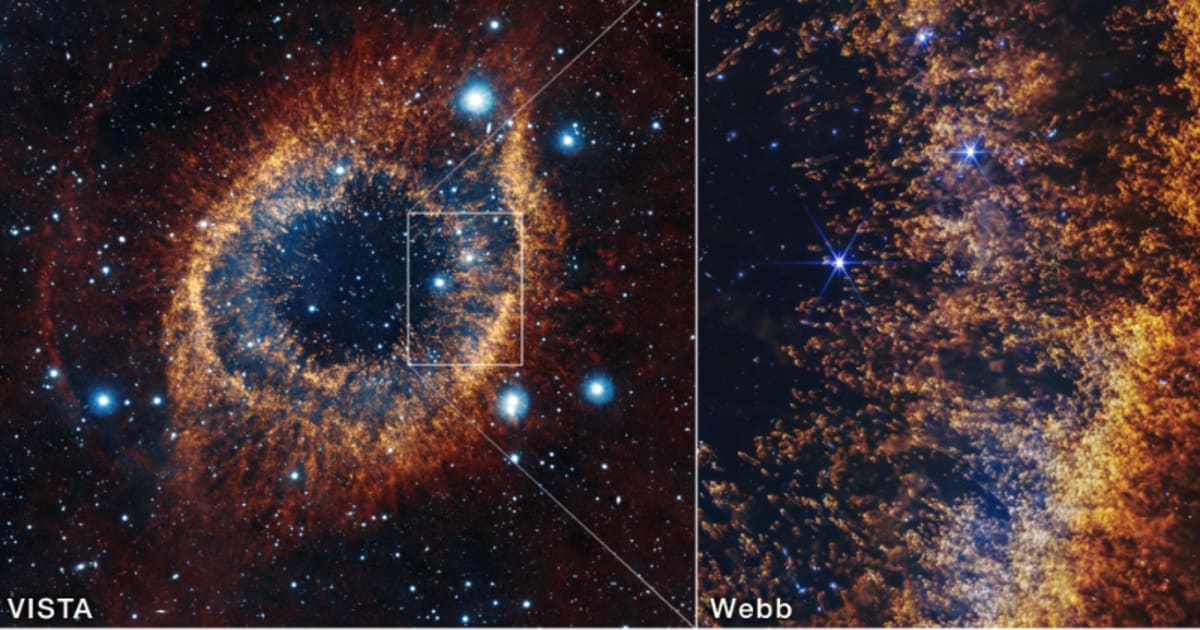
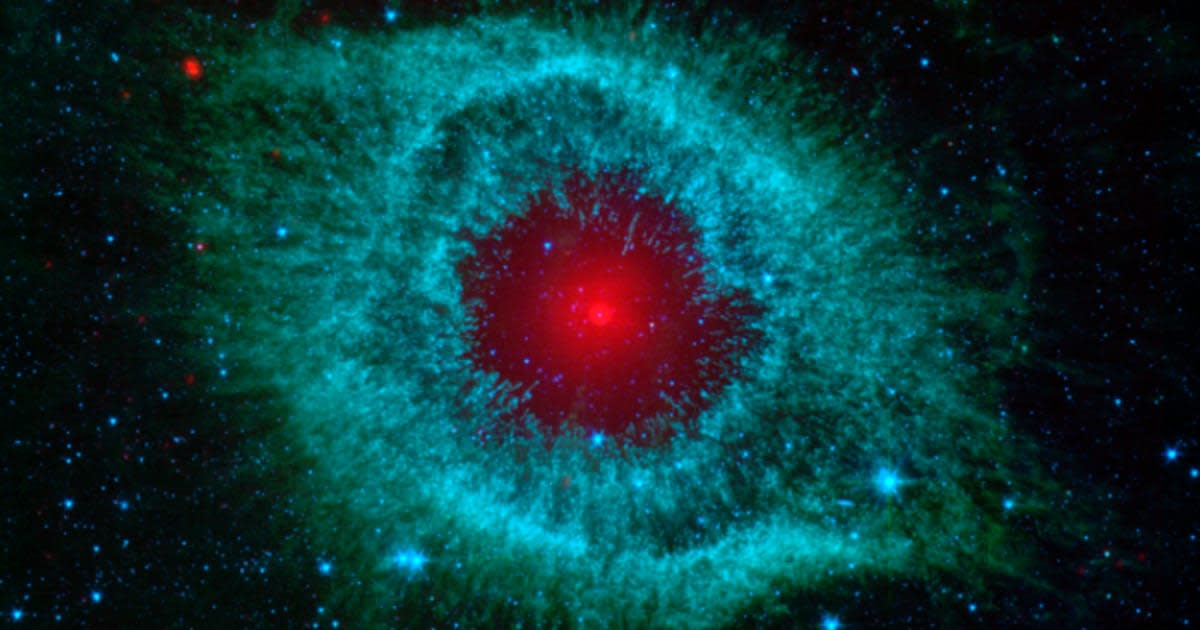
The nebula, being pre-planetary, is unlike mature planetary nebulae such as the Helix or Butterfly nebulae. Observations over decades, from WFPC2 (Wide Field and Planetary Camera 2) in the late 1990s to ACS (Advanced Camera for Surveys) in 2003 and WFC3 in 2012, have tracked the light, the ripples of dust, and the gas outflows of the nebula. The latest forensic snapshot captures evidence of its ejection process before it fades away. In general, for planetary nebulae, these structures arise from dying stars exhausting their hydrogen and helium fuel. Throughout celestial history, nebulae with their clouds of dust and gas have later gone on to form rocky worlds around new stars.
Managed by NASA’s Goddard Space Flight Center in collaboration with the European Space Agency, Hubble’s legacy now spans over three decades as it continues to capture path-breaking visuals of the universe, thereby enriching our understanding of it.
More on Starlust
NASA's James Webb Space Telescope pictures Helix Nebula in extraordinary detail
Stunning new image of Butterfly Nebula captured by Gemini South telescope in Chile