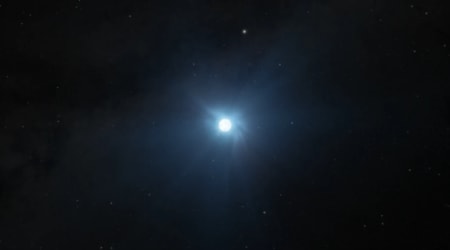
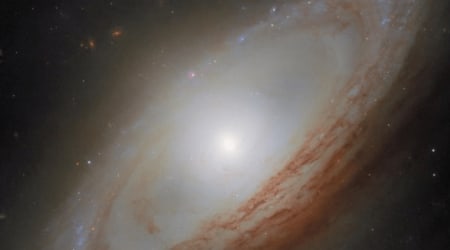
Helix planetary nebula

The Helix Nebula is one of the closest of all planetary nebulae, lying at a distance of about 400 light-years from Earth.
UPDATED JUN 26, 2024
helix nebula
helix nebula

The Helix Nebula is one of the closest of all planetary nebulae, lying at a distance of about 400 light years from Earth.

To find the nebula, start from Fomalhaut (Alpha Piscis Austrinus) and move your telescope 11 degrees northwest to 5th-magnitude 47 Aquarii. From this star slide two degrees east to Upsilon Aquarii, and you’re almost there. The Helix Nebula is just one degree west of this star.

The planetary appears bright at magnitude 7.3, and a huge 12.8 arcminutes across. This is about half the size of the Full Moon! However, despite its large size the nebula is faint and has a low surface brightness, making it hard to pick out from the sky background.

Small scopes show NGC 7293 as a circular misty patch, and a 150-mm telescope reveals that the center is dark and contains a 13th-magnitude star.

If observed from a dark location the Helix is visible even with binoculars, that show the object as a large circular hazy spot. Rich-field instruments with wide-angle eyepieces are ideal for picking up objects like this on the night sky.
MORE STORIES

Astronomers have sifted through half a petabyte of data to create a detailed 3D map.
1 day ago
The inner three stars are so tightly packed that they would fit inside the orbit of Mercury.
2 days ago
A strange fading radio signal hints at powerful gamma-ray burst or an elusive black hole.
3 days ago
The Jupiter-bound spacecraft got 120+ images that reveal jets, dust streams, and a glowing coma.
4 days ago
The planetary system TOI-2076 can help astronomers understand how planets change between birth and adulthood.
4 days ago
Supermassive black hole binaries where the black holes are separated by short distances are extremely hard to find.
Feb 26, 2026
The Karl G. Jansky Very Large Array in New Mexico and the MeerKAT radio telescope in South Africa were employed for the project.
Feb 26, 2026
The plan aims to launch a spacecraft directed towards the comet in 2035.
Feb 25, 2026
The discovery made by a large research team challenges the existing models of the universe.
Feb 24, 2026