NASA’s Hubble finds largest chaotic ‘sandwich’ where planets are born, baffling astronomers
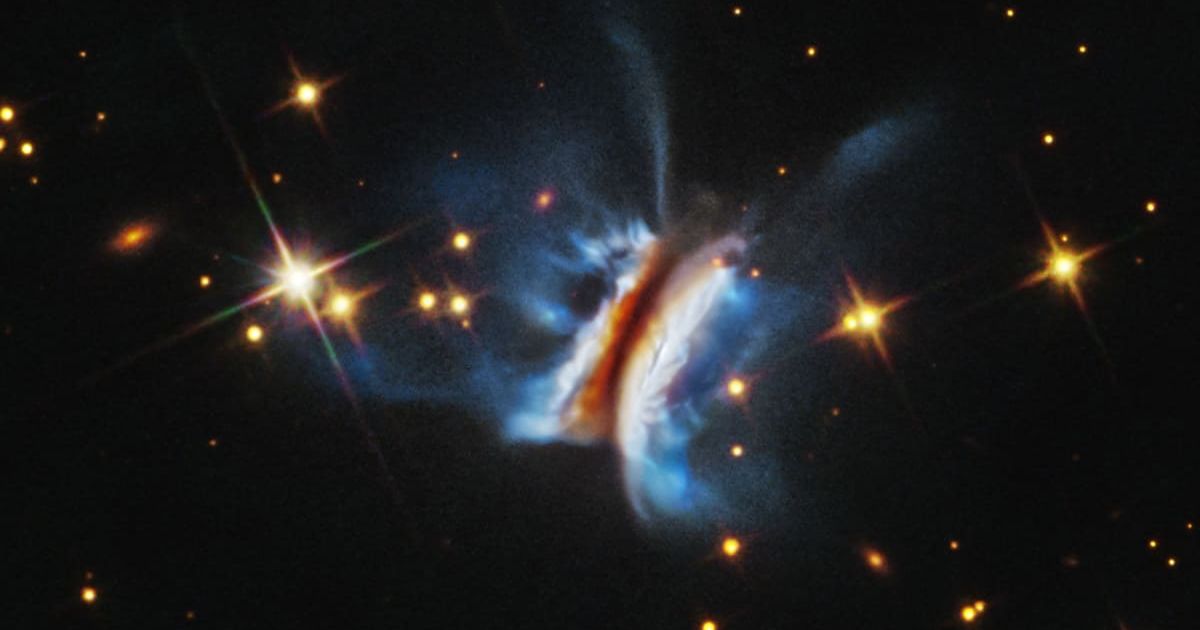
The largest protoplanetary disk ever has been found by the Hubble Space Telescope and is quite active as materials stretch in the system.
PUBLISHED 1 HOUR AGO
This Hubble Space Telescope image shows the largest planet-forming disk ever observed around a young star. (Cover Image Source: NASA | Photo by NASA, ESA, STScI, Kristina Monsch (CfA); Image Processing: Joseph DePasquale (STScI))

NASA’s Hubble Space Telescope imaged for the first time a chaotic and turbulent disk in visible light. It found the largest protoplanetary disk ever observed orbiting a young star with material extending out from both ends. The details published in The Astrophysical Journal revealed that the filaments are unlike any observed before and extend more on one side of the disk. Known as IRAS 23077+6707 and nicknamed “Dracula’s Chivito,” the disk is around 1,000 light-years from Earth and spans around 400 billion miles, as per NASA.
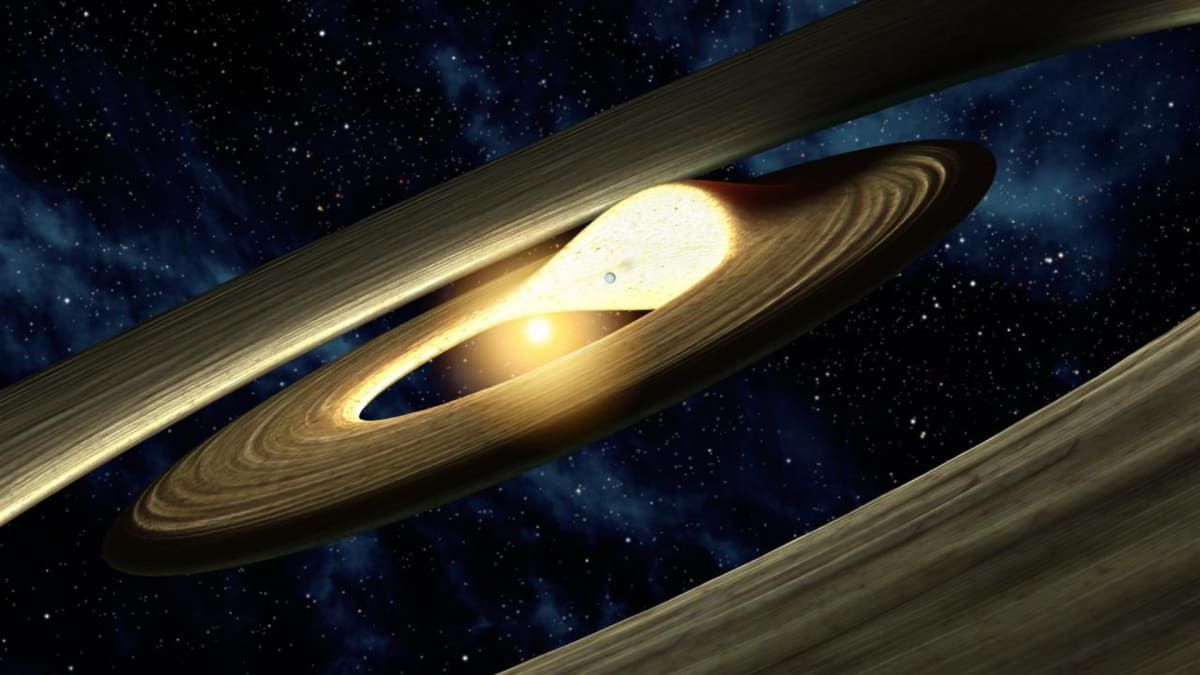
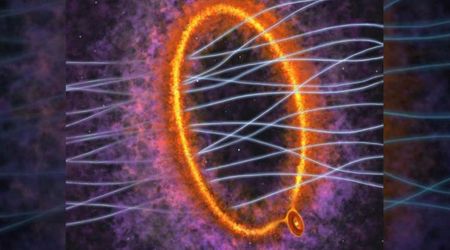
This artist conception shows a lump of material in a swirling, planet- forming disk. (Representative Image Source: NASA Image and Video Library | Photo by NASA/JPL-Caltech)
This artist's conception shows a lump of material in a swirling, planet- forming disk. (Representative Image Source: NASA Image and Video Library | Photo by NASA/JPL-Caltech)

The disk completely hides the young star inside, and is assumed to be a hot, massive star, or a pair of stars. “The level of detail we’re seeing is rare in protoplanetary disk imaging, and these new Hubble images show that planet nurseries can be much more active and chaotic than we expected,” said lead author Kristina Monsch of the Center for Astrophysics at Harvard & Smithsonian (CfA). “We’re seeing this disk nearly edge-on, and its wispy upper layers and asymmetric features are especially striking,” they added. 
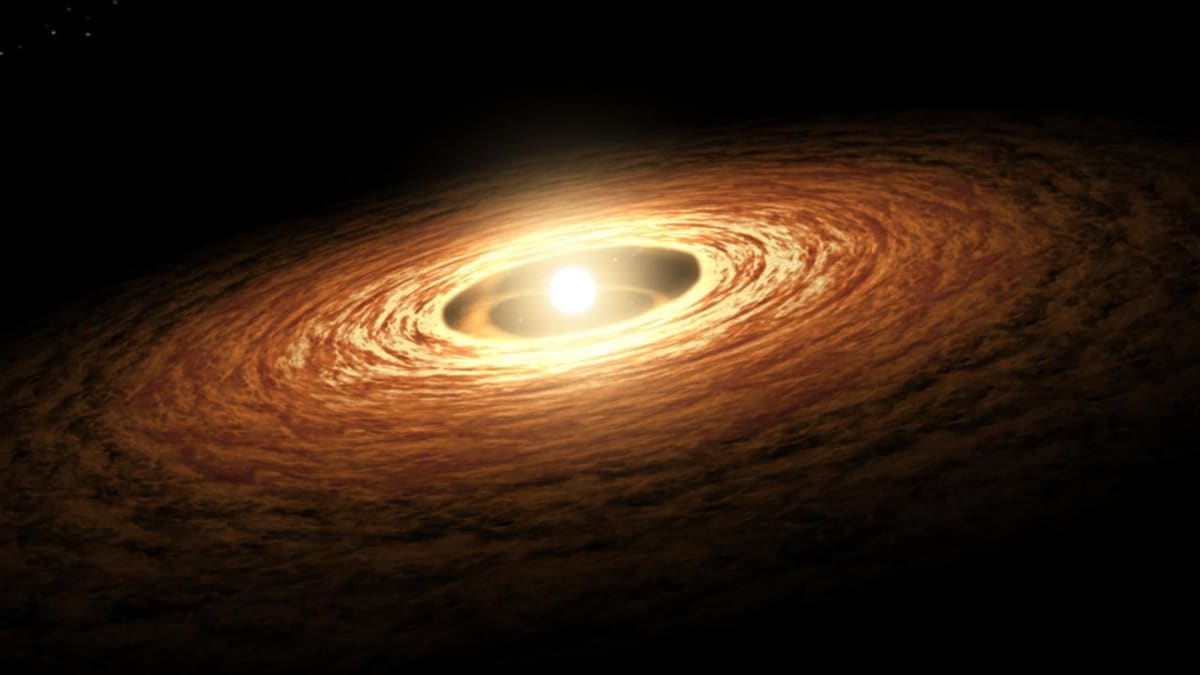
The image shows a young sun-like star encircled by its planet-forming disk of gas and dust. (Representative Image Source: NASA Image and Video Library | Photo by NASA/JPL-Caltech)

The “Dracula’s Chivito” helped trace substructures in great detail, though Hubble and NASA’s James Webb Space Telescope had observed other similar structures. Studying this structure in visible light helped us understand planet formation and the environments that foster it. The name “Dracula’s Chivito” hints at the national dish of Uruguay, a sandwich called a chivito. The shape of the structure was compared to a hamburger, given its layered design and extended materials. The structure was also lopsided, which indicated the dynamic processes that influenced its shape.
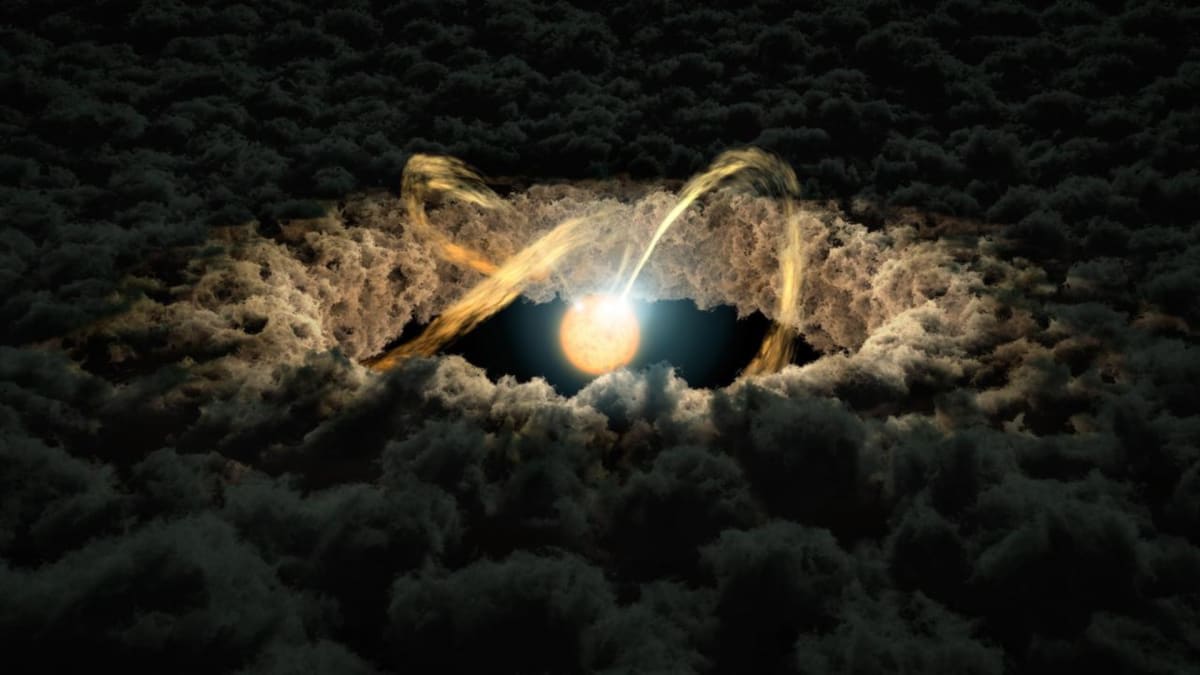
This illustration shows a star surrounded by a protoplanetary disk. (Representative Image Source: NASA Image and Video Library | Photo by NASA/JPL-Caltech)

The vertically extending filament-like features were observed only on one side, while the other appeared to have a sharp edge with no visible filaments. The processes could involve infall of dust and gas, or interactions with its surroundings. Disks of gas and dust around young stars can be seen in all planetary systems, and this new one is a large-scale version of the early solar system. IRAS 23077+6707 has an estimated disk mass that is 10 to 30 times that of Jupiter, which contains more than enough material to form multiple gas giants.
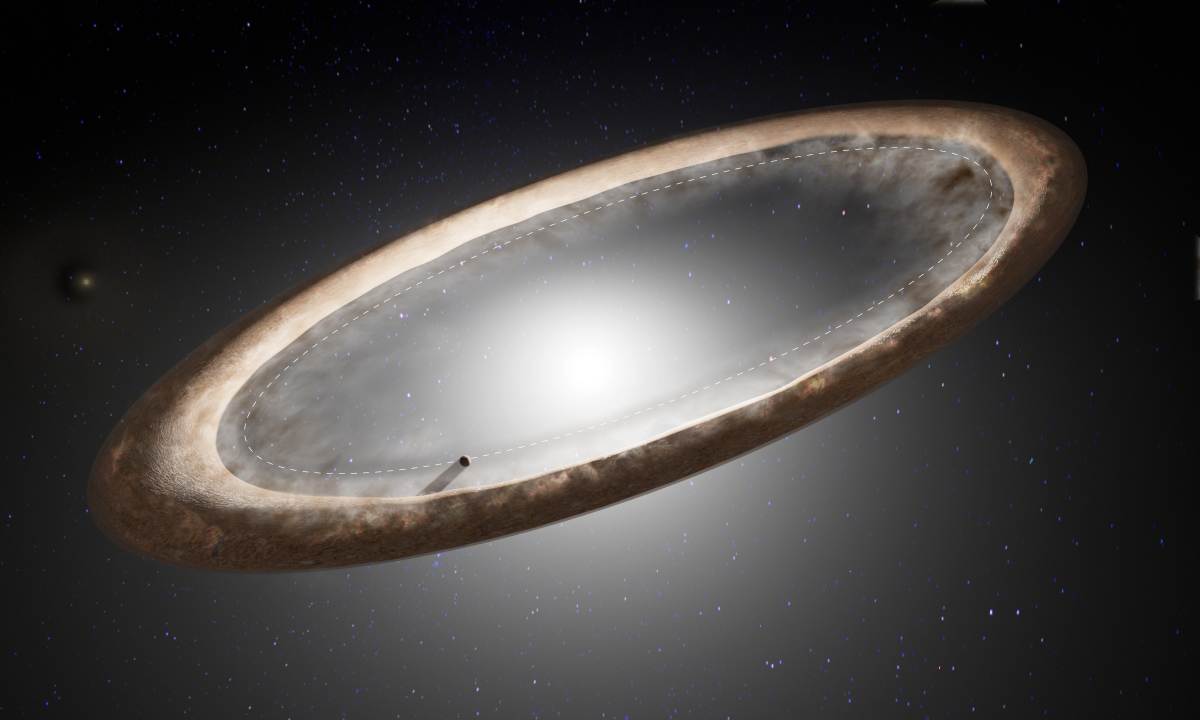
The bright star in the center, Fomalhaut, is surrounded by an ancient debris disk of uneven brightness (Cover Image Source: NSF/AUI/NSF NRAO | B. Saxton)
The bright star in the center, Fomalhaut, is surrounded by an ancient debris disk of uneven brightness (Representative Image Source: NSF/AUI/NSF NRAO | B. Saxton)

“In theory, IRAS 23077+6707 could host a vast planetary system,” said Monsch. Though the formation itself might differ in this different environment, the processes involved could be the same. The volatile nature of the disk was a unique research arena for experts, and planetary disks are the building blocks of solar systems, according to Popular Science. “These new Hubble images show that planet nurseries can be much more active and chaotic than we expected,” Monsch added about the disk’s turbulence.
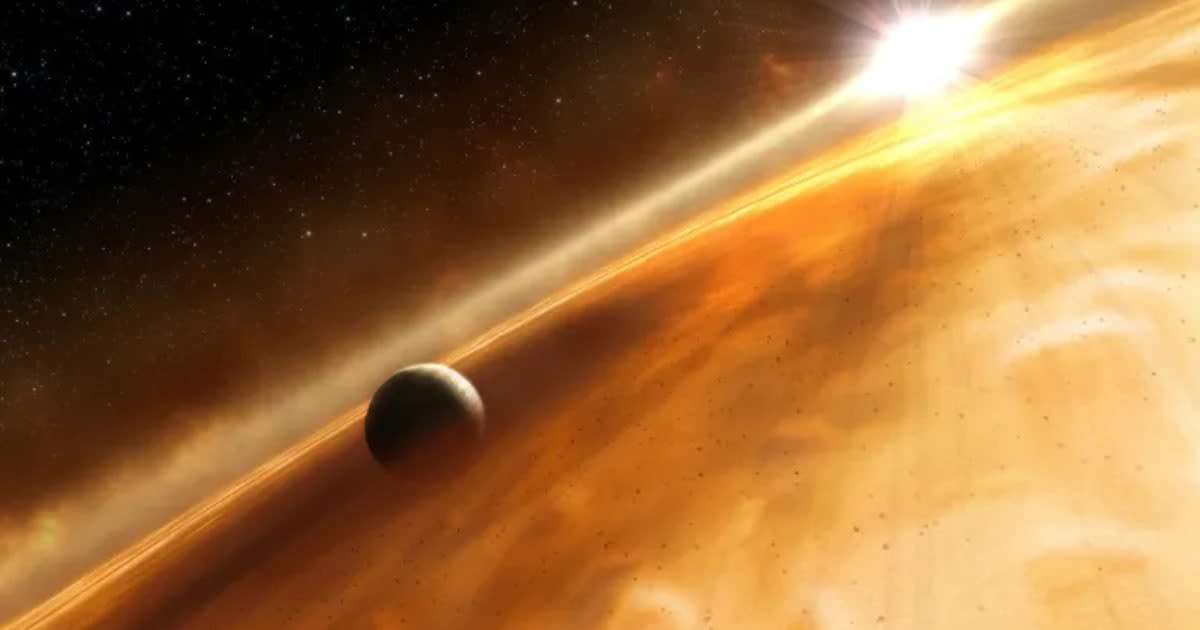
NASA's Hubble Space Telescope has taken the first visible-light snapshot of a planet circling another star (Image Source: NASA)
NASA's Hubble Space Telescope has taken the first visible-light snapshot of a planet circling another star (Representative Image Source: NASA)

“Hubble has given us a front row seat to the chaotic processes that are shaping disks as they build new planets, processes that we don’t yet fully understand but can now study in a whole new way,” said study co-investigator Joshua Bennett. The Hubble Space Telescope, though not as powerful in its technology as the James Webb, is continuously contributing to science. Hubble captured a unique glimpse of colliding space rocks, a white dwarf munching on a Pluto-like object, and created the largest photomosaic of the Andromeda galaxy yet, all during this year.

More on Starlust

NASA's Hubble captures new view of 3I/ATLAS as ESA’s Juice spots heightened comet activity
NASA's Hubble captures stunning image of Tarantula Nebula, brightest star-forming region in local universe

MORE STORIES

The astronomer looked into the possibility of materials from 3I/ATLAS hitting Earth following the comet's closest approach.
1 day ago
NASA scientists have finally pinpointed the source of mysterious radiation from a supermassive black hole, solving a puzzle that has lasted for years.
7 days ago
Webb uncovers evidence of giant primordial stars that may explain how early black holes formed less than a billion years after the Big Bang.
Dec 16, 2025
Smaller black holes tend to attract less material, making them naturally dimmer. Chandra would miss many of these faint objects.
Dec 15, 2025
The data suggest this small, super-hot world is shrouded in a thick layer of gas, likely hovering above a planet-wide ocean of magma.
Dec 13, 2025
The region around black holes was not thought to be conducive to star formation, yet research proved otherwise.
Dec 12, 2025
The discovery, validated by a separate European team led by the University of Exeter, may offer fresh insight into interactions between planets and binary star systems.
Dec 12, 2025
During its 1986 observation of the planet in the first and only flyby, the spacecraft measured a surprisingly strong electron radiation belt.
Dec 11, 2025
Previously, the most ancient supernova ever confirmed dated back to when the universe was 1.8 billion years old.
Dec 10, 2025