Misidentified near-Earth object now linked to Elon Musk after closer examination

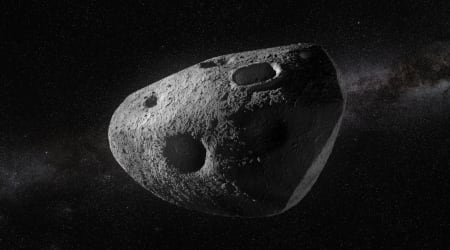
In a surprise turn of events, a celestial body initially spotted by an amateur astronomer in Turkey and classified as a near-Earth object turned out to be something quite different. This misidentification has revealed a fascinating tale connected to humanity's ventures beyond Earth, as per a recent article by Daily Galaxy.

What was briefly cataloged as asteroid 2018 CN41 by the International Astronomical Union’s Minor Planet Center (MPC) on January 2, based on an amateur astronomer's analysis of public data in Turkey, was quickly recategorized. Just 17 hours later, the MCP corrected its announcement: the supposed asteroid was actually the long-term travelling remains of the Tesla Roadster launched by SpaceX in 2018. The object had been orbiting the sun for nearly six years, per the publication.

The vehicle, with its mannequin passenger, "Starman," was the unusual payload of SpaceX's inaugural Falcon Heavy Launch back in February 2018. Instead of reaching Mars, it entered a solar orbit, completing around 4.5 orbits around the sun, traveling at a speed of up to 45,000 mph. The car and Starman have been floating through space for years.

Peter Veres, the one who created the database entry for 2018 CN41, addressed the error and noted, “(The amateur astronomer) was correct. (The data points) really did belong together." He further said, "But again, we just receive the numbers — the positions, and even the astronomers (using) telescopes, they just see a dot that is moving." Veres continued, "So from that perspective, if you don’t know up front it’s a Tesla Roadster, there is no way to tell," as reported by CNN.
This misidentification is not unique. Several other artificial objects and debris, including ESA’s Rosetta probe and NASA’s Lucy mission, have previously been mistaken for asteroids. As more human-made objects are launched into space, this increasing frequency raises concerns about potential costly errors in space exploration. On this, Jonathan McDowell, an astronomer at the Harvard-Smithsonian Center for Astrophysics, said, "You spend a billion [dollars] launching a space probe to study an asteroid and only realize it’s not an asteroid when you get there,” warning that such errors could lead to expensive failures.
The president of the American Astronomical Society, Dara Norman, said in an interview with CNN, "What we’d like to do is work in cooperation with those commercial entities to be able to make sure that science isn’t impacted in some of the most egregious ways. If we’re confused about whether something is an unknown asteroid or a Tesla Roadster, then it starts to cost us money to do things like tracking it or figuring it out.”

While objects orbiting Earth are being tracked, there are no similar requirements for objects leaving the planet's gravity, like Tesla Roadster. There's a lack of mandated transparency from companies and agencies regarding their deep-space objects. This issue of space situational awareness is a growing worry for astronomers. The American Astronomical Society (AAS) has recently stressed the need for improved tracking of human-made space objects to avoid interruptions with missions, confusion with natural celestial bodies, and ensure the safety and coordination of space exploration, as reported by Daily Galaxy.