James Webb Space Telescope reveals strange features of auroral footprints of Jupiter's moon Io
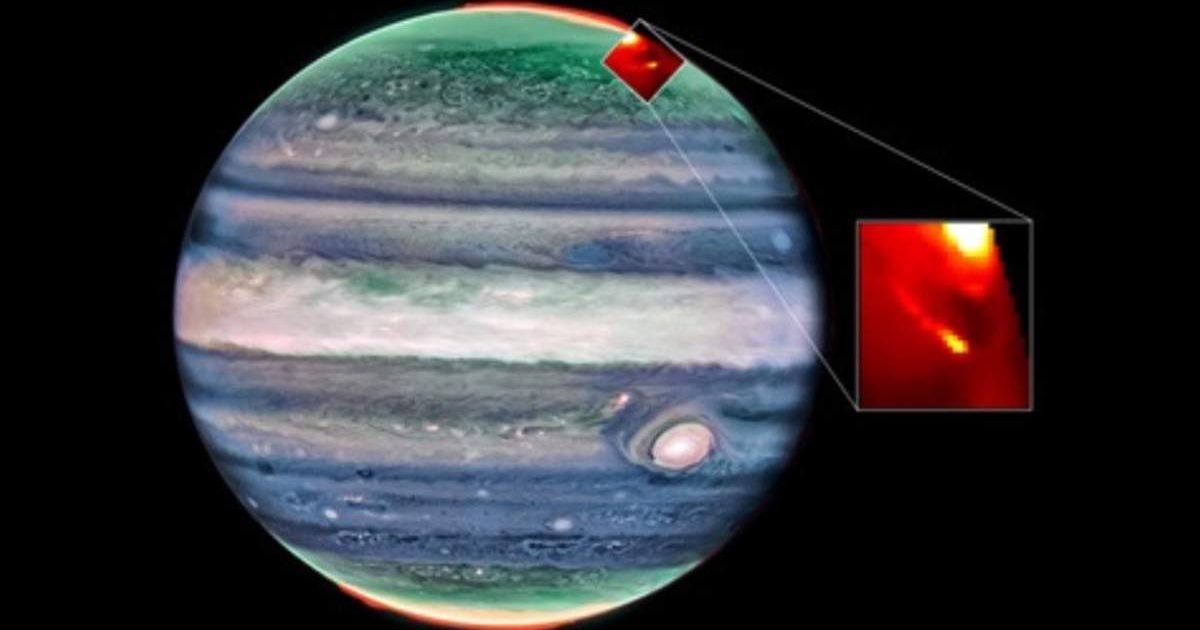
Back in September 2023, a research team chasing Jupiter's northern lights using the James Webb Space Telescope made the first spectral measurements ever of the infrared auroral footprints created by two of the planet's moons—Io and Europa. “These emissions have been measured previously at ultraviolet and infrared wavelengths, but only sporadically in how brightly they shine,” said Katie Knowles, a PhD researcher at Northumbria University and the lead author of the study published in Geophysical Research Letters, in a statement. “With Webb’s incredible sensitivity, we have been able to extract the physical properties of the auroral footprints for the first time, including the temperature of the upper atmosphere and the ion density, which has never been reported on before.”
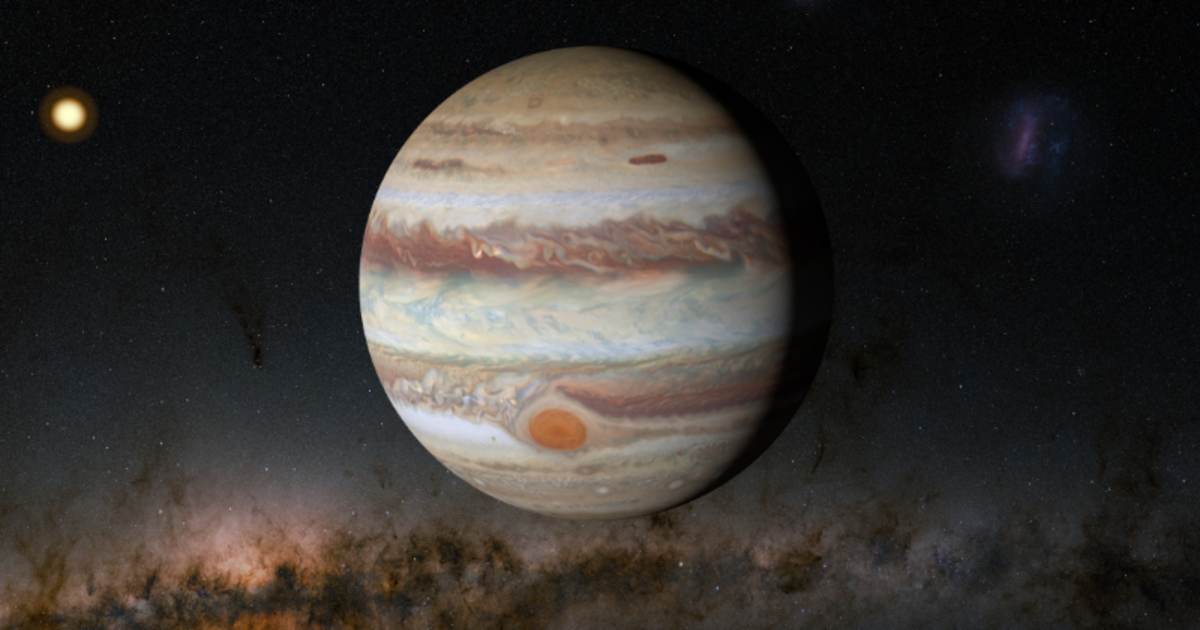
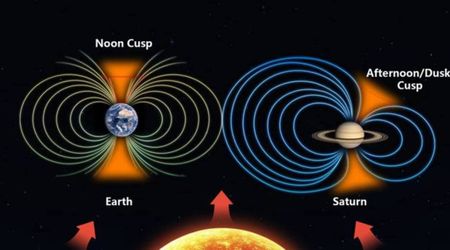
On Earth, solar winds' charged particles interact with the planet’s magnetic field to create auroras. But Jupiter's aurora includes the impact of its four large Galilean moons—Io, Europa, Ganymede, and Callisto—that induces a ‘mini aurora.’ Jupiter rotates incredibly fast on its axis, and so does its powerful magnetic field, creating swirls of charged particles. However, the Jovian moons orbit slowly. Io, the innermost moon, for instance, completes one revolution around the planet in 42.5 hours. “The moons continuously interact with the magnetic field and plasma surrounding the planet, and that interaction leads to highly energetic particles travelling down magnetic field lines and then crashing into the planet’s atmosphere, creating the auroral footprints, which magnetically map to where the moons orbit,” Knowles explained. “Jupiter's aurora is the most powerful and continuously observable of any aurora in the Solar System,” she added.

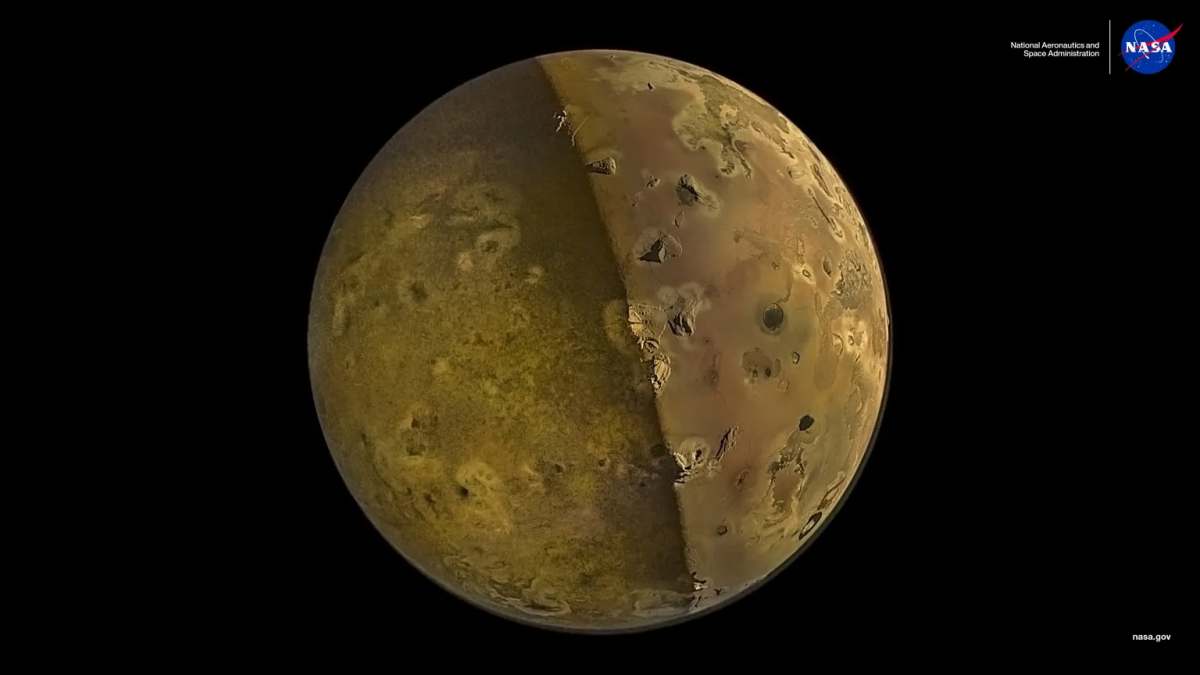
But while Jupiter's main aurora contains a great deal of hot material, one snapshot of the scan revealed a cold spot in Io's auroral footprint. The temperature of the spot was way less than what the team had expected and had extremely high densities. Io is the most volcanically active in the solar system. Its volcanoes spew 1,000 kilograms of material into space every second. Some of these ejected materials become ionized and form a cloud around Jupiter that is called the Io plasma torus. As Io drifts through its orbit, it generates powerful electric currents that give rise to auroral footprints.

Knowles and her peers detected that Io’s auroral footprint is a rich reservoir of trihydrogen cation whose densities are three times higher than those found in Jupiter’s main aurora. In the same small area, they found that densities change by a factor of 45. “We found extreme variability in both temperature and density within Io's auroral footprint on the timescale of minutes,” said Knowles. “This tells us that the flow of high-energy electrons crashing into Jupiter's atmosphere is changing incredibly rapidly." As for exactly how cold the cold spot actually was, Knowles and her team found that it registered a temperature of 538 Kelvin, or 265°C. For perspective, the rest of Jupiter's aurora was at 766 Kelvin, or 493°C.
The researchers note that their findings can be used to better understand the auroral patterns of other planetary systems. In fact, Enceladus, Saturn’s moon, is known to form an auroral footprint on the planet. Moreover, the temperature and density difference was only seen in one of the five snapshots, so the team cannot be entirely sure as to whether the phenomenon was typical or not. Knowles was awarded over 32 hours of observation time with NASA’s Infrared Telescope Facility in Hawaii in January 2026 so that she could dig deeper.
More on Starlust
Auroras on Jupiter's moon Ganymede are not too different from those on Earth