In a first, Europe’s Proba-3 and India’s Aditya-L1 spacecraft jointly observe early stage CMEs
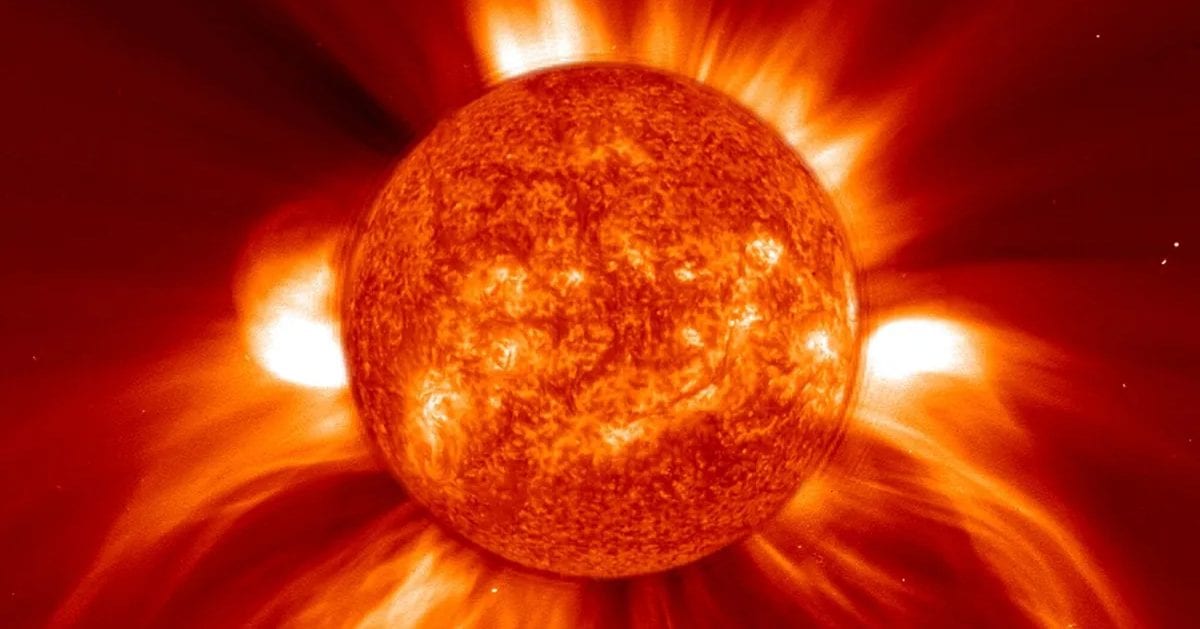
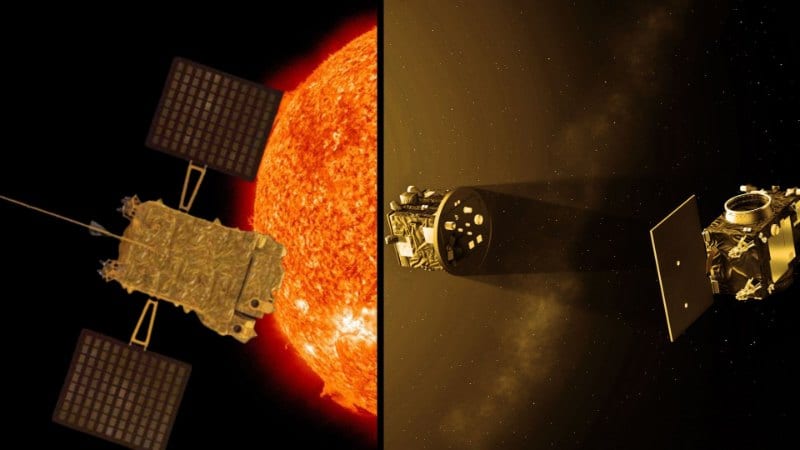
Two different space observatories from India and Europe have viewed the same eruptions on the Sun for the first time from different vantage points. India’s Aditya-L1 and the European Space Agency’s (ESA) Proba-3 spacecraft recently observed coronal mass ejections (CMEs) very close to the Sun, providing new insights into the early stages of this phenomenon. According to the Indian Space Research Organisation (ISRO), the two observatories together measured the mass, density, and energetics of these CMEs, and the findings have been published in the journal Astronomy & Astrophysics. The Aditya-L1 spacecraft is deployed at the first Earth-Sun Lagrange Point approximately a million miles away from Earth, whereas Proba-3 operates in a highly elliptical Earth orbit. While both are focused on studying the Sun’s corona (outermost atmosphere), there’s a huge difference in how they operate. The Indian observatory is equipped with a coronagraph along with six other instruments to investigate the corona, whereas Proba-3 is actually a twin-spacecraft mission that creates artificial solar eclipses for coronal studies.
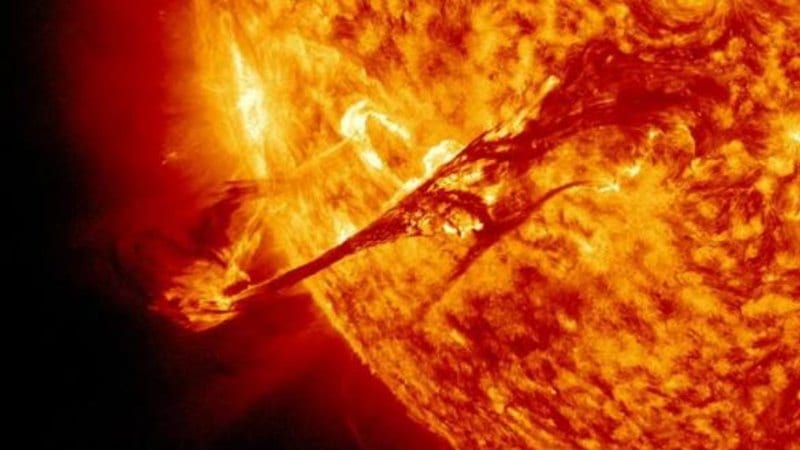
For the latest research, they were observing CMEs that originate from the corona. These CMEs are expulsions of charged plasma into outer space that are often directed towards our planet. If their intensity is too high, they can disturb the near-Earth space environment, cause blackouts by crippling power lines, affect radio communication and GPS signals, and even harm satellites in low Earth orbit. “Measurements of CME parameters near the Sun are very valuable for understanding the physical processes that shape CME properties and subsequent evolution,” ISRO said in a statement. “However, observing CMEs very close to the solar disk is challenging, and earlier space coronagraphs only partially succeeded in observing them and could not track the early evolution of faint CMEs.”
With the combined power of Aditya-L1 and Proba-3, scientists are now getting a closer look at what these eruptions look like shortly after erupting and how they evolve. The two conducted joint observations of the same part of the corona using the ASPIICS instrument (on Proba-3), which provided accurate estimates of a CME's shape, dynamics, and mass, and the VELC payload (on Aditya-L1), which provided information on the density and thermal energy of the hot CME gas. Notably, the former takes pictures of the corona, whereas the latter splits light from the corona into different wavelengths—a technique called spectroscopy.
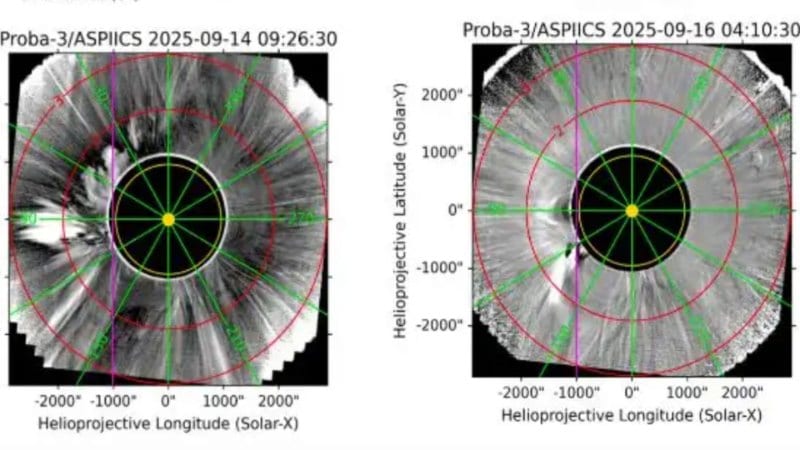
From July to December 2025, the two instruments simultaneously studied a couple of CME events on September 14 and September 16 and noted their different behaviors. The key finding, according to scientists, was that the first one traveled faster at 400 miles per second and its thermal energy was only about one percent of the total, whereas the second one traveled at 90 miles per second and its thermal energy grew until it matched the kinetic energy. They also found that the density of the second CME dropped more steeply with height than the first one, indicating its stronger early expansion. “The results demonstrate the scientific potential of synergetic ASPIICS and VELC observations to constrain the CME mass, density, and energetics in the inner corona, thereby providing new observational constraints on the early evolution of CMEs," ISRO said. "The study shows that pairing a coronagraph that images the corona with one that measures its spectrum yields a more complete, cross-checked view of the origin and evolution of CMEs."
More on Starlust
The Sun’s death could throw the outer solar system into chaos sooner than expected
What are coronal holes on the Sun? How do they affect us on Earth?