Hubble Telescope accidentally captures comet C/2025 K1 (ATLAS) breaking up after perihelion
![This Hubble series shows comet C/2025 K1 (ATLAS) fragmenting over Nov. 8–10, 2025. Captured with the STIS instrument, it reveals rapid disintegration across three days. [Cover Image Source: NASA, ESA, D. Bodewits (Auburn)]](https://d3hedi16gruj5j.cloudfront.net/795892/uploads/67fd6a60-2346-11f1-9da1-6ba4be1eda97_1200_630.jpeg)
A last-minute target switch allowed the NASA/ESA Hubble Space Telescope to witness a comet breaking apart in real time. Hubble witnessed this extremely rare event in November 2025, and the findings were published on Wednesday in the journal Icarus. Comet C/2025 K1 (ATLAS) wasn’t in the space telescope’s observation plans, and it was chosen only after certain technical constraints did not allow the original target to be observed. While the names may sound vaguely similar to a new enthusiast, C/2025 K1 (ATLAS) is not the same as the popular interstellar comet 3I/ATLAS.

The chances of Hubble capturing a comet in the middle of breaking up were extraordinarily slim. The research team, in fact, had wanted to carry out such an experiment with the telescope for a long time. But such things are difficult to schedule. The Hubble study’s co-investigator, John Noonan of Auburn University in Alabama, explained that the comet's fragmentation became clear only after he saw the resolved images the day after they were taken. K1 had broken apart into at least four pieces, each with its own coma—a cloud of gas and dust surrounding a comet. “While I was taking an initial look at the data, I saw that there were four comets in those images when we only proposed to look at one,” said Noonan, in a statement. “So we knew this was something really, really special.”
K1 fragmented into at least four pieces, each with a distinct coma (the fuzzy envelope of gas and dust surrounding a comet’s icy nucleus). From the ground, these were barely distinguishable blobs – but Hubble cleanly resolved the fragments! 2/4
— HUBBLE (@HUBBLE_space) March 18, 2026
During its perihelion on October 8, 2025, K1 passed inside Mercury’s orbit, which is when it underwent maximum heating and stress, like most similar comets typically do. The breakup likely began roughly eight days before Hubble began its observations, capturing three 20-second images, one on each day from Nov. 8–10, 2025. A smaller K1 fragment also broke apart while Hubble was still watching, and the space telescope’s resolution allowed scientists to reconstruct the entire event. The team traced the motion of the fragments backward to analyze the original unbroken object, which was about 5 miles across, but there was a delay between the initial breakup and when bright outbursts were seen from the ground.
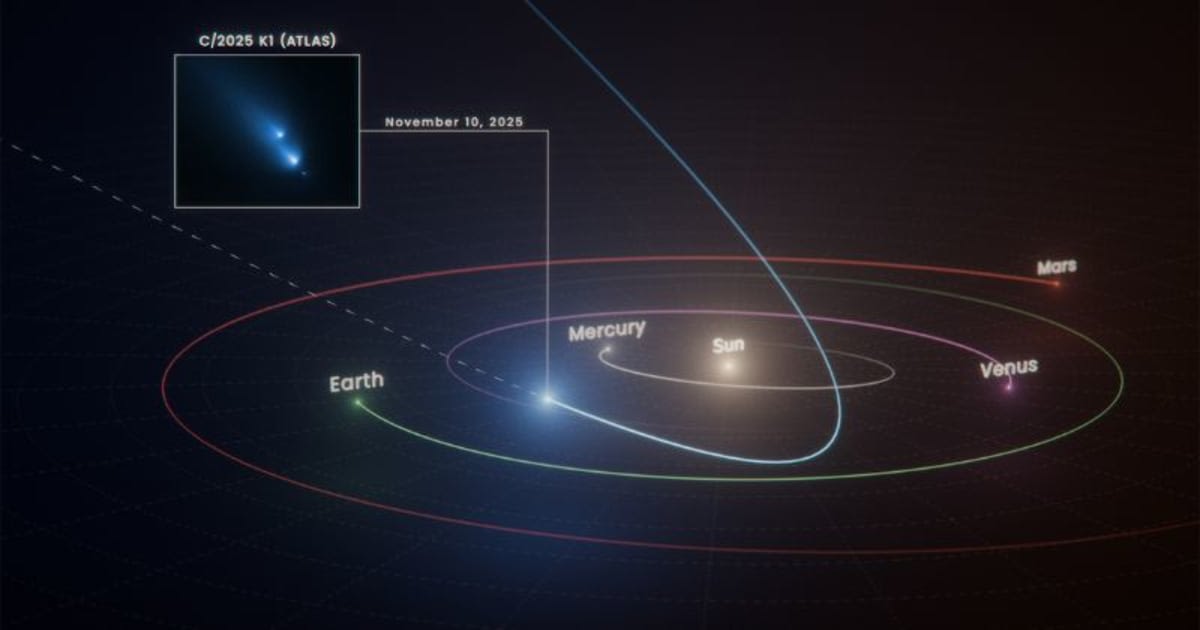
Astronomers expect comets to brighten up instantaneously when they break and expose their fresh ice, but K1 did not. Some theories suggest that a dust layer may need to form over exposed ice before being blown away, or heat needs to seep deep into the rock before triggering an outburst. “This is telling us something very important about the physics of what's happening at the comet’s surface,” explained Noonan. “We may be seeing the timescale it takes to form a substantial dust layer that can then be ejected by the gas.”
The results will complement the detailed view of a long-period comet that ESA will obtain from the upcoming mission Comet Interceptor, as well as helping astronomers to select the mission’s target. 4/4
— HUBBLE (@HUBBLE_space) March 18, 2026
The research team’s next step is to use Hubble’s data to understand the comet’s chemistry. Compared to other comets, K1 is already significantly low in carbon. Spectroscopic analysis from Hubble’s STIS (Space Telescope Imaging Spectrograph) and COS (Cosmic Origins Spectrograph) instruments will reveal more, and the findings will help us understand the origins of our solar system better. As for K1 itself, it’s unlikely to ever return as it is now broken into fragments and heading out of the solar system, around 250 million miles from Earth.
More on Starlust
NASA’s Hubble Space Telescope captures sharpest-ever picture of interstellar comet 3I/ATLAS
Newly discovered comet C/2026 A1 (MAPS) raises the question: Could it be visible in daylight?