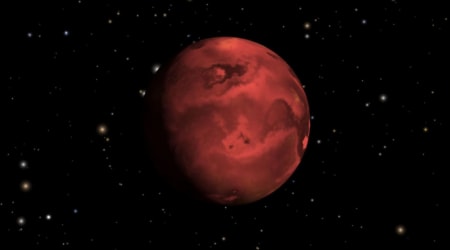
ESA's Mars Express reveals the reason behind the planet's striking yellow, orange and deep red hues

The European Space Agency's Mars Express orbiter has delivered a striking new view of the Martian surface, revealing a vibrant tapestry of yellows, oranges, and deep reds across the Arcadia Planitia region. This latest imagery not only showcases the planet's diverse geological features but also provides compelling evidence of dynamic atmospheric processes and the potential for near-surface water ice, as per the European Space Agency.

The newly released image, captured by the Mars Express High Resolution Stereo Camera (HRSC), focuses on the eastern expanses of Arcadia Planitia, an area of significant interest situated northwest of the monumental Tharsis volcanic province. This relatively flat terrain, primarily composed of ancient, solidified lava flows, is a prime candidate for future Martian missions due to the suspected presence of accessible water ice beneath its surface.

A notable characteristic of the captured scene is a pervasive atmospheric haze, which, while appearing to create a subtle blur, is in fact a testament to the constant movement of fine particles by Martian winds. This phenomenon underscores the critical role wind plays in reshaping the planet's topography. Further evidence of the wind's powerful influence is evident in the reddish upper section of the image, where distinctive "yardangs" are prominently displayed. These streamlined rocky ridges, previously observed by Mars Express, are sculpted by wind-driven sand and dust over vast periods. These parallel scratch-like formations cluster near a prominent curved boundary that bisects the image.

The differing hues observed across this divide, from reddish to darker tones, are believed to indicate varying material compositions, with iron-rich deposits contributing to the red coloration and silicate-rich elements forming the darker areas. Particle properties such as density and size also contribute to the varied distribution of sand across the Martian landscape. The imagery provides a clear illustration of four active dust devils, appearing as bright spots with trailing pinkish shadows. These transient, rapidly moving atmospheric vortices, common in Earth's desert environments, are a regular occurrence on Mars' broad plains. They form as the Martian surface heats up, causing air to rise and create spiraling columns of dust and sand.

While analogues to terrestrial dust devils, their Martian counterparts are significantly larger, reaching heights of up to 8 kilometers (comparable to Mount Everest) and speeds up to 45 meters per second. This happens as a result of the more extreme temperatures on the Red Planet. The elongated shadows captured in the image are a direct consequence of the rapid movement of these dust devils during the camera's exposure. Located at the bottom right of the frame is a well-preserved impact crater, approximately 15 kilometers in diameter. Surrounding the crater are distinct, layered lobes of material radiating outwards from the impact zone. This characteristic formation is a strong indicator that the ground at the time of impact contained a substantial amount of water ice. The crater's relatively intact state suggests a geologically recent formation, as mentioned on ESA's official site.
The potential for near-surface water ice in regions like Arcadia Planitia is a pivotal discovery. Climate models suggest that in Mars' recent history, water ice extended to mid-latitudes, unlike its current confinement to the poles. This makes these areas crucial in the ongoing quest for Martian water and enhances their viability as landing sites for future robotic and potentially crewed missions. Since its launch in 2003, ESA's Mars Express has continuously expanded our understanding of Mars, providing unprecedented high-resolution, color, and three-dimensional mapping of its diverse landscapes for over two decades. The insights gleaned from its ongoing mission continue to fundamentally reshape the comprehension of our planetary neighbor.