Astronomers witness rocky planet like Earth being born around a baby star for the first time

In a significant astronomical breakthrough, scientists using the European Southern Observatory's (ESO) Very Large Telescope (VLT) may have directly observed a nascent planet actively sculpting the swirling gas and dust disk around its young hot star. This marks the first potential detection of a planet embedded within a spiral arm of a protoplanetary disk, offering an unprecedented glimpse into the early stages of planetary system development, as mentioned on the European Southern Observatory.
European Southern Observatory: Astronomers Witness Newborn Planet Sculpting the Dust Around It https://t.co/vIBBnQXTQc
— AAS Press Office (@AAS_Press) July 21, 2025
The discovery detailed in Astronomy & Astrophysics centers on the star HD 135344B, located 440 light-years away. Researchers believe they've identified a budding planet, estimated to be twice Jupiter's size and positioned at a distance comparable to Neptune from our Sun, intricately carving out its surroundings within the protoplanetary disk. “We will never witness the formation of Earth, but here, around a young star 440 light-years away, we may be watching a planet come into existence in real time,” stated Francesco Maio, lead author and doctoral researcher at the University of Florence, Italy.
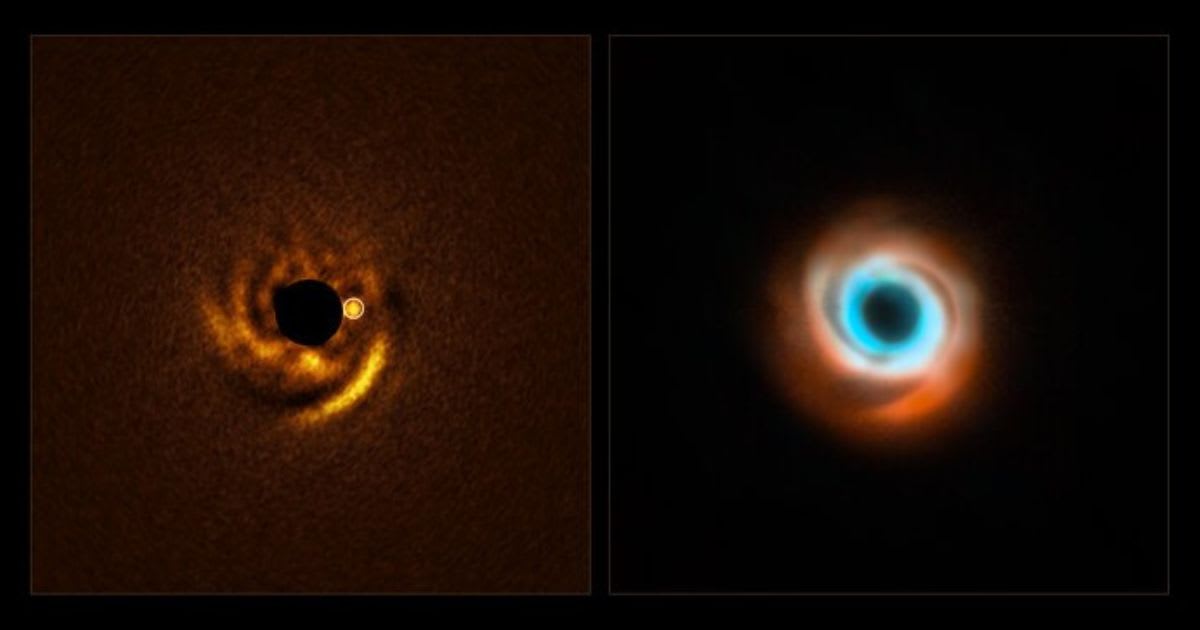
Protoplanetary disks, common around young stars, often exhibit complex structures like rings, gaps, and spirals. Astronomers have long theorized that these features are carved by orbiting nascent planets. However, direct evidence of these "planetary sculptors" in action has remained elusive until now. Previous observations of HD 135344B's disk, conducted with the VLT's SPHERE (spectro-polarimetric high-contrast exoplanet research) instrument, had revealed prominent spiral arms, but lacked definitive proof of a forming planet. The recent insights, utilizing the VLT's new Enhanced Resolution Imager and Spectrograph (ERIS) Instrument, pinpointed the planet candidate precisely where theoretical models predicted it would be: at the base of one of the disk's prominent spiral arms.

In a separate but related development, another team of astronomers, also leveraging the ERIS instrument, has identified a companion object orbiting the young star V960 Mon. Published on July 18 in The Astrophysical Journal Letters, this study investigates a star in its very earliest stages of life, though the exact nature of its newly found companion remains to be fully determined. The research follows up on earlier observations of V960 Mon, which, using SPHERE and the Atacama Large Millimeter/submillimeter Array (ALMA), revealed intricate spiral arms within its orbiting material. These prior observations also indicated the material was undergoing "gravitational instability," a process where large clumps contract and collapse, potentially forming planets or larger celestial bodies, as per European Southern Observatory's official site.

“That work revealed unstable material but left open the question of what happens next. With ERIS, we set out to find any compact, luminous fragments signalling the presence of a companion in the disc — and we did,” said Anuroop Dasgupta, a doctoral researcher at ESO and the Diego Portales University in Chile, who led the new study. The team discovered a potential companion object close to one of the previously observed spiral arms. This object could be either a forming planet or a "brown dwarf," an object more massive than a planet but not massive enough to ignite as a star. If confirmed, this finding could provide the first clear evidence of a planet or brown dwarf forming through gravitational instability.