Astronomers capture stunning close-up photos of exploding stars blasting material in multiple streams
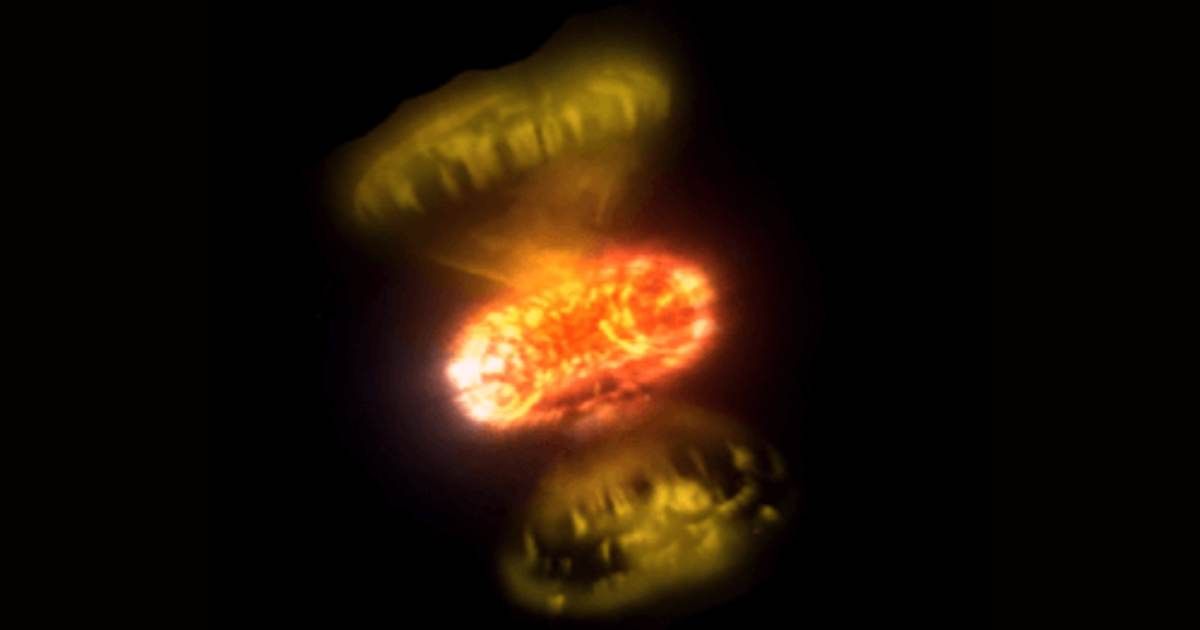
A nova is a massive, temporary star explosion caused when a dense white dwarf star pulls material from a nearby star, setting off an uncontrolled nuclear reaction.
PUBLISHED 1 HOUR AGO
Close-Up Images Show How Stars Explode (Cover Image Source: Georgia State University)

Astronomers have succeeded in capturing the first direct, high-resolution images of two stars in the immediate aftermath of their explosion, according to Georgia State University. And the breathtaking new pictures of these stellar blasts, or novae, reveal that they are much more complex than previously thought by scientists.
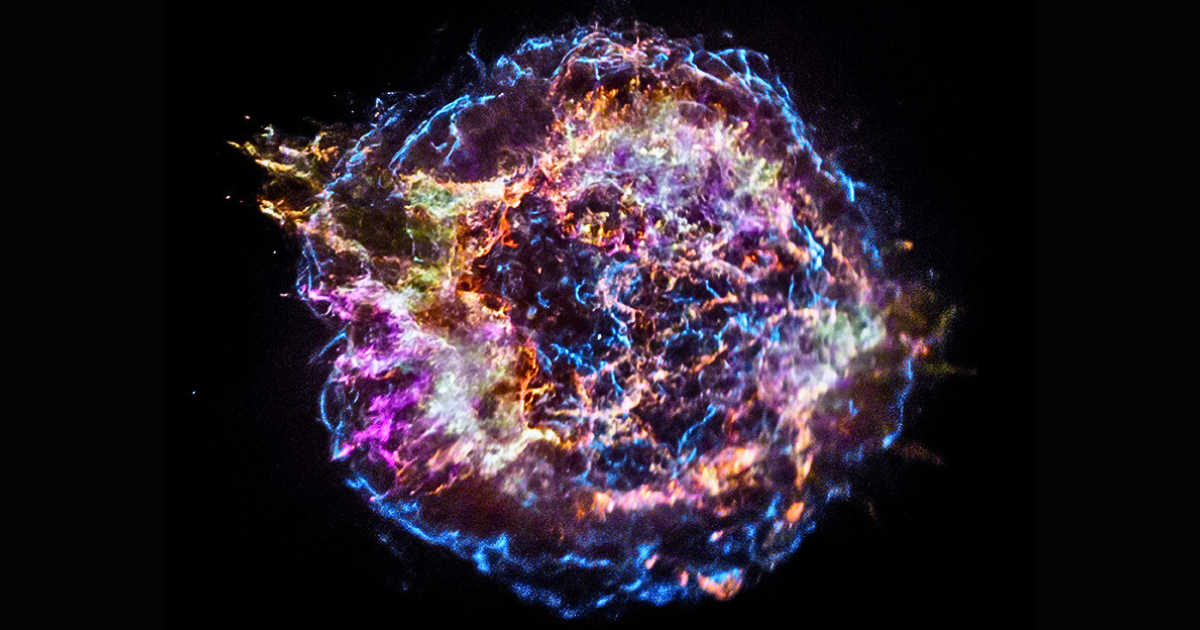
This graphic features Chandra data of the Cassiopeia A (Cas A) supernova remnant that reveals that the star’s interior violently rearranged itself mere hours before it exploded. (Cover Image Source: Chandra | Photo by  NASA/CXC/Meiji Univ./T. Sato et al.)
This graphic features Chandra data of the Cassiopeia A (Cas A) supernova remnant that reveals that the star’s interior violently rearranged itself mere hours before it exploded. (Representative Image Source: Chandra | Photo by NASA/CXC/Meiji Univ./T. Sato et al.)

Rather than a single burst, the images uncovered multiple streams of material being shot out. And in a shocking twist, there were significant delays before ejection. Novae occur when a small, dense remnant of a star, a white dwarf, sucks matter from a nearby companion star. This stolen material triggers a runaway nuclear reaction.
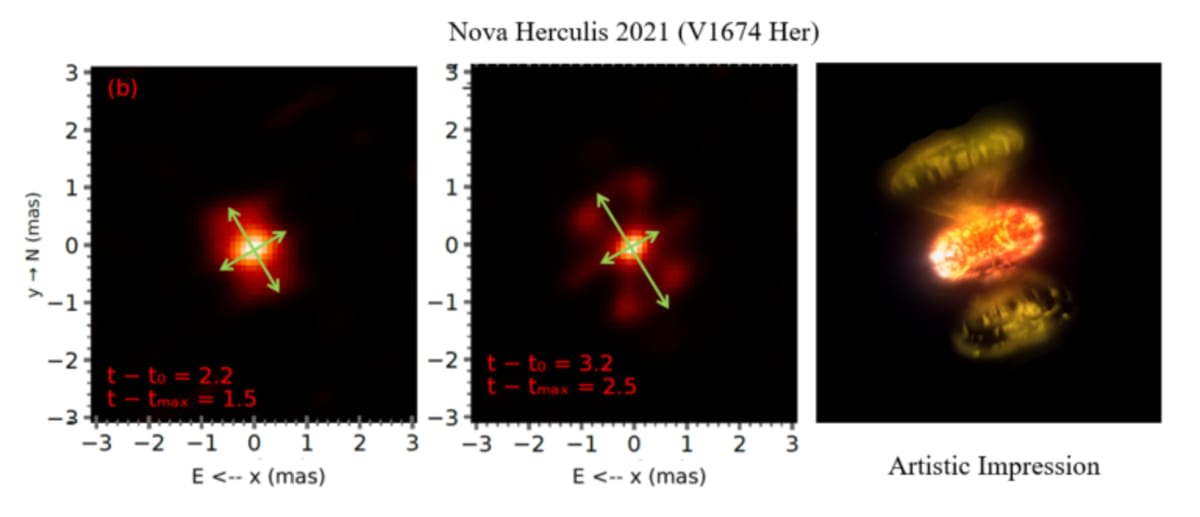
Scientists at Georgia State’s CHARA Array captured images of Nova V1674 Herculis — one of the fastest stellar explosions on record. Images of Nova V1674 Herculis obtained 2.2 days (left) and 3.2 days (middle) after the explosion (Image Source: Georgia State University)
Scientists at Georgia State’s CHARA Array captured images of Nova V1674 Herculis. Images of Nova V1674 Herculis obtained 2.2 days (left) and 3.2 days (middle) after the explosion (Image Source: Georgia State University)

Until now, astronomers could see the expanding explosion only as a single, fuzzy point of light. The new pictures are described in the journal Nature Astronomy and were made possible by combining the light from multiple telescopes using a special technique in California called interferometry. The same general approach is used to photograph black holes, yielding the sharpness needed. “The images give us a close-up view of how material is ejected away from the star during the explosion,” said Gail Schaefer, director of the Center for High Angular Resolution Astronomy—the facility in California that gathered the data. 

This is the remnant of Kepler’s supernova, the famous explosion that was discovered by Johannes Kepler in 1604 (Image Source: NASA/JPL-Caltech)
This is the remnant of Kepler’s supernova, the famous explosion that was discovered by Johannes Kepler in 1604 (Representative Image Source: NASA/JPL-Caltech)

The team concentrated on two novae that blew up in 2021. One nova, V1674 Herculis, was among the fastest on record in terms of brightening and then faded in a matter of days. The pictures immediately showed two separate, perpendicular jets of gas shooting out, confirming the explosion was a complex event involving more than one ejection. This was directly related to the powerful gamma rays seen by NASA's Fermi Gamma-ray Space Telescope. The second nova, V1405 Cassiopeiae, developed much more slowly: It held onto its material for more than 50 days before finally flinging it into space, the clearest evidence yet of a delayed ejection. This delayed blast also set off new shock waves and produced gamma rays

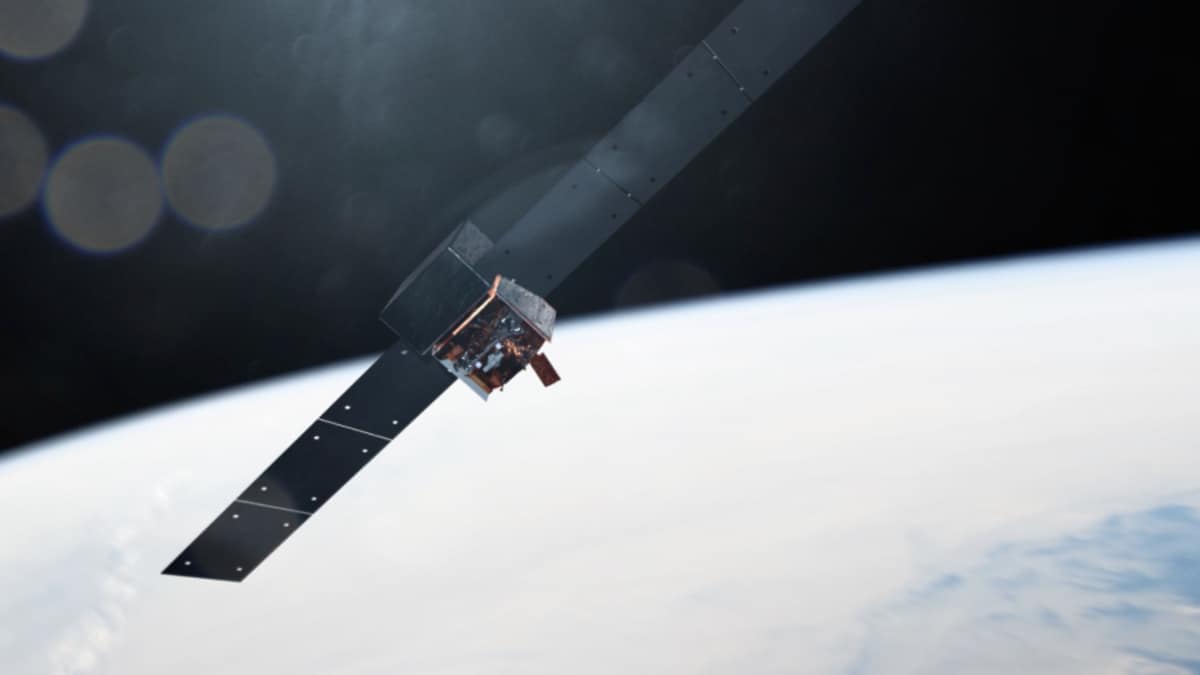
NASA’s Fermi Gamma-ray Space Telescope, illustrated here, scans the entire sky every three hours as it orbits Earth.
(Image Source: NASA's Goddard Space Flight Center | Chris Smith)
NASA’s Fermi Gamma-ray Space Telescope, illustrated here, scans the entire sky every three hours as it orbits Earth. (Image Source: NASA's Goddard Space Flight Center | Chris Smith)

This new capability to visualize the structure of the outbursts as they occur helps answer a key mystery: how novae create their potent shock waves and high-energy radiation, including gamma rays. NASA's Fermi telescope earlier discovered that novae are major sources of these gamma rays within our galaxy. As experts view it, the findings completely upset the old idea that novae are single, straightforward events. 

On top of the general flurry of discoveries about stellar explosions, astronomers have also succeeded in capturing the exact shape of a massive star's death during its absolute earliest phase. In this effort, a research team documented the first moments of a stellar collapse using the Very Large Telescope at the European Southern Observatory. For the first time, this provided a clear look at the initial asymmetrical geometry of the explosion just one day after it was detected.
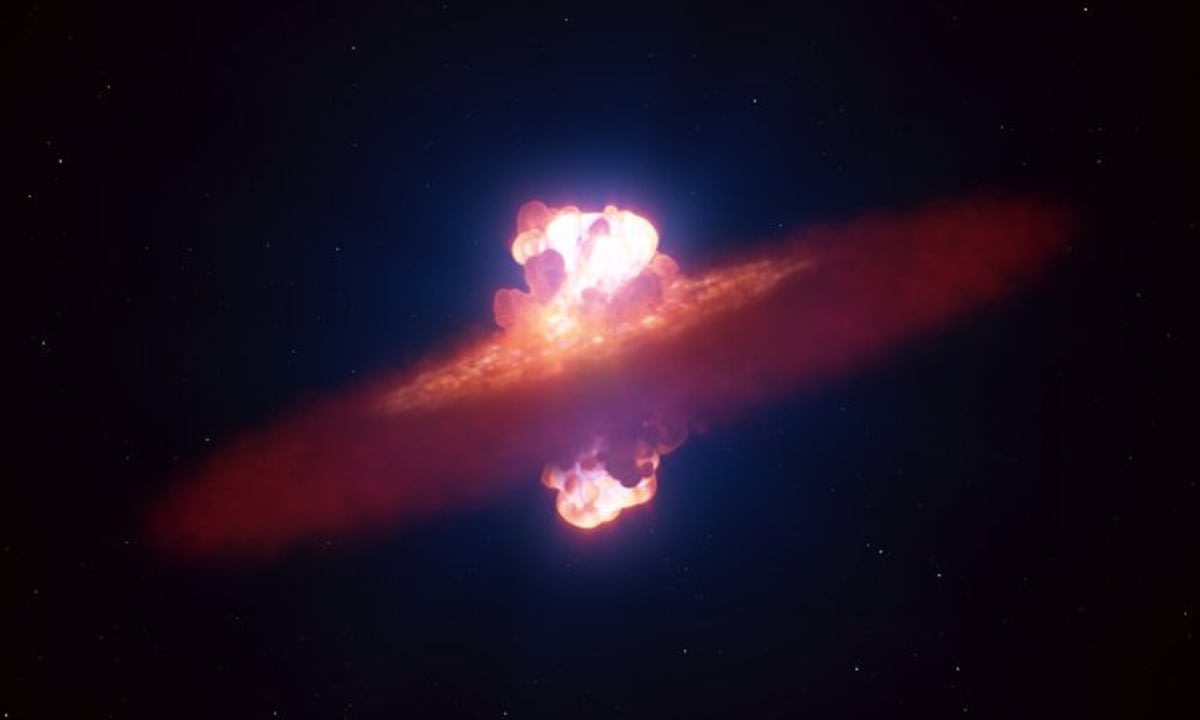
This artist’s impression shows a star going supernova. About 22 million light-years away the supernova, SN 2024ggi, exploded in the galaxy NGC 3621 (Image Source: ESO | L. Calçada)

The target, a supernova now officially known as SN 2024ggi, sits nestled in a galaxy some 22 million light-years away. When first spotted on April 10, 2024, the team knew they had to spring into action; such events do not last very long. A rapid proposal was submitted, and the VLT was able to pivot onto the supernova a mere 26 hours after it had been discovered. 

More on Starlust

Astronomers surprised to witness a young star's jet backfire, triggering dramatic cosmic explosion

NASA’s Roman Space Telescope survey aims to discover 100,000 star explosions and feeding black holes
MORE STORIES

A team of computational astrophysicists has developed a simulation that explains the behavior of matter around black holes.
2 days ago
A study has also concluded that the interior of 3I/ATLAS is rich in metal, which could challenge our current understanding of comet formation.
2 days ago
The James Webb captures a more panoramic image of stars and galaxies, spectacular visuals that were missed by most other observatories.
3 days ago
The discovery comes as a surprise to scientists, as they believed the formation of such well-organized spiral galaxies took billions of years.
4 days ago
Scientists have found a nutrient crucial to the production of serotonin in the asteroid samples.
4 days ago
These giant radio quasars belong to a group of 369 that was recently discovered by the Giant Meterwave Radio Telescope near Pune, India.
5 days ago
An international team of researchers observed four highly intriguing 'dust objects' using the ERIS instrument at the Very Large Telescope facility in Chile.
7 days ago
Delve into how black holes went from being mathematical curiosities to imaged phenomena
7 days ago
10,000 of the 40,000 were discovered in the last three years alone.
Nov 28, 2025
Located 2,500 to 3,800 light-years away in the Scorpius constellation, this nebula's unusual shape is a result of its central star shedding material.
Nov 27, 2025