A black hole belching out the remains of a star it ate is emitting more energy than the 'Death Star'
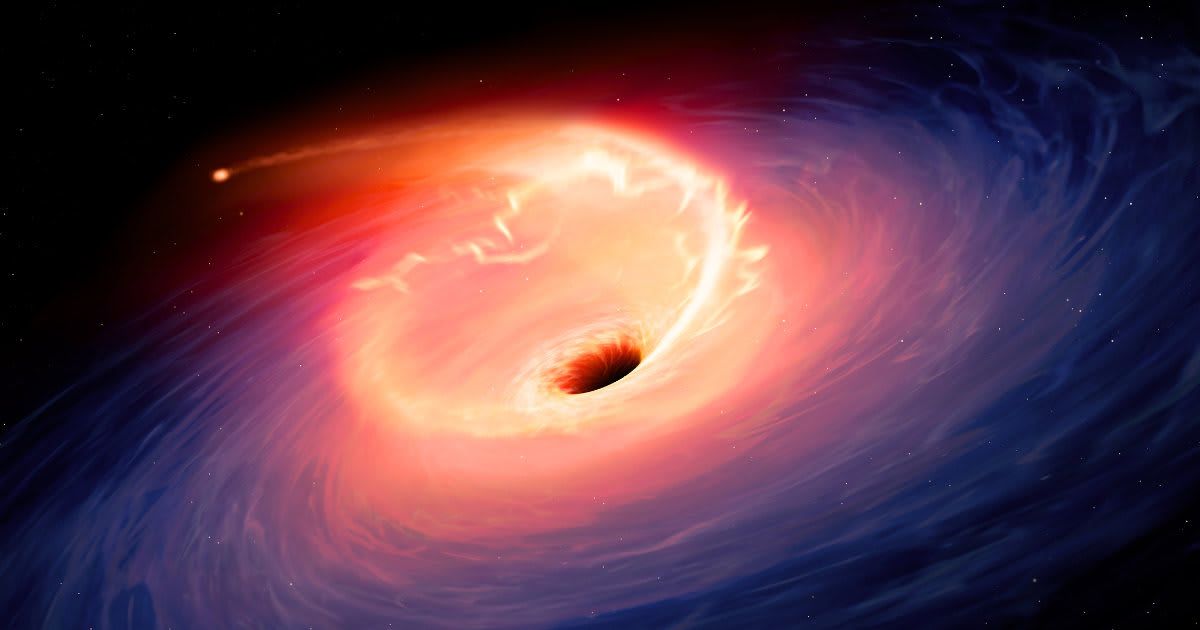
A supermassive black hole, designated AT2018hyz, picked up a nearby star, shredded it, and has been belching out its remains for four years, with no signs of stopping anytime soon. The finding was made by a research team led by a University of Oregon (UO) astrophysicist and reported in a paper published in the Astrophysical Journal. Analyzing it, the scientists predict that the black hole will emit a steady stream of radio waves, which will increase exponentially before peaking in 2027. “This is really unusual,” said Yvette Cendes, an astrophysicist at the UO who led the study. “I’d be hard-pressed to think of anything rising like this over such a long period of time,” she pointed out in a statement.

When a star comes close to a black hole, its gravitational field grabs the star and tears it into shreds, spilling the matter into space. This phenomenon is called a tidal disruption event, which is caused by the same gravitational force that the Moon uses to create ocean tides on Earth. Such shredding of a star has also been named spaghettification. “But a black hole emitting this much energy so many years after chewing up a star is unprecedented,” Cendes said in the statement. For perspective, if you are a fan of Star Wars and you know how powerful the infamous Death Star is, the energy emitted by the black hole is possibly 100 trillion times more intense than that. One of Cendes' lab mates first noticed the tidal disruption event using an optical telescope in 2018 when Cendes was a postdoctoral researcher at Harvard University. But Cendes brushed it aside by saying that it was “the most boring, garden-variety event.”
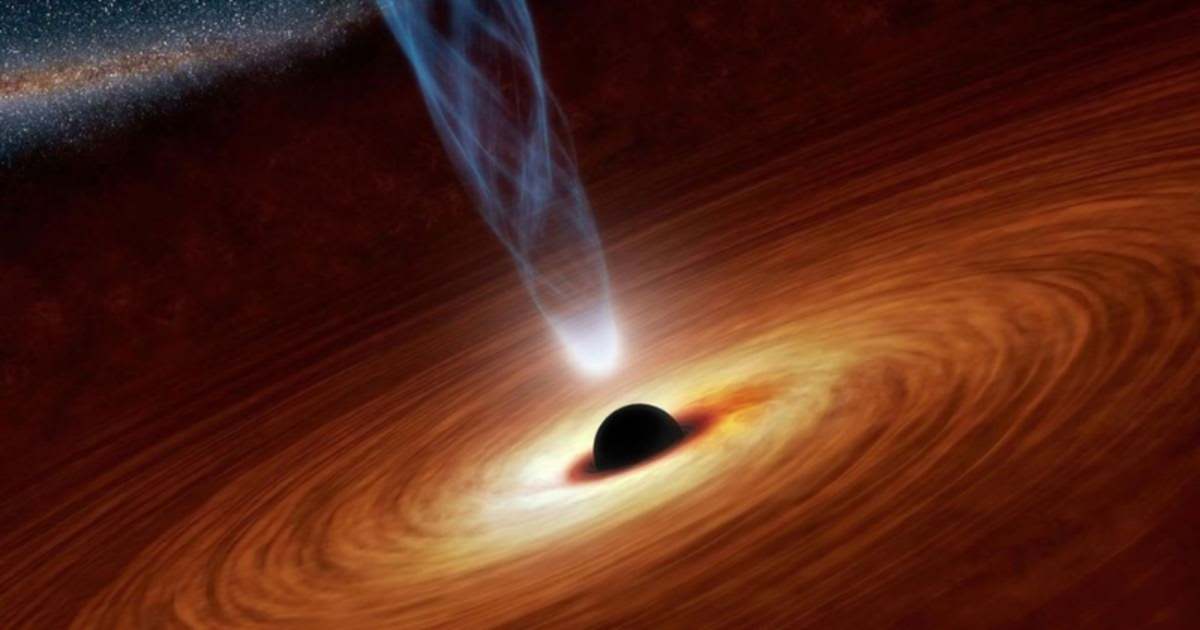
Then, a few years later, Cendes noticed something strange in the black hole’s behavior. Besides shredding a star, it was emitting huge amounts of energy in radio waves. Its energy emission rose sharply over the last few years, growing 50 times brighter than it was in 2019. The researchers did some calculations about the black hole’s behavior. The results suggest that the radiation from the star has been shooting out in one direction as a single jet. “That could explain why it wasn’t initially detected, if the jet wasn’t aimed toward Earth,” Cendes said in the statement. Cendes, a radio astronomer by profession, finds it easier to measure the energetic radio waves emanating from the black hole. The black hole also emits some faint visible light. Her team used data collected at big radio telescopes in New Mexico and South Africa that measure radiation from around the universe at very high sensitivities.

The energy outflow of the black hole is on par with a gamma ray burst and has been placed among the most powerful single events ever detected in the universe. Meanwhile, Cendes and her colleagues are scanning the sky to hunt down other black holes that might also display similar star-shredding behavior. “No one has ever seen anything like this before, but that could be in part because nobody has really looked,” Cendes noted.
More on Starlust
Astronomers observe a black hole coming back to life after 100 million years of silence