3I/ATLAS isn't just older than our solar system—it may be almost as old as the universe itself

Earlier estimates of its age were around 7 billion years, but a new study suggests it’s much older.
PUBLISHED 1 HOUR AGO
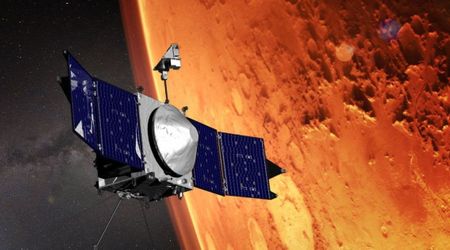
This image, taken by the MAVEN spacecraft on October 9, shows the halo of gas and dust, or coma, surrounding comet 3I/ATLAS. (Cover Image Source: NASA/Goddard/LASP/CU Boulder)

A new study, published in the preprint server Research Square, looked into the composition of 3I/ATLAS and concluded that the interstellar comet formed about 10 to 12 billion years ago. This puts the age of the comet more in the ballpark of that of the Milky Way galaxy, or the entire universe itself, rather than just our solar system. The universe, as well as our galaxy, is known to be over 13 billion years old, while that number for our solar system is 4.6 billion years. The study also suggests that 3I/ATLAS is just one of many icy bodies that found themselves in the interstellar medium, having been chucked out by gravitational interaction during exoplanet formation.
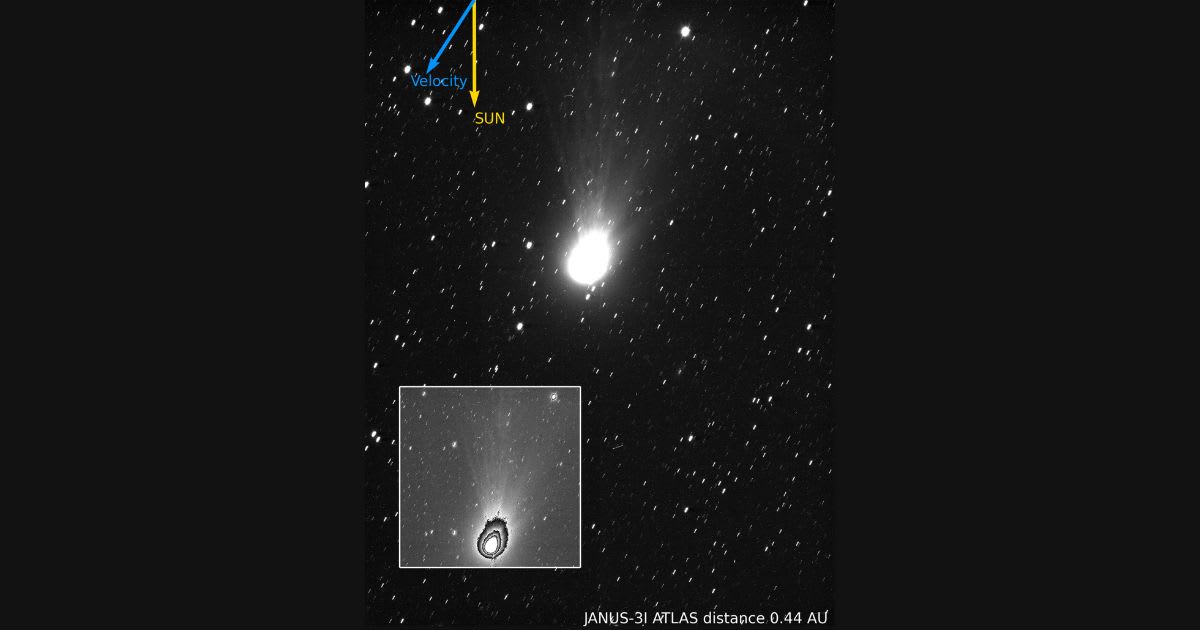
Black-and-white image of interstellar comet 3I/ATLAS captured by JUICE’s JANUS camera, showing a bright central coma with a long tail streaming away; arrows indicate the comet’s velocity (blue) and the direction of the Sun (yellow), with an inset highlighting detailed coma structure. (Image source: ESA)
Black-and-white image of interstellar comet 3I/ATLAS captured by JUICE’s JANUS camera, showing a bright central coma with a long tail streaming away; arrows indicate the comet’s velocity (blue) and the direction of the Sun (yellow). (Image source: ESA)

The research points to a time, after the initial period of intensified star creation inside our galaxy, when planetesimals—which are essentially the building blocks of planets—formed. The study claims that not only is 3I/ATLAS a representative of an ancient planetary system, but it is also indicative of active ice chemistry and volatile-rich planetary formation that took place in the early days of the Milky Way.
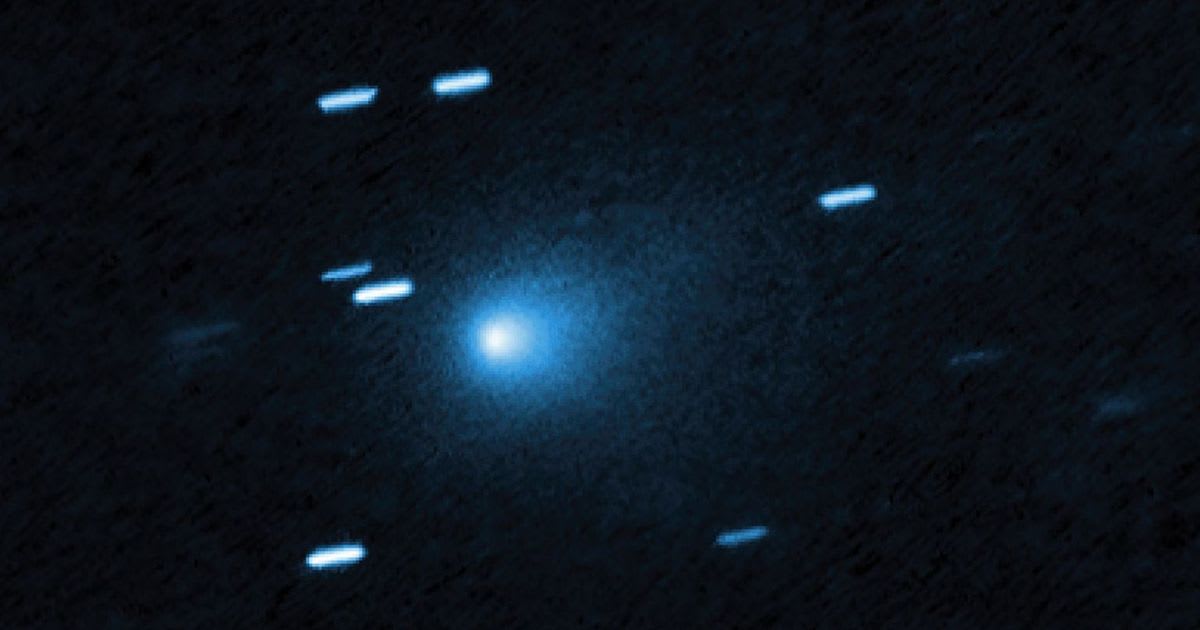
Hubble captured this image of the interstellar comet 3I/ATLAS on July 21, 2025 (Cover Image Source: NASA/ESA |  David Jewitt)
Hubble captured this image of the interstellar comet 3I/ATLAS on July 21, 2025 (Image Source: NASA/ESA | David Jewitt)

The researchers employed NASA’s James Webb Space Telescope to study the composition of 3I/ATLAS shortly after its perihelion—closest approach to the Sun. The methodology used to draw the conclusions mentioned above involved comparing isotopic measurements of the interstellar comet to those of bodies found in our solar system. Isotopes are variants of an element containing the same number of protons but a different number of neutrons in the nucleus. The researchers found that the comet's ice had a higher concentration of deuterium, a heavier hydrogen isotope, than any other previously studied comet. They also found that it has a higher ratio of carbon isotopes than what is usually seen in our solar neighborhood.

The James Webb Space Telescope (JWST or Webb) observes outer space to detect anomalies. Elements of this image are furnished by NASA (Representative Image by alex-mit / Getty Images)
The James Webb Space Telescope (JWST or Webb) observes outer space to detect anomalies. Elements of this image are furnished by NASA (Representative Image Source: Alex-mit | Getty Images)

What these readings told the researchers is that not only is 3I/ATLAS unique in its make-up, but also that for it to have been formed, temperatures below minus 405 degrees Fahrenheit would have been required in conditions that were relatively metal-poor. These are properties of an early Milky Way. These findings follow on from earlier research that estimated the comet to have been much younger, though still billions of years older than our solar system. 

Hubble Space Telescope reobserved 3I/ATLAS on November 30, with its Wide Field Camera 3 instrument. (Cover Image Source: NASA, ESA, STScI, D. Jewitt (UCLA), M.-T. Hui (Shanghai Astronomical Observatory)
Hubble Space Telescope reobserved 3I/ATLAS on November 30 with its Wide Field Camera 3 instrument. [Image Source: NASA, ESA, STScI, D. Jewitt (UCLA), M.-T. Hui (Shanghai Astronomical Observatory)]

The comet became the subject of focus for several missions by NASA ever since it was first discovered by the ATLAS (Asteroid Terrestrial-impact Last Alert System) telescope in Chile in July last year. One of only three interstellar objects to have paid a visit from beyond our solar system, it made its closest approach to Earth on December 19, 2025, when it came within 168 million miles of our planet. As is evident, it continues to be of interest to scientists across the world even as it makes its way out of the solar system to never return again.

More on Starlust

ESA's Juice captured interstellar comet 3I/ATLAS shortly after perihelion—here's what it found

Could we possibly catch up with 3I/ATLAS? A daring new plan says 'yes'
MORE STORIES

What makes this discovery even more interesting is that ices are not known to survive in planetary nebulae.
1 day ago
It all started when a doctoral candidate at the University of Washington found a Sun-like star behaving strangely.
1 day ago
The seasonal lunar name traces back to spring phlox blooms in North America, not the actual color.
3 days ago
The coronal hole is a recurrent feature, having appeared in the last rotation as well.
3 days ago
Elena Tomasetti of the University of Bologna discusses her team's calculation of the estimated age of the universe in an exclusive interview with Starlust.
3 days ago
Far from the harsh galaxy center, they reached a location that is hospitable for life.
3 days ago
GW200105 reveals an eccentric orbit before merger, challenging formation models.
5 days ago
While Jupiter's main aurora has a great deal of hot materials, a snapshot showed a cold spot in Io's auroral footprint.
5 days ago
As a civilization, we currently just don't have the industrial might to make terraforming a reality.
5 days ago
Damage reports have come from the Hunsrück region, the Eifel mountains, and Koblenz, among others.
7 days ago