NOAA's SWFO-L1 satellite launches aboard SpaceX Falcon 9 rocket from Kennedy Space Center
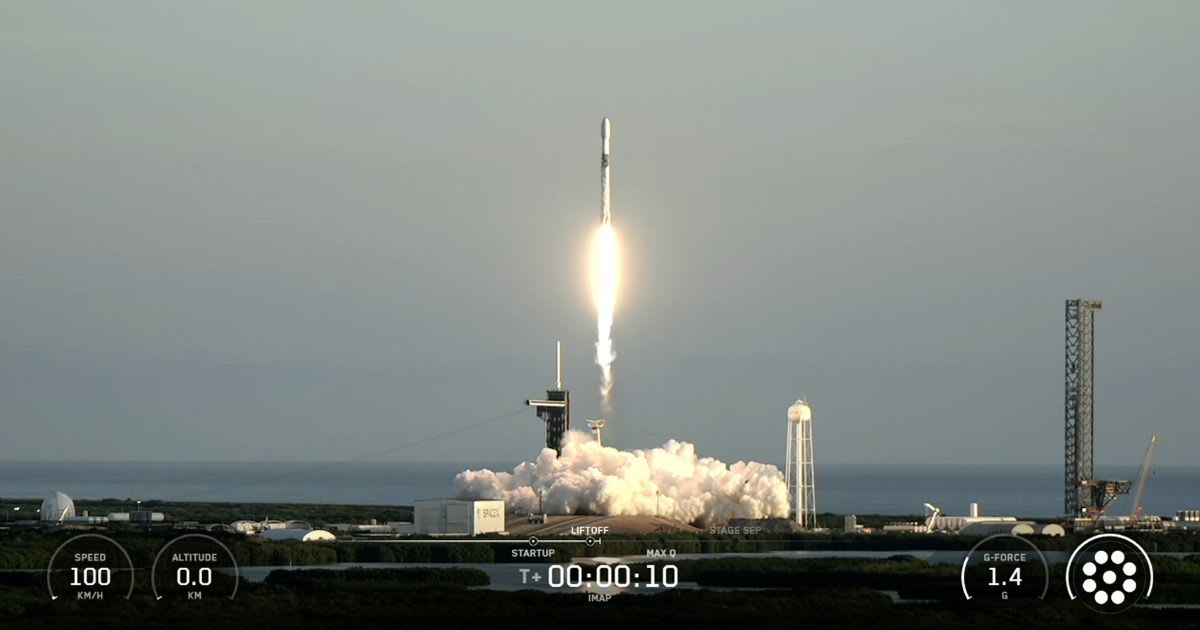
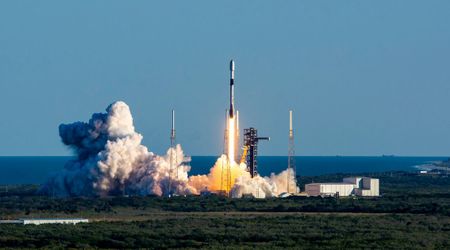
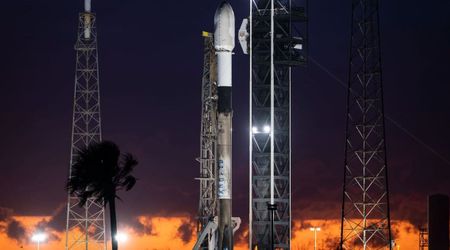
A new era in space weather forecasting is set to begin with the launch of the Space Weather Follow-On–Lagrange 1 (SWFO-L1) observatory. The NOAA satellite launched aboard a SpaceX Falcon 9 rocket from Kennedy Space Center on Wednesday, Sept. 24, at 7:30 a.m. EDT, as per NASA's Kennedy Space Center's X post.
AND... WE HAVE LIFTOFF of NOAA’s #SWFOL1 satellite, riding along with @NASA’s Interstellar Mapping and Acceleration Probe (#IMAP) and Carruthers Geocorona Observatory!
— NOAA (@NOAA) September 24, 2025
More about SWFO-L1: https://t.co/VancH1CGOU
#LetsGoSWFO! @NOAASatellites https://t.co/uCeGbAmAz7
According to SpaceX on X, the mission, which aims to improve the monitoring and prediction of solar events that can affect Earth, shared the launch vehicle with two other spacecraft: NASA's Interstellar Mapping and Acceleration Probe (IMAP) and the Carruthers Geocorona Observatory.
There are three spacecraft on board today’s mission including @NASA’s IMAP and Carruthers Geocorona Observatory as well as NOAA’s SWFO-L1 pic.twitter.com/w8RhoZMWEF
— SpaceX (@SpaceX) September 24, 2025
The SWFO-L1 observatory, the first NOAA satellite exclusively dedicated to operational space weather observations, is equipped with a suite of instruments designed to provide a continuous, high-speed data stream, as per the National Environmental Satellite, Data, and Information Service (NESDIS). This includes a compact coronagraph for monitoring the sun's outer atmosphere and instruments for real-time measurements of the solar wind.

Once in its designated orbit around the Sun-Earth Lagrange 1 point, the satellite will be renamed Space Weather Observations at L1 to Advance Readiness (SOLAR)-1. It will be followed by subsequent missions, SOLAR-2 and beyond, as part of NOAA’s Space Weather Next program to ensure consistent data flow and expanded capabilities. Data from the satellite's four onboard instruments will be delivered to NOAA’s Space Weather Prediction Center (SWPC) with unprecedented speed. For example, imagery of coronal mass ejections (CMEs) is expected to reach forecasters within 30 minutes of acquisition, a significant improvement over the several hours it can take for similar data from older research satellites. Additionally, real-time solar wind data from sensors will be available in as little as 5 minutes.
By providing a constant flow of critical solar wind, thermal plasma, and magnetic field data, SOLAR-1 will serve as a vital early warning system. The enhanced speed and accuracy of these observations will provide forecasters with crucial lead time to issue warnings, helping to safeguard essential infrastructure and national security interests both on Earth and in space from potentially disruptive space weather events.

Sharing the ride to space, NASA's Interstellar Mapping and Acceleration Probe (IMAP) also embarks on a separate, but equally critical, mission. The IMAP spacecraft will map the boundaries of the heliosphere, the immense bubble of solar wind that surrounds our solar system. The probe's objective is to study how the heliosphere interacts with the surrounding interstellar space, according to SpaceX.
Watch Falcon 9 launch @NASA’s IMAP mission to orbit https://t.co/iuCcM4Oaqp
— SpaceX (@SpaceX) September 24, 2025
IMAP will also provide real-time observations of solar wind and energetic particles, supporting the study of potentially hazardous space weather conditions near Earth. The Falcon 9 rocket successfully launched IMAP into a transfer orbit that will carry it to the Earth-Sun L1 Lagrange Point, a gravitationally stable location between Earth and the sun where the satellite will begin its mission. This space launch is crucial for humanity's safety and technological resilience. The satellites, especially NOAA's SWFO-L1, will provide critical, real-time data on solar events that can disrupt power grids, communications, and GPS systems. This early warning capability is essential for protecting our modern infrastructure, which is increasingly dependent on technology vulnerable to space weather.
Grab your coffee and tune into #SWFOL1 launch livestream in progress here on X -- from NASA's Kennedy Space Center!
— NOAA (@NOAA) September 24, 2025
Launch time scheduled for 7:30 a.m. EDT today, 9/24.
More at https://t.co/mJG3ygil0i via @NOAASatellites https://t.co/ykJymPSqCs
More on Starlust
Solar storm may hit Earth at the autumn equinox, setting the stage for fall auroras