Mars takes its place in the Spring Triangle and will remain there until mid-September

Stargazers are advised to look to the west in the nights following June 18 as Mars makes a notable celestial pass, sweeping past the bright star Regulus to enter the Spring Triangle. This prominent asterism, visible as spring transitions to summer in the northern hemisphere, is comprised of three massive stars, each belonging to a distinct constellation, as per Space.com.

The Spring Triangle includes the orange-hued Arcturus, found high above the southwestern horizon in the hours after sunset this month, within the constellation Bootes, the herdsman. Directly below, the blue-white Spica is visible, embedded in the constellation Virgo. Completing this cosmic formation near the western horizon is Regulus, often referred to as the heart of the lion in the constellation Leo.
🌟 Discover the Spring Triangle 🌟
— Star Walk (@StarWalk) April 9, 2025
As we welcome a new season, the Spring Triangle lights up the night sky. 🌙✨
Formed by three brilliant stars—Arcturus from Bootes, Spica from Virgo, and Regulus from Leo—this iconic star pattern marks the arrival of spring in the Northern… pic.twitter.com/E1tuYpsyYb
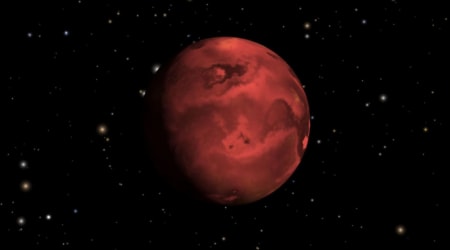
Eagle-eyed stargazers may have already noticed Mars drawing closer to Regulus in recent weeks. This convergence is due to the Red Planet's orbit carrying it along the ecliptic, the apparent path taken by the Sun and planets as they traverse Earth's sky. On the night of June 18, Mars was positioned just under 1 degree to the upper left of Regulus in the hours following sunset. To visualize this, 1 degree is roughly the equivalent width of your little fingertip when held at arm's length against the night sky. By the following night, Mars officially entered the Spring Triangle, having just crossed the imaginary line connecting Regulus and Arcturus. The Red Planet will continue to skim along the lower edge of this stellar formation until it moves beyond Spica in mid-September.
In addition to the captivating planetary alignment, June also ushers in the peak "core season" for viewing the Milky Way galaxy, offering stargazers a unique opportunity to witness the luminous central core of our home galaxy. This breathtaking celestial phenomenon is best observed from secluded locations, far removed from urban light pollution.

As explained by NASA's Jet Propulsion Laboratory (JPL), "This is the time of year when the Milky Way is visible as a faint band of hazy light arching across the sky all night. You just need to be under dark skies, away from bright city lights, to see it. What you’re looking at is the bright central core of our home galaxy, seen edge-on, from our position within the galaxy’s disk.” While it might seem counterintuitive to view the Milky Way from within it, the visible band in our night sky does not represent the entire galactic structure. Unlike external photographs of other galaxies, such as Andromeda, which depict a full, spinning disk or spiral, our perspective of the Milky Way is inherently from the inside looking out.

For those interested in capturing or further understanding this celestial marvel, NASA JPL notes that “Long-exposure photos make the Milky Way’s bright stars and dark dust clouds even clearer." They further elaborate that while our eyes perceive it in visible light, "NASA telescopes observe the galaxy across the spectrum, peering through dust to help us better understand our origins.” Regardless of the method of observation, NASA's JPL emphasizes that “getting out under the Milky Way in June is a truly remarkable way to connect with the cosmos.”

For individuals hoping to jump into their celestial explorations, resources are available to enhance the experience. Stargazers should consult guides to the best telescopes and binocular deals available to equip themselves with suitable observation tools. Newcomers to astronomy are also encouraged to explore lists of the best stargazing apps, many of which leverage augmented reality technology to assist users in navigating the multitude of stars and deep-sky objects visible from Earth, per Space.com.