M104 Galaxy

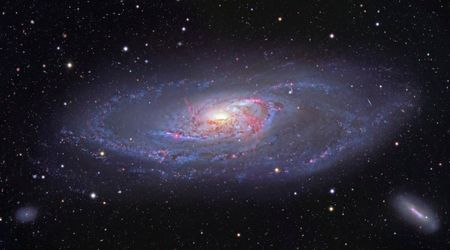
The well-known “Sombrero” galaxy M104 in Virgo is probably the best example of an Sa spiral, with tightly- wound spiral arms and a large luminous bulge.
UPDATED JUN 26, 2024
m104 the sombrero galaxy

The well-known “Sombrero” galaxy M104 in Virgo is probably the best example of an Sa spiral, with tightly- wound spiral arms and a large luminous bulge. M104 is not a member of the Virgo Cluster, and lies at about half the cluster’s distance.

The Sombrero is a fabulous object in any telescope, and it is easy to locate by aiming three degrees south of the 5th-magnitude star Chi Virginis.

The galaxy’s lenticular form and bisecting dust lane are easily visible in small telescopes. Because M104 is inclined six degrees to our line of sight, its dust lane appears to cross just south of the center. A large elliptical core surrounds a star-like nucleus, and depending on the size of your telescope and the sky darkness, the south portion of the core may not be visible at all. The dust lane is narrow and dense, appearing to completely obscure the light from beyond.
MORE STORIES

This newly discovered explosion from the dawn of time is helping scientists map the chemical evolution of the first galaxies.
1 day ago
The galaxy in question dates back to about 3 billion years after the Big Bang.
4 days ago
'We're still trying to figure out why black holes are suddenly more common in galaxies like our own,' said one of the scientists.
5 days ago
The four planets orbit a very young star, V1298 Tau, and have already lost much of their atmospheres.
Jan 8, 2026
Astronomers detect the earliest known galaxy cluster gas from just 1.4 billion years after the Big Bang.
Jan 8, 2026
The James Webb Space Telescope has identified massive, short-lived stars that are essentially 'seeds' for the universe's first supermassive black holes.
Jan 7, 2026
These newly-discovered objects look like stars but behave like galaxies.
Jan 7, 2026
Astronomers used the XRISM mission to separate signals and analyze the extreme gravitational forces at work in active galactic nucleus MCG–6-30-15.
Jan 7, 2026
Astronomer had been trying to solve the mystery behind Betelgeuse's behavior for decades.
Jan 6, 2026
The Champagne Cluster was discovered back on December 30, 2020.
Jan 5, 2026