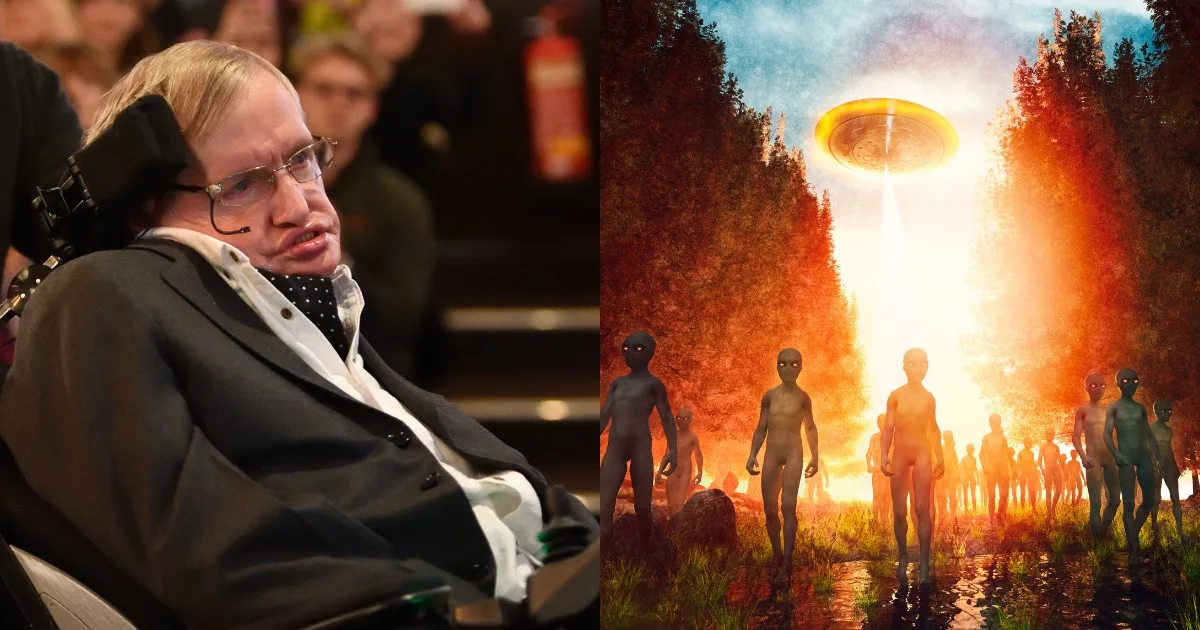
Contact with 'advanced aliens' may not end well for Earth, warned Stephen Hawking
Stephen Hawking's chilling message about aliens

The fact that we haven't had contact with aliens could be a blessing in disguise.
Stephen Hawking, the late British theoretical physicist and author of the bestselling book A Brief History of Time, feared our encounter with intelligent alien life wouldn't end well.
"If aliens visit us, the outcome would be much as when Columbus landed in America, which didn't turn out well for the Native Americans," he said in the Discovery Channel documentary titled Into the Universe with Stephen Hawking, which was released in 2010. "We only have to look at ourselves to see how intelligent life might develop into something we wouldn't want to meet."
Alien nomads may target Earth for resources, Hawking warned
Hawking believed that after exhausting the resources on their own world, advanced spacefaring extraterrestrials would try to extract vital materials from other planets.
“Such advanced aliens would perhaps become nomads, looking to conquer and colonize whatever planets they could reach," he said on the show. "If so, it makes sense for them to exploit each new planet for material to build more spaceships so they could move on. Who knows what the limits would be?"
Hawking on how aliens would travel to distant corners of the universe

In one episode of the four-part Discovery Channel series, Hawking said that a sufficiently advanced civilization might have the technology to open up a wormhole that would allow them to travel to distant parts of the universe.
He said, “It might be possible to collect the energy from an entire star. To do that, they could deploy millions of mirrors in space, encircling the whole sun and feeding the power to one single collection point."
Alien invasion or not, Hawking wanted us to spread out into space
Even if aliens didn't conquer Earth, Hawking believed that the chances of Earth falling victim to a man-made disaster could eventually rise to a "near certainty."
”We face a number of threats: nuclear war, global warming and genetically engineered viruses," he told Radio Times in 2016. “Although the chance of a disaster on planet Earth in a given year may be quite low, it adds up over time, becoming a near certainty in the next thousand or ten thousand years. By that time we should have spread out into space, and to other stars, so it would not mean the end of the human race."
Tame progress: Hawking's advice on how we can buy ourselves some time
Hawking believed that it would be a long time before we established space colonies, and so we must exercise caution in the meantime.
"We will not establish self-sustaining colonies in space for at least the next hundred years, so we have to be very careful in this period," he said. "Most of the threats we face come from the progress we’ve made in science and technology. We are not going to stop making progress, or reverse it, so we must recognize the dangers and control them. I’m an optimist, and I believe we can."