First-ever map of Mars’ massive drainage systems hints the planet may once have been a world built for life

It’s no secret that regions around large river systems here on Earth are some of the most ecologically diverse places on the planet. But the idea of such systems on Mars sounds far-fetched, right? Well, apparently not. That’s because a team of researchers at the University of Texas at Austin has mapped drainage systems on Mars for the first time ever.

The study published in Proceedings of the National Academy of Sciences has outlined no less than 16 large-scale river basins around which life could have flourished. "We've known for a long time that there were rivers on Mars," said Timothy A. Goudge, co-author and an assistant professor in the Department of Earth and Planetary Sciences at UT Jackson School of Geosciences. “But we really didn't know the extent to which the rivers were organized in large drainage systems at the global scale.”

After bringing together existing individual datasets of Mars’ rivers, valley networks, and lakes, Goudge and lead researcher Abdallah S. Zaki outlined the combined drainage systems in an attempt to figure out the total area covered by them. "We did the simplest thing that could be done. We just mapped them and pieced them together," said Zaki, per Phys.org. While they were able to identify 19 big clusters, 16 of them crossed what is considered to be the threshold for large drainage basins here on Earth, which is 100,000 square kilometers.

Granted, Earth has a higher number of such large drainage basins – 91 – and these drainage systems only account for 5% of the Martian terrain. That being said, research says that they are representative of no less than 42% of the total material eroded by Martian rivers. This automatically makes them the ideal spots to look for signs of life for the simple reason that sediments carry nutrients with them. That being said, Zaki noted that pinpointing exactly where these sediments were deposited warrants more work.

“Tim Goudge and his team continue to be leaders in the field, making groundbreaking contributions to the understanding of Mars' planetary surface and hydrologic processes,” said Department Chair Danny Stockli. Speaking of hydrologic processes, another recent study published in Communications Earth & Environment has provided fresh evidence that the Red Planet once had a humid atmosphere and experienced substantial rainfall.

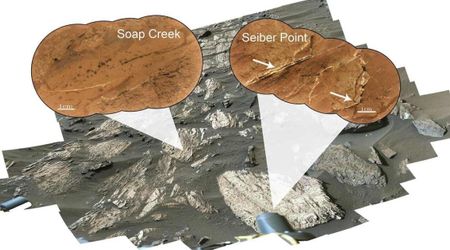
It all started when NASA’s Perseverance rover came across light-colored rocks in the Jezero crater that stood out against the planet’s reddish-orange terrain. These rocks were then identified to be kaolinite, a white, aluminum-rich clay. Here on Earth, they are mostly found in tropical climates like rainforests. “So when you see kaolinite on a place like Mars, where it’s barren, cold and with certainly no liquid water at the surface, it tells us that there was once a lot more water than there is today,” explained lead author Adrian Broz, a postdoctoral collaborator on the Perseverance rover. He did a comparative study between the Perseverance-acquired samples and those found near San Diego, California, and in South Africa, and found that they were a close match.

Both the mapping of the large drainage systems and fresh evidence of a rainfall-driven environment provide incredible insights into Mars’ past and suggest that life, if there was any, could have thrived on the Red Planet. These are truly exciting times.
More on Starlust
NASA's Perseverance rover discovers bizarre alien rock on Mars
Stunning new study claims Mars may have supported life longer than initially suspected