First-ever direct glimpse captures earliest moments of a new solar system formation

International researchers have, for the first time, directly observed the initial stages of planet formation around a star beyond our Sun. This groundbreaking discovery, detailed in a new study published in Nature, provides a striking glimpse into the early moments of a nascent solar system, mirroring the dawn of our Sun, as per the European Southern Observatory.
View this post on Instagram
Utilizing the advanced capabilities of the ALMA telescope and the James Webb Space Telescope, scientists pinpointed the very inception of planet-building materials: hot minerals just beginning to solidify. This marks the earliest stage of planetary system development ever identified, opening a crucial window into the processes that sculpted our cosmic neighborhood billions of years ago. "For the first time, we have identified the earliest moment when planet formation is initiated around a star other than our Sun,” stated Melissa McClure, a professor at Leiden University and lead author of the study. Co-author Merel van ‘t Hoff, a professor at Purdue University, likened the findings to "a picture of the baby Solar System," emphasizing the striking resemblance to our own system's nascent phase.

The newborn system is forming around HOPS-315, a young "proto" situated approximately 1300 light-years away. This star serves as a compelling analogue to our early Sun, surrounded by a protoplanetary disc of gas and dust, the cosmic cradle for new planets. While the previous observations have revealed young discs already harboring massive, Jupiter-like planets, McClure noted that the formation of the first solid planetary building blocks, or "planetesimals," must occur much earlier.
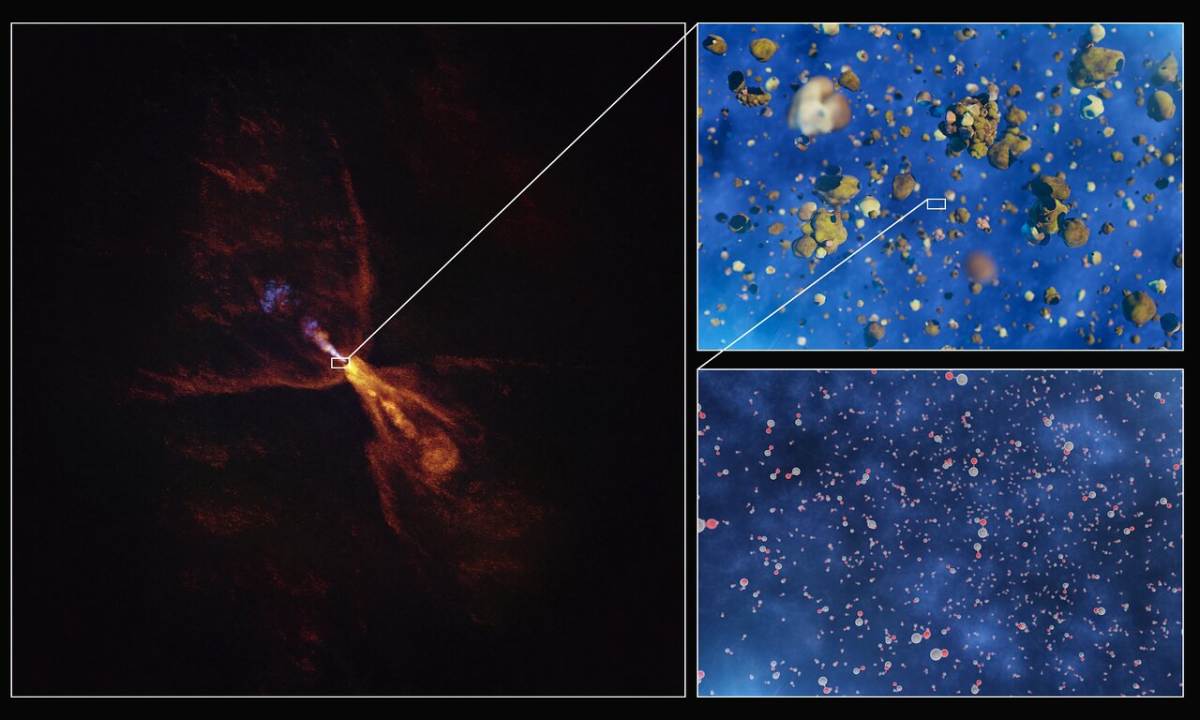
In our Solar System, the earliest solid materials are preserved within ancient meteorites, providing a timeline for our system's genesis. These meteorites are rich in crystalline minerals containing silicon monoxide (SiO), which condense at the extreme temperatures present in young planetary discs. These newly condensed solids gradually coalesce, forming the fundamental seeds for planet formation. The first kilometer-sized planetesimals, from which Earth and the cores of gas giants like Jupiter emerged, formed shortly after these crystalline minerals solidified. The new research presents compelling evidence of these hot minerals beginning to condense within the disc surrounding HOPS-315. Their findings indicate the presence of gaseous SiO alongside these crystalline minerals, suggesting an active solidification process. "This process has never been seen before in a protoplanetary disc — or anywhere outside our Solar System," commented co-author Edwin Bergin, a professor at the University of Michigan.

The James Webb Space Telescope initially identified these critical minerals. Subsequently, the ALMA array, operated by the European Southern Observatory, helped pinpoint the exact location of these chemical signals. The team determined that these signals originated from a small region of the HOPS-315 disc, remarkably similar in scale to the asteroid belt in our Solar System. “We're really seeing these minerals at the same location in this extrasolar system as where we see them in asteroids in the Solar System,“ explained co-author Logan Francis, a postdoctoral researcher at Leiden University, as mentioned on ESO.org.
This parallel makes the HOPS-315 disc an invaluable analogue for understanding our cosmic past. As van ‘t Hoff underscored, “this system is one of the best that we know to actually probe some of the processes that happened in our Solar System." The discovery offers an unprecedented opportunity to study early planet formation, effectively providing a proxy for countless newborn solar systems throughout the galaxy. Elizabeth Humphreys, an ESO astronomer and European ALMA Programme manager not involved in the study, praised the research: “I was really impressed by this study, which reveals a very early stage of planet formation. It suggests that HOPS-315 can be used to understand how our own Solar System formed. This result highlights the combined strength of JWST and ALMA for exploring protoplanetary discs.”