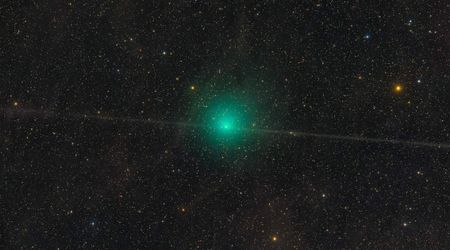
Where is comet C/2024 E1 (Wierzchos)? Current location and coordinates
Comet C/2024 E1 (Wierzchos) is currently traveling through the constellation Sagittarius as of January 9, 2026. According to Sky Live, astronomers now estimate the object's distance from Earth to be roughly 233.6 million kilometers, 145.2 million miles, or 1.56 Astronomical Units (AU).
As far as its apparent coordinates are concerned, its Declination is -32° 04’ 17” and its Right ascension is 19h 40m 54s. At the time of writing, the object's estimated magnitude (brightness) is 11.35, with its light taking close to 13 minutes to reach observers here on Earth. On Tuesday, February 17, 2026, the comet is predicted to come closest to Earth (perigee) at a distance of around 151.5 million kilometers, 94 million miles, or 1.01 astronomical units (AU).
The comet, according to Starwalk, will be visible from the Northern Hemisphere at this time, appearing low on the southwestern horizon approximately one hour after sunset. Before that, the comet will be visible in the evening sky of the Southern Hemisphere at perihelion (closest approach to the Sun) on January 20, 2026. It will be situated quite low over the southwest horizon, at roughly 22° away from the Sun. The most optimistic estimates predict its brightness around this time to be around magnitude 5, which implies that it will be rather easy to observe using binoculars under dark skies. More cautious predictions, however, point to a peak brightness of about magnitude 8. In that case, observers would require a larger pair of binoculars or a small telescope.
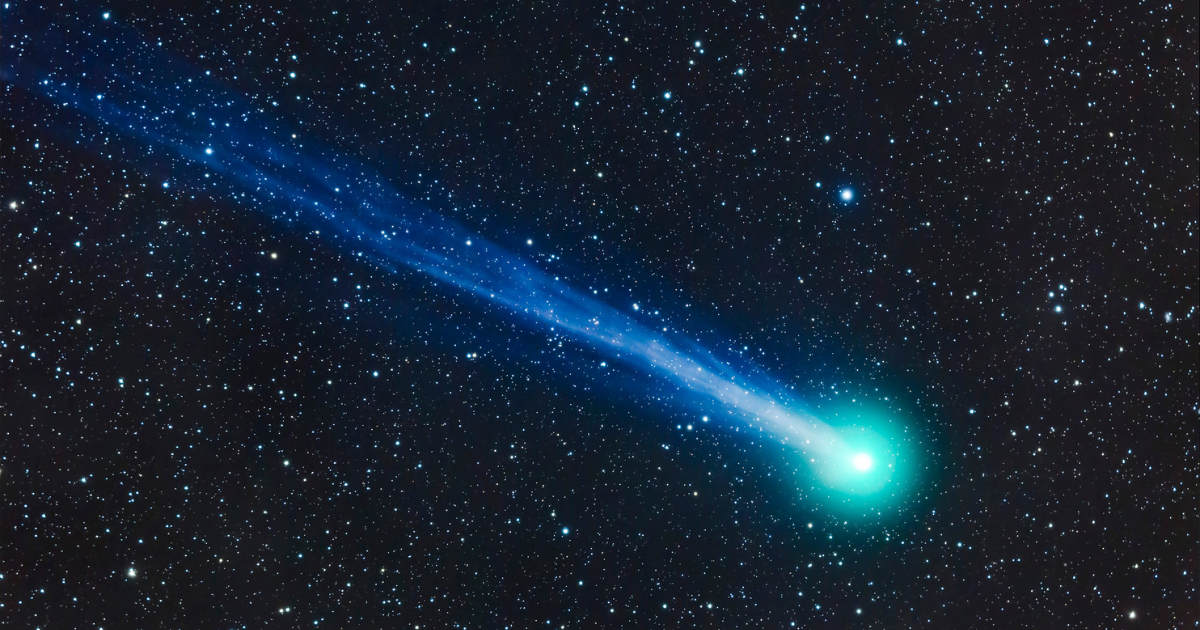
Naturally, observers must locate a dark area of the sky, and the weather must be clear. According to In The Sky, the comet will pass through Fornax, Cetus, and Eridanus after being in the constellation Sculptor at the time of its closest approach.

Polish astronomer Kacper Wierzchos found comet C/2024 E1 Wierzchos on March 3, 2024, using photos from the Mount Lemmon Survey. Being a hyperbolic comet, C/2024 E1 will only pass through the solar system once before departing for interstellar space. Researchers believe it originated somewhere in the Oort Cloud, which is a thick bubble of rocks and icy objects surrounding our solar system.

Not too long ago, on December 19, 2025, another comet, designated 3I/ATLAS, made its closest approach to Earth when it came within 170 million miles of our planet. Its arrival marked a significant moment for the astronomy community and casual skygazers alike, since it is only the third known interstellar object to enter our solar neighborhood. In fact, some of its anomalies gave rise to speculation that it could be a technological object. That theory, however, has been repeatedly countered. As of now, 3I/ATLAS is on its way towards Jupiter, where it might be imaged by spacecraft like Juno, before it heads out of the solar system, never to return again, much like Wierzchos.
More on Starlust
From life on Mars to interstellar comet 3I/ATLAS: 5 space discoveries that defined 2025
Ancient Chinese text about a comet may have solved the mystery of 'The Star of Bethlehem