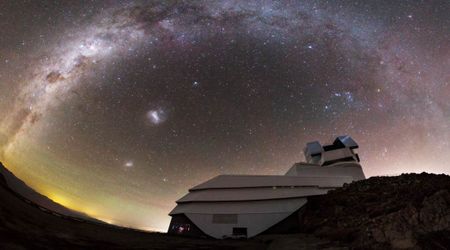
This January, spot the bright star that traces the solar system's path through the Milky Way

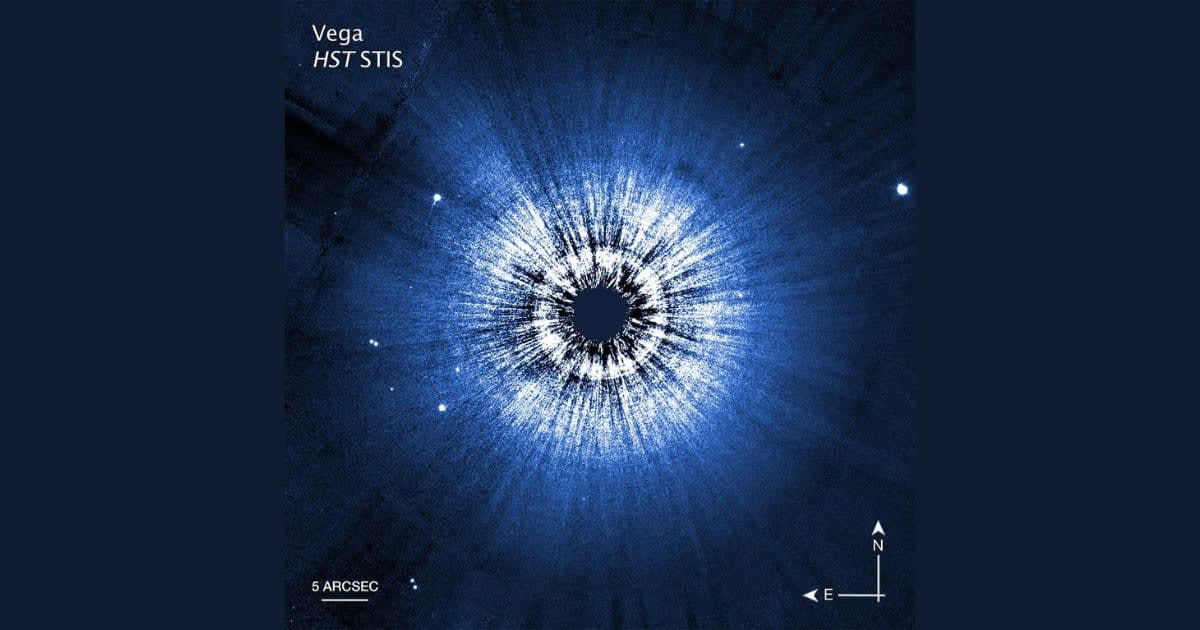
Sunsets this January will bring skygazers in the Northern Hemisphere a unique opportunity. By looking toward the northwest sky, observers can locate the bright star Vega, which serves as a glowing landmark for the direction in which our entire solar system is traveling through the galaxy, according to EarthSky.

Astronomers have a specific term for the direction our Sun and its planets travel through the Milky Way: the solar apex or the apex of the Sun's way. Though it is often associated with the brilliant, blue-white star Vega, the true center of this motion lies a little to the southwest in the constellation Hercules. While Hercules is trickier to find than the sparkling Vega, astronomers have identified the precise coordinates of our journey as 18h 28m 0s in right ascension and 30° North in declination.
Tracing the Sun's path through billions of stars may seem like an impossible task, but there is a rather interesting way that can be done. Picture yourself hurrying across a busy city square. As you pass near a group of people, from your perspective, they appear to fan out and drift apart from each other. If you walk away from a group, they seem to press together and huddle into the distance.

Our Sun moves at a slightly higher velocity than the mean velocity of its surrounding stars. Thus, when using tools like the Gaia space telescope to look at our local universe, astronomers see that stars appear to be moving away from us in the general direction of the solar apex over hundreds of thousands of years. Stars on the other side of the sky, in the direction of the antapex, appear to be moving closer together. This effect can be seen in the animation the European Space Agency (ESA) released based on the Gaia telescope's data of the motion of 40,000 stars extrapolated over 1.6 million years. On the upper left of the video, it looks like many stars are moving away from a central region, while the opposite is observed on the right, which represents the solar antapex, located near the bright star Sirius.
Vega is a lovely reminder of our perpetual motion. You are essentially looking through the solar system's windshield as you observe that blue-white spark on the horizon. In terms of scale, this is a marathon that is almost unimaginable. After all, the Milky Way is a giant assembly of hundreds of billions of stars spread across some 100,000 light-years. The Sun hurtles through space to complete this enormous circuit at a speed of about 140 miles per second, which is around 225 kilometers per second. Despite that breathtaking speed, the galaxy is so big that it would take the Sun approximately 230 million years to circle it once.
More on Starlust
Hubble Telescope spots mysterious collisions in nearby star system echoing our solar system's birth