NASA's Hubble traces a glowing 'wake,' uncovering evidence of Betelgeuse’s elusive companion star
![This artist’s concept shows the red supergiant star Betelgeuse and an orbiting companion star. [Representative Cover Image Source: NASA, ESA, Elizabeth Wheatley (STScI); Science: Andrea Dupree (CfA)]](https://d3hedi16gruj5j.cloudfront.net/786116/uploads/47d64540-eacf-11f0-94f1-01bb16cabf61_1200_630.jpeg)
After more than three decades of trailblazing discoveries, NASA’s Hubble Space Telescope has done it again. Combining fresh Hubble observations with data from ground-based observatories, astronomers have traced how Betelgeuse’s newly identified companion star, Siwarha, is shaping and stirring the surrounding gas. The study, led by scientists at the Center for Astrophysics (CfA), Harvard and Smithsonian, reveals a stream of dense gas flowing through Betelgeuse's enormous, extended atmosphere, as indicated by shifts in the star's brightness and unusual changes in its outer layers.
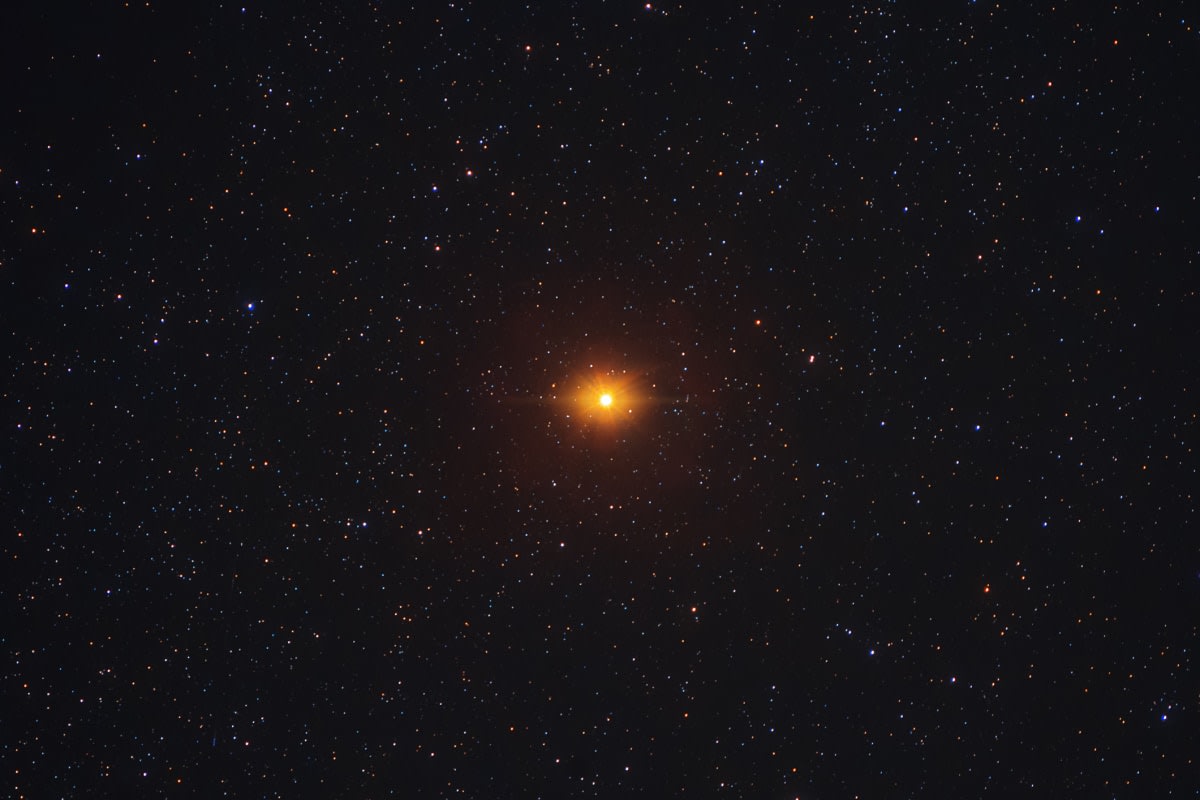
The findings were unveiled Monday at a news conference during the 247th meeting of the American Astronomical Society in Phoenix and have been accepted for publication in The Astrophysical Journal. According to NASA, Betelgeuse lies about 650 light-years from Earth in the constellation Orion. It is such an enormous red giant that more than 400 million Suns could fit inside it; the star's immense size and relative closeness make it one of the few whose surface and extended atmosphere can be directly observed. This rare accessibility has made Betelgeuse into a natural laboratory for understanding how giant stars age, lose mass, and ultimately explode as supernovae.
Using data from NASA's Hubble Space Telescope, along with ground-based observations from the Fred Lawrence Whipple Observatory and the Roque de los Muchachos Observatory, astronomers identified recurring patterns in Betelgeuse's behavior. These included changes in the star's spectrum, the specific colors of light emitted by different elements, as well as shifts in the speed and direction of gas in its outer atmosphere. Together, these signatures point to a dense trail of material, or wake, that forms shortly after the companion passes in front of Betelgeuse every six years, or roughly 2100 days, precisely as predicted by theoretical models.
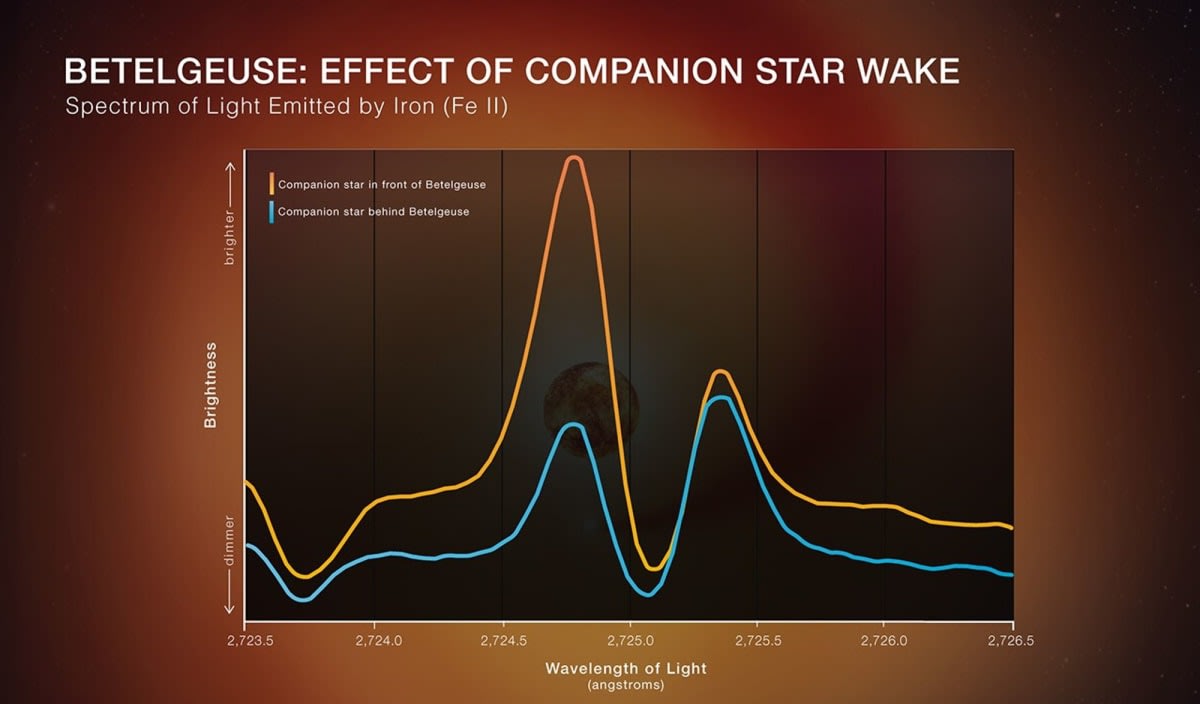
“It’s a bit like a boat moving through water. The companion star creates a ripple effect in Betelgeuse’s atmosphere that we can actually see in the data. For the first time, we’re observing direct evidence of this wake, confirming that Betelgeuse truly has a hidden companion shaping how it looks and behaves,” said Andrea Dupree, lead author of the study and an astronomer at the Center for Astrophysics. Astronomers have monitored Betelgeuse for decades, drawn by puzzling changes in its brightness and surface features. Interest surged in 2020 when the star dramatically dimmed. Two cycles in its variability stood out: a short, 400-day period now linked to internal pulsations, and a much longer, 2,100-day cycle that defied explanation.
Scientists explored many possibilities, from massive convection cells and dust clouds to magnetic activity and an unseen companion. While recent studies suggested a low-mass star orbiting deep within Betelgeuse’s atmosphere could explain the long cycle, definitive proof remained elusive until now. The newly detected wake provides the clearest evidence yet that the companion is actively disturbing the supergiant’s atmosphere. With Betelgeuse currently eclipsing its companion from Earth’s perspective, astronomers are already planning follow-up observations for the companion’s next appearance in 2027. The breakthrough may also help solve similar mysteries surrounding other giant and supergiant stars across the galaxy.
More on Starlust
NASA’s Hubble finds largest chaotic ‘sandwich’ where planets are born, baffling astronomers
10 strangest things Hubble Space Telescope has discovered in space
Hubble Telescope spots mysterious collisions in nearby star system echoing our solar system's birth